
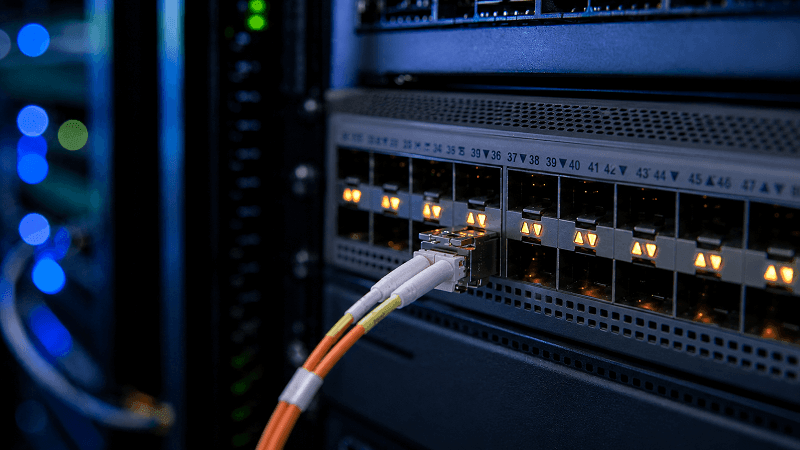
The cable looked fine. It clicked into the cage, the link came up, and every LED blinked green. Three days later, the same network team found hundreds of CRC errors stacking up on one switch port, and nobody could explain why.
That switch was running 25G SFP28 links. The cable was a passive DAC stretched past its reliable reach. It cost $28. The fix, after two nights of troubleshooting, cost the team a full rack re-cable and a bruised reputation with management.
If you’re building or expanding a 25G network, the SFP28 DAC vs AOC decision is one of the first you’ll face, and it’s easy to get wrong. Both deliver the same 25 Gbps Ethernet data rate using the same SFP28 interface. Both plug into the same SFP28 cage. But they differ in reach, power, cost, weight, and EMI behavior, and those differences can determine whether your deployment remains simple and cost-effective or becomes expensive and difficult to troubleshoot.
This guide breaks down SFP28 DAC and AOC cables, gives you a distance-based selection matrix, and covers the option most guides skip entirely: active DAC (ACC). You’ll also get 2026 pricing examples, breakout cable economics, and the vendor compatibility checks that help prevent unexpected link failures.
Need help picking cables for your switch and NIC? Contact our networking engineers for a compatibility check before you order.
What Is an SFP28 DAC Cable?
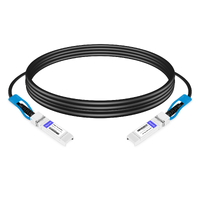
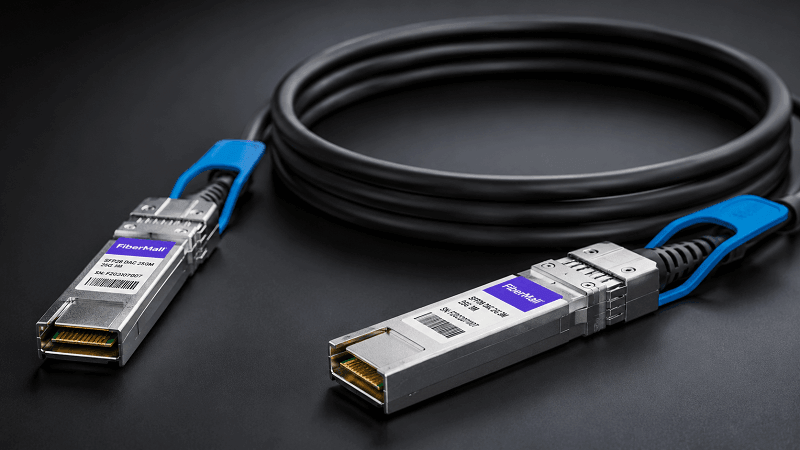
An SFP28 DAC (Direct Attach Copper) cable is a pre-terminated copper twinax assembly with integrated SFP28 connectors on each end. There are no separate transceivers to buy, no fiber connectors to clean, and no optical patch cords to route. The electrical signal runs directly from one host to the other over shielded copper pairs.
That simplicity is why DAC is the default answer for short links in many data centers. A 25G Ethernet DAC operates at the 25.78125 GBd signaling rate used by IEEE 802.3by 25GBASE-CR. The cable assembly also follows the applicable SFP28 mechanical and electrical interface specifications, including SFF-8402.
Passive DAC vs Active DAC (ACC)
People usually say “DAC” when they mean passive DAC. That’s the twinax cable with no active signal-conditioning electronics inside, drawing essentially no active cable power and relying primarily on the host SerDes to drive and equalize the signal. Passive SFP28 DACs typically reach 1 to 3 meters, although vendor-qualified implementations can support up to about 5 meters depending on cable gauge, host capabilities, and FEC configuration.
Active DAC, often called ACC (Active Copper Cable), integrates active signal-conditioning electronics into the connector housing. These electronics compensate for high-frequency loss and extend the usable copper reach, commonly to around 5 to 10 meters depending on the vendor and implementation. They can also allow manufacturers to use thinner cable while maintaining link performance. The trade-off is a small amount of power consumption, often below 1 watt per end, and a modest price increase.
Both are copper. Both use the same SFP28 host interface. The key difference is whether signal compensation is performed primarily by active electronics inside the cable or by the host SerDes.
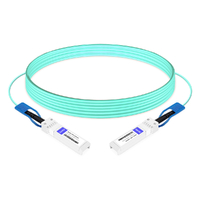
What Is an SFP28 AOC Cable?
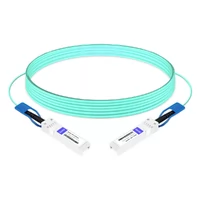
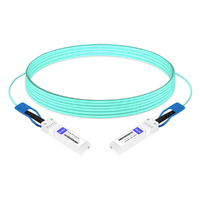
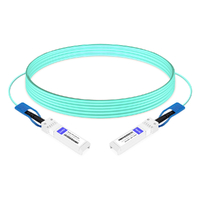
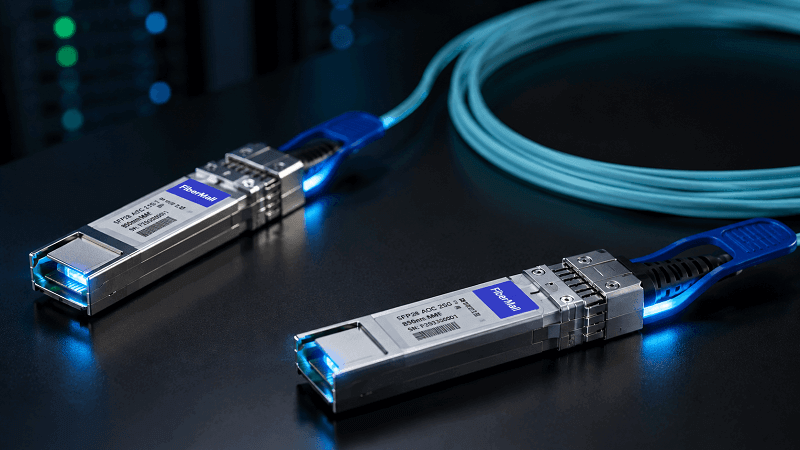
An SFP28 AOC (Active Optical Cable) replaces the copper transmission medium with multimode fiber and integrates optical transceiver electronics into each connector. The host sends an electrical signal, the near-end connector converts it into an optical signal, typically using a VCSEL-based transmitter, the light travels through the integrated multimode fiber, and the far-end connector converts it back into an electrical signal.
That electrical-optical-electrical conversion allows AOCs to support significantly longer transmission distances than passive copper while maintaining a thin and lightweight cable construction. Unlike discrete 25GBASE-SR transceivers, whose standardized reach is typically 70 meters over OM3 and 100 meters over OM4, AOC reach is determined by the specific cable design and vendor qualification. Commercial 25G SFP28 AOCs are commonly available from a few meters to around 30 meters, with some implementations supporting longer distances.
AOC also provides excellent immunity to electromagnetic interference because the signal travels through fiber as light rather than as an electrical signal.
The trade-offs are higher power consumption and cost compared with passive DAC. An AOC commonly consumes around 1 watt per connector end, although actual values vary by vendor and design. Optical conversion electronics can also add some device latency, but total link latency depends on cable length, PHY implementation, and FEC configuration. Fiber propagation itself contributes roughly 5 nanoseconds per meter, while FEC processing can contribute substantially more latency than the optical conversion alone.
In exchange, you get a thin, lightweight, flexible assembly that routes cleanly through dense racks and performs predictably in electrically noisy environments.
SFP28 DAC vs AOC: Side-by-Side Comparison
Here’s the table most engineers actually keep open while ordering.
| Feature | SFP28 Passive DAC | SFP28 Active DAC (ACC) | SFP28 AOC |
| Transmission medium | Copper twinax | Copper twinax | Multimode fiber (OM3/OM4) |
| Typical reach | 0.5-5 m | 5-10 m | 25-100 m (70 m OM3 / 100 m OM4) |
| Power per link | ~0-0.1 W | ~0.5-1 W | ~1 W per module |
| Latency | <0.1 µs | ~0.1-0.2 µs | ~0.3-0.5 µs |
| Relative cost | Lowest | Moderate | Highest |
| EMI immunity | Susceptible | Susceptible | Immune |
| Cable bulk | Thick, heavy | Thick, heavy | Thin, light, flexible |
| Bend radius | Large | Large | Tight |
| Electronics | None | Linear equalizer chip | Integrated optical transceivers |
| Best for | Same-rack ToR links | Adjacent-rack, longer copper runs | Cross-rack, row-to-row, high-EMI sites |
The headline is simple: DAC wins on cost, power, and latency for short runs; AOC wins on distance, flexibility, and EMI immunity. The nuance is where those thresholds actually sit.
When to Choose SFP28 DAC Over AOC
Start with DAC for anything inside the same rack or between adjacent racks. A server to top-of-rack switch link is usually 1 to 3 meters, well inside passive DAC territory. You get the lowest price per port, near-zero power draw, and the lowest possible latency, which matters for HPC and financial trading fabrics.
Rani, a network engineer in Chicago, spent a month planning a 144-server leaf deployment. Her first instinct was to buy AOC everywhere “to be safe.” The quote came back roughly $6,000 higher than the equivalent passive DAC solution, for links that were all under 3 meters. She switched to passive DAC for every in-rack link and reserved AOC for the handful of runs crossing between racks. The deployment came in under budget and nothing ever failed to link.
Use passive DAC when your link is 5 meters or less. Step up to active DAC (ACC) when the path runs 5 to 10 meters, or when copper routing through tight cable trays is the constraint. Active DAC gives you copper’s cost and latency profile with enough reach to span adjacent racks.
When to Choose SFP28 AOC
Reach beyond 10 meters is the clearest trigger for AOC. A cross-aisle run from one rack row to another is typically 20 to 50 meters, and no copper assembly at 25G survives that distance without active electronics on every hop.
AOC also wins in specific environments regardless of distance. If the cable path passes near power distribution, industrial equipment, or anything that radiates EMI, fiber’s immunity is worth the premium. If you’re packing high port density into leaf switches and every millimeter of airflow matters, the thin flexible AOC assembly is dramatically easier to route than stiff copper bundles.
Mei, a facilities lead in a shared co-location building, found this out the hard way. Her team ran passive DAC from a ToR switch to servers, but the shortest cable path crossed a row of power strips feeding the neighboring tenant’s racks. The copper links flapped randomly for weeks.
Moving to AOC on those specific runs eliminated the problem entirely. The cables cost more. The stability was worth every dollar.
The practical rule: DAC inside the rack, AOC between racks. Most 25G data centers run a hybrid mix, and you should too.
The Third Option: Active DAC (ACC)
Most SFP28 DAC vs AOC articles pretend there are two choices. There are three, and skipping the middle one is how a lot of teams over-spend.
Active DAC sits between passive copper and AOC. It keeps copper’s low cost and low latency but extends reach to about 10 meters, which covers most adjacent-rack scenarios that passive DAC can’t handle. When the choice is active DAC versus AOC for a 7-meter run, active DAC is typically about half the price and draws a fraction of the power.
We saw this play out with a FiberMall customer who had 5.5-meter cable paths in an existing deployment. They bought passive DAC first because the distance looked borderline. The links came up, then accumulated CRC errors under load.
They assumed the answer was AOC. Our engineers recommended active DAC instead, at roughly half the price and a quarter of the power draw. The swap fixed the errors and the customer saved a meaningful chunk of their cabling budget.
Don’t let “DAC vs AOC” force you into a binary. Check the middle option before you spend on optics.
SFP28 Breakout Cables: QSFP28 to 4×25G
There’s a fourth option hiding in the 25G world, and it changes the economics of server connectivity entirely.
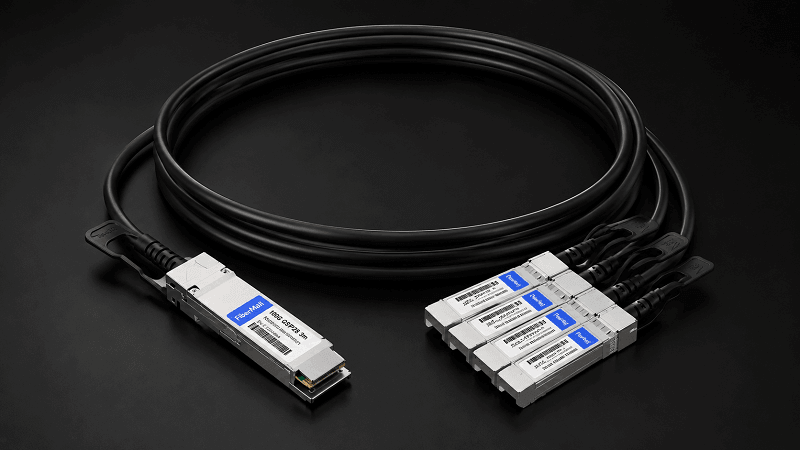
A QSFP28 breakout DAC takes a single 100G QSFP28 switch port and fans it out into four independent 25G SFP28 connections. The QSFP28 side carries four 25G lanes; each lane terminates in its own SFP28 connector. One 100G leaf port can therefore feed four servers at 25G each.
The lane mapping is fixed: QSFP28 lane 0 maps to SFP28 connector 1, lane 1 to connector 2, and so on. Breakout DACs reach 1 to 3 meters in passive form, cost roughly 70 to 90, and draw well under half a watt. That makes them the cheapest way to build a 25G server access layer when your leaf switches are 100G-native. A single 48-port QSFP28 leaf switch can theoretically feed up to 192 servers at 25G using breakout cables.
Breakout AOCs extend the same idea to longer runs, but at a steeper price. For in-rack fan-out, breakout DAC is usually the right call. Just verify the switch actually supports port breakout before you buy. Not every ASIC and firmware combination allows it, and “supported” sometimes depends on the exact port group.
Power Consumption and Thermal Impact
Per cable, the power difference between DAC and AOC looks trivial. A passive DAC draws almost nothing. An active DAC draws under a watt.
An AOC draws about a watt per module. Nobody replaces a cable over one watt.
Scale it up and the picture changes. On a 256-port switch running passive DACs, the cabling itself accounts for roughly 26 watts total. The same switch running active DACs jumps to around 205 watts. That’s an 8x difference in thermal load that has to be removed by the cooling system, every hour, every day.
In hyperscale or high-density co-location, that number lands directly in your power budget. A row of racks running AOC or active DAC needs more cooling capacity than the same row running passive copper. It’s rarely a showstopper for a single rack, but it compounds fast across a hall.
The math doesn’t argue for passive DAC everywhere. It argues for matching the cable to the actual distance, so you’re not paying a power tax on links that could have run on plain copper.

SFP28 DAC vs AOC Pricing (2026)
Pricing in 2026 makes the choice even easier for short links. Here’s what we’re seeing in the market:
- SFP28 passive DAC (1-3 m): roughly 20 to 40 per cable.
- SFP28 active DAC (5-10 m): a premium over passive, but still well under optics.
- SFP28 AOC (5 m): around 65 to 75.
- SFP28 AOC (30 m): roughly 120 to 150.
- QSFP28 to 4×25G breakout DAC: about 70 to 90.
One trap worth knowing: cost per meter is heavily distorted for short cables. A 1-meter DAC costs about 26 per meter because the connectors dominate the price. A 30-meter AOC works out to around 4 per meter.
That makes short AOC look bad on a per-meter basis and long AOC look great, but neither comparison tells you what to buy. Compare total cable cost per link for the distance you actually need.
The bigger saving is comparing cables to discrete transceivers. A 25G link built from separate SFP28 SR modules plus patch cables can run several times the cost of a single DAC or AOC assembly.
On a large deployment, that difference adds up to hundreds of thousands of dollars. Our full SFP28 price guide walks through the module-side math in detail.
Vendor Compatibility and Coding
Cable selection doesn’t end with DAC versus AOC. You also have to match the assembly to the switch or NIC firmware.
Cisco, Arista, Juniper, Dell, and NVIDIA all maintain approved transceiver and cable lists. A third-party SFP28 DAC coded for one vendor may be rejected by another, even though the copper is electrically identical, because the switch reads the EEPROM vendor ID and refuses to trust it. This is why the same cable can work fine in an Arista switch and show as “unsupported” in a Cisco Nexus.
Before you order, verify three things. Confirm your switch ports support SFP28 and, where relevant, breakout mode. Check that the cable’s EEPROM coding matches the switch brand you’re plugging into.
Make sure the FEC settings align on both ends, since a mismatch can cause links to flap or accumulate errors. Our SFP28 compatibility guide covers vendor-specific checks in more depth.
Common Mistakes and Gotchas
Even with the right framework, deployments fail in predictable ways.
Buying AOC for a 2-meter run. It works. It also costs three times more than it needs to, draws more power, and adds latency you didn’t need. Measure first.
Pushing passive DAC past its validated length. A 5-meter passive SFP28 DAC might link up today and accumulate errors under load tomorrow. The 5.5-meter story above is a real example of how this shows up.
Forgetting active DAC exists. Teams jump from passive copper straight to AOC and pay for optics they never needed. ACC covers the 5-to-10-meter gap at copper prices.
Ignoring cable weight in dense racks. Copper bundles are heavy and stiff. In a fully populated leaf switch, cable management becomes a physical problem, not just a visual one.
Mixing vendors without checking coding. Third-party cables coded for Arista may not be recognized by Cisco. Always match coding to the platform.
Assuming every QSFP28 port supports breakout. Port breakout depends on ASIC, license, and firmware. Verify before you design around it.
FAQ
What is the difference between 25G DAC vs AOC?
SFP28 DAC is a copper twinax cable for short, low-cost, low-power links up to about 10 meters with active versions. SFP28 AOC is a fiber-based assembly with integrated transceivers that reaches 70 to 100 meters and is immune to EMI.
How far can an SFP28 DAC reach?
Passive SFP28 DACs reach 1 to 3 meters typically, up to 5 meters at the limit. Active DAC (ACC) extends that to 7 to 10 meters.
Is AOC better than DAC for data centers?
Not universally. AOC is better beyond 10 meters, in high-EMI environments, and where cable flexibility matters. DAC is better for short in-rack links because it costs less, uses less power, and has lower latency.
When should I use active DAC instead of AOC?
For links between 5 and 10 meters, active DAC gives you copper pricing and latency at roughly half the cost and a fraction of the power draw of AOC.
Can I use a 25G DAC between different switch vendors?
Physically yes, but firmware may reject it. The switch reads the EEPROM vendor coding, so order cables coded for the specific platform you’re using.
What is a QSFP28 to 4×25G breakout cable?
A breakout cable that takes one 100G QSFP28 port and fans it out into four independent 25G SFP28 connections, letting one switch port feed four servers.
Conclusion
Choosing between SFP28 DAC vs AOC isn’t a preference debate. It’s a distance, budget, and environment calculation.
- Use passive DAC for same-rack links up to 5 meters. Lowest cost, lowest power, lowest latency.
- Use active DAC (ACC) for 5 to 10 meter runs. Copper economics with longer reach.
- Use AOC beyond 10 meters, in high-EMI sites, or where cable flexibility and airflow are priorities.
- Consider QSFP28 breakout DAC when leaf ports are 100G and servers need 25G, because the cost per port drops dramatically.
- Always verify vendor coding, FEC settings, and breakout support before you order.
The expensive mistake isn’t choosing DAC over AOC. It’s choosing either one without measuring the cable path first.
If you’re planning a 25G rollout and want cables that link up on the first try, explore our 25G SFP28 DAC and AOC assemblies or contact our engineering team for a compatibility review. We’ll help you match reach, coding, and budget to your actual deployment.
Related Products:
-
 SFP28-25G-PC50CM 50cm (1.6ft) 25G SFP28 to SFP28 Passive Direct Attach Copper Cable
$18.00
SFP28-25G-PC50CM 50cm (1.6ft) 25G SFP28 to SFP28 Passive Direct Attach Copper Cable
$18.00
-
SFP28-25G-PC1M 1m (3ft) 25G SFP28 to SFP28 Passive Direct Attach Copper Cable
$18.00
-
SFP28-25G-PC1.5M 1.5m (5ft) 25G SFP28 to SFP28 Passive Direct Attach Copper Cable
$20.00
-
SFP28-25G-PC2M 2m (7ft) 25G SFP28 to SFP28 Passive Direct Attach Copper Cable
$23.00
-
SFP28-25G-PC2.5M 2.5m (8ft) 25G SFP28 to SFP28 Passive Direct Attach Copper Cable
$28.00
-
SFP28-25G-PC3M 3m (10ft) 25G SFP28 to SFP28 Passive Direct Attach Copper Cable
$30.00
-
SFP28-25G-PC5M 5m (16ft) 25G SFP28 to SFP28 Passive Direct Attach Copper Cable
$45.00
-
SFP28-25G-AOC3M 3m (10ft) 25G SFP28 to SFP28 Active Optical Cable
$40.00
-
SFP28-25G-AOC2M 2m (7ft) 25G SFP28 to SFP28 Active Optical Cable
$40.00
-
SFP28-25G-AOC1M 1m (3ft) 25G SFP28 to SFP28 Active Optical Cable
$40.00
-
SFP28-25G-AOC5M 5m (16ft) 25G SFP28 to SFP28 Active Optical Cable
$45.00
-
SFP28-25G-AOC7M 7m (23ft) 25G SFP28 to SFP28 Active Optical Cable
$46.00
-
SFP28-25G-AOC10M 10m (33ft) 25G SFP28 to SFP28 Active Optical Cable
$48.00
-
SFP28-25G-AOC15M 15m (49ft) 25G SFP28 to SFP28 Active Optical Cable
$52.00