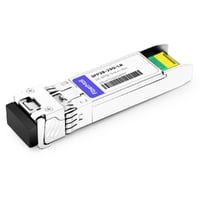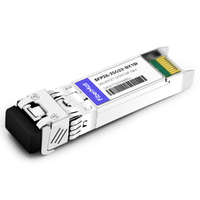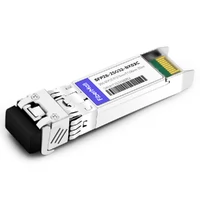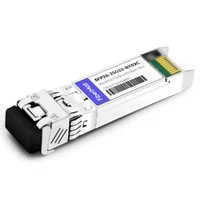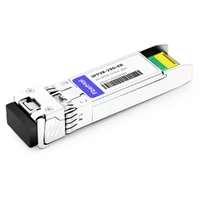

Two 25G products can slide into the same SFP28 port and solve completely different problems. One may be a 1 m passive copper cable for a server in the same rack. The other may be a 40 km single-mode optic for a remote site. The cage is the same. The network design is not.
That is why SFP28 module types can be confusing during a refresh. A name such as SR, LR, BiDi, or DWDM tells you about the medium, wavelength, fiber count, reach, and often the deployment cost. It does not just describe a label on a pull tab. This guide maps the common 25G choices to the fiber and distance you already have, then flags the compatibility checks that keep a purchase order from becoming a link-down ticket.
In March, Elena’s operations team planned a 25G upgrade between two rows of leaf switches. Their drawings showed 62 m of OM3 fiber, which seemed safe for a short-reach design. But the route included four patch panels and a 9 m service loop.
That put the full channel close to the 70 m OM3 limit. The team kept the 25GBASE-SR design, measured the route before ordering, and avoided the wrong reach class. Small details decide these jobs.
What SFP28 Module Types Really Describe
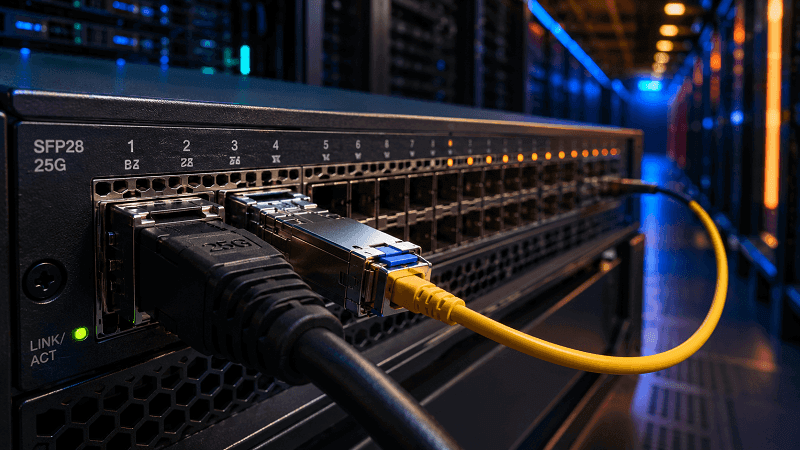
SFP28 is a compact pluggable form factor and electrical interface. It carries one 25GbE lane. With 64b/66b coding, the host line rate is 25.78125 GBd. The item in the port then provides an optical interface, such as 25GBASE-SR or 25GBASE-LR, or a fixed cable assembly such as DAC or AOC. IEEE 802.3 defines the Ethernet architecture behind these links.
So, SFP28 is not a single kind of optical transceiver. It is the common package. SR, LR, ER, BiDi, CWDM, and DWDM describe different optical approaches. Direct-attach copper (DAC) and active optical cable (AOC) use the same host-side SFP28 electrical interface, but their connectors and cable are a single permanent assembly.
This distinction matters because every option asks something different of the network:
- SR uses multimode fiber for short data-center channels.
- LR and ER use duplex single-mode fiber for longer links.
- BiDi puts transmit and receive wavelengths on one single-mode strand.
- CWDM and DWDM place several wavelength channels on shared fiber through WDM equipment.
- DAC and AOC target short physical runs where separate optics and patch cords would add cost and handling.
For the underlying standards, signaling, migration choices, and troubleshooting flow, see our complete SFP28 transceiver guide. If you are new to pluggable optics, it also helps to understand how optical transceivers convert electrical and optical signals before comparing part numbers.
Need a second set of eyes on your 25G design? Send FiberMall the switch model, fiber type, and measured route length. An engineering compatibility review can narrow the list before you buy modules in volume.
SFP28 Module Types Compared
Start with the installed cabling, not the module catalog. The table below gives the practical selection view. Reaches for DAC and AOC are typical product ranges, not universal limits; always check the cable data sheet and the host validation matrix.
| Type | Medium | Fiber or cable | Typical wavelength | Typical reach | Best fit | Main caution |
| 25GBASE-SR | Removable optical module | Duplex OM3 or OM4 multimode fiber | 850 nm | 70 m on OM3; 100 m on OM4 | In-rack and nearby-rack data-center links | OM3 and OM4 do not have the same reach limit |
| Passive DAC | Fixed copper assembly | Twinax copper | Not applicable | Often 1–3 m | Server-to-ToR links in one rack | Reach varies with cable gauge and host equalization |
| Active DAC | Fixed copper assembly | Twinax copper with signal conditioning | Not applicable | Several meters, product dependent | Nearby racks where passive copper is too short | Draws power and needs host-specific validation |
| AOC | Fixed active optical assembly | Integrated fiber cable | Assembly-specific | A few meters to tens of meters | Short rack-to-rack links with lower cable weight | Optics are not field-replaceable |
| 25GBASE-LR | Removable optical module | Duplex single-mode fiber | 1310 nm | 10 km | Campus, building, and data-center interconnects | Check the complete optical budget |
| 25GBASE-ER | Removable optical module | Duplex single-mode fiber | 1310 nm band | Up to 40 km | Longer point-to-point links | Higher power and a tighter loss budget often apply |
| BiDi | Removable optical module | One single-mode strand | Complementary Tx/Rx wavelength pair | Product dependent | Fiber-constrained upgrades | Each end needs the matched partner module |
| CWDM or DWDM | Removable optical module | Single-mode fiber plus mux/demux | Vendor-specific channel plan | Product and system dependent | Shared transport fiber | Match channel, passband, insertion loss, and power budget |
A few names need care. SR, LR, and ER correspond to recognized 25GbE optical interface families. The terms BiDi, CWDM, DWDM, and ZR cover widely available market products, but their channel plan, reach, and interoperability depend on the particular module and transport system. Treat the data sheet as the final authority.
The shortest suitable medium usually wins. It lowers power draw, cost, and failure points. But “shortest” means the entire channel, not the straight-line distance between racks.
Short-Reach SFP28 Options: SR, DAC, and AOC
25GBASE-SR for multimode fiber
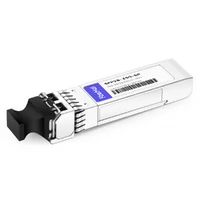
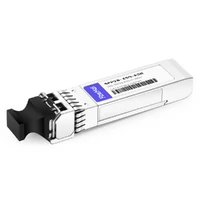
A 25G SFP28 SR module uses an 850 nm VCSEL over duplex multimode fiber. It is the usual choice for short optical links inside a data center. The key limits are 70 m on OM3 and 100 m on OM4 under the IEEE channel model. The Cisco 25G SFP28 module data sheet lists those limits and is a useful reference when a route is close to the boundary.
Do not treat “multimode” as a sufficient answer. Check whether the installed cable is OM3 or OM4, include the patch leads, and count the connectors and cassettes. A clean 68 m OM3 channel is one thing. A design with marginal length and unmeasured connector loss is another.
SR fits well for leaf-to-server or leaf-to-leaf links where fiber already exists. It also makes moves and changes easier because the modules can be replaced independently from the patch cord. That flexibility matters in dense environments where link paths change over time.
Passive and active DAC for copper links
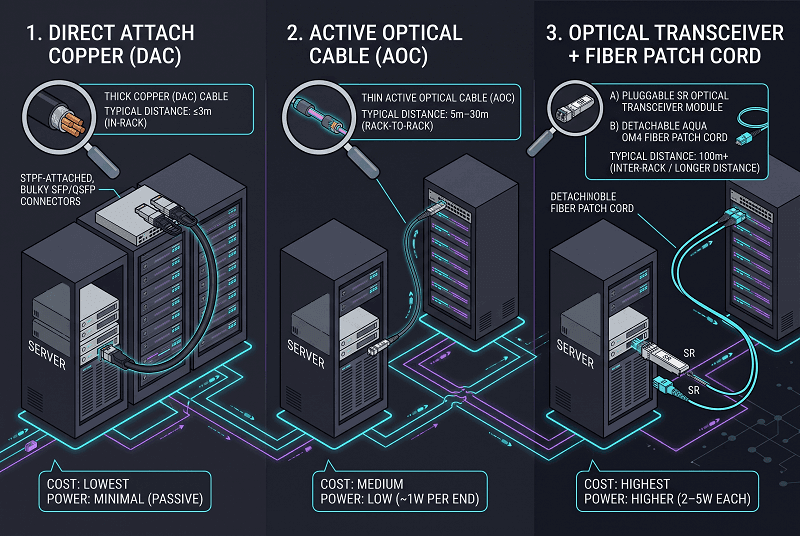
A passive 25G DAC has SFP28 connectors on both ends and twinax copper between them. It has no active electronics in the cable body, draws almost no module-side power, and is usually the lowest-cost choice for a same-rack server-to-switch connection. Most passive deployments are 1–3 m, though a specific cable and host pair can support more.
Active DAC adds signal conditioning in the connectors. That can stretch the usable copper run into the several-meter range, but it also adds power and compatibility variables. The rule is simple: choose passive DAC first for a short, known-good path; choose active copper only after checking the switch and NIC documentation.
A DAC is not just a cheaper optic. It changes operations. You cannot replace one failed end without replacing the whole assembly. It is also thicker and heavier than fiber, so a rack with dozens of copper links needs careful cable management.
AOC for lighter short links
An AOC converts the electrical signal to optical signal inside its permanently attached ends. It is lighter than an equivalent copper run and often reaches farther. That makes it useful between nearby racks where twinax weight, bend radius, and airflow become annoying.
Take Miguel’s GPU pod in May. He needed 25G links from a top-of-rack switch to eight hosts located 5.5 m away in the adjacent cabinet. Passive DAC was not a safe bet at that length, while separate SR optics plus patch cords would have increased the number of field connectors. He selected validated 7 m AOCs, labeled the fixed assemblies at both ends, and kept two matching spares. The choice reduced cable bulk, but it also made spares more important because the optics are bonded to the cable.
Planning server connections inside a rack? Compare the number of ports, cable lengths, and maintenance policy before defaulting to optics. FiberMall can help you compare compatible 25G DAC and AOC assemblies against SR modules for the same switch and NIC pair.
Single-Mode SFP28 Types: LR and ER
25GBASE-LR for 10 km links
An SFP28 LR module uses 1310 nm optics over duplex single-mode fiber and supports a 10 km reach under the relevant specification. It is the practical 25G option for links across a building, campus, or distributed data-center footprint. Single-mode fiber has lower attenuation than multimode fiber over these distances, but the module still needs enough receive power after every connector, splice, and patch panel.
A 10 km label is not a blank check. Start with the transmitter minimum and receiver sensitivity in the data sheet. Subtract estimated fiber attenuation, connector loss, splice loss, WDM insertion loss if present, and an engineering margin. Then confirm that the calculated received power sits inside the module’s allowed range.
Here is a simplified LR planning example. A 6.2 km OS2 route might have 0.4 dB/km estimated fiber attenuation at 1310 nm, or about 2.5 dB, plus 1.2 dB across six connector pairs and a 2 dB design margin. The modeled channel loss is 5.7 dB. The exact result depends on the module’s optical budget, so use the published minimum figures and field test the completed path.
25GBASE-ER for longer routes
ER extends the single-mode option to up to 40 km where the host and specified PMD support it. It is intended for longer point-to-point links, not as a casual replacement for LR. The module may draw more power, run warmer, and require more disciplined optical-budget work.
Use ER only if LR cannot cover the channel. Overpowering a short link may require attenuation, and choosing a longer-reach class adds cost without fixing a design problem. For metro and transport designs, ask whether a WDM system, amplification, or a different architecture makes more sense before buying 40 km optics.
Fiber-Constrained SFP28 Types: BiDi, CWDM, and DWDM
BiDi for a single available strand
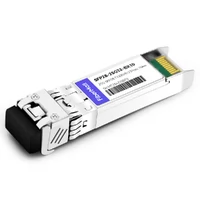
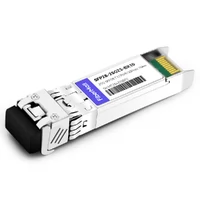
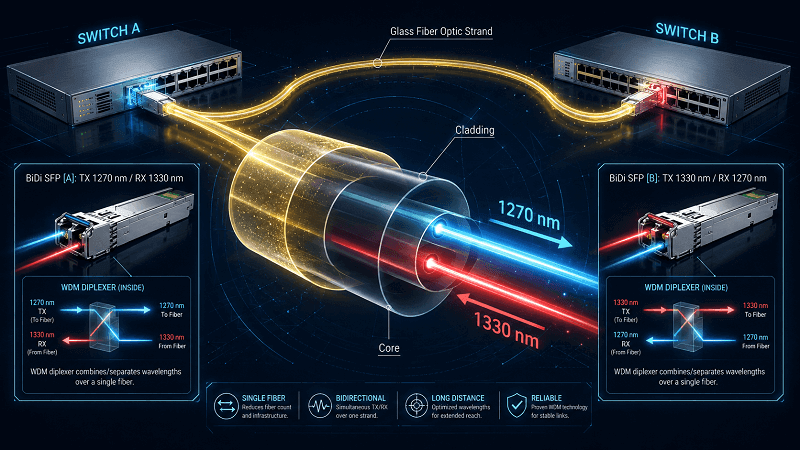
A 25G BiDi SFP28 module transmits and receives on different wavelengths over one simplex single-mode fiber. A common pairing uses one module with a 1270 nm transmitter and 1330 nm receiver, while the far end reverses that arrangement. The pair doubles use of a single strand without adding new fiber.
The pairing rule is non-negotiable: matching part numbers at both ends will not work if they transmit and receive on the same wavelengths. Order and label complementary A-side and B-side modules together. Also check the connector type and the supplier’s stated reach, because BiDi products vary widely.
Priya’s branch office had only one spare OS2 strand between two telecom rooms. Pulling a second cable would have meant access work through an occupied ceiling. She used a complementary BiDi pair after documenting the endpoint wavelengths and verifying the switch’s 25G port mode. The link came up on the first test. The useful lesson was not “BiDi solves every fiber shortage.” It was that BiDi solves a very specific shortage when both ends are designed as a pair.
CWDM and DWDM for shared fiber
CWDM and DWDM SFP28 modules send 25G traffic over a selected wavelength channel so multiple services can share one fiber pair through a multiplexer and demultiplexer. CWDM channels have wider spacing, while DWDM uses a dense frequency grid defined by ITU-T G. 694.1. DWDM packs more channels into the same spectrum, but it also demands tighter channel and power planning.
These are system choices, not just optic choices. The module wavelength must fall inside the mux/demux passband. The combined fiber attenuation, connector loss, and mux insertion loss must fit the optical budget. If an amplifier is part of the design, verify power levels and channel behavior with the transport vendor.
A plain 1310 nm LR module does not replace a channel-specific CWDM or DWDM module. The connector may fit, but the wavelength plan will not. That is the kind of mismatch that looks fine in a spreadsheet and fails at turn-up.
SFP28 SR vs. LR vs. ER vs. BiDi: Choose by Deployment
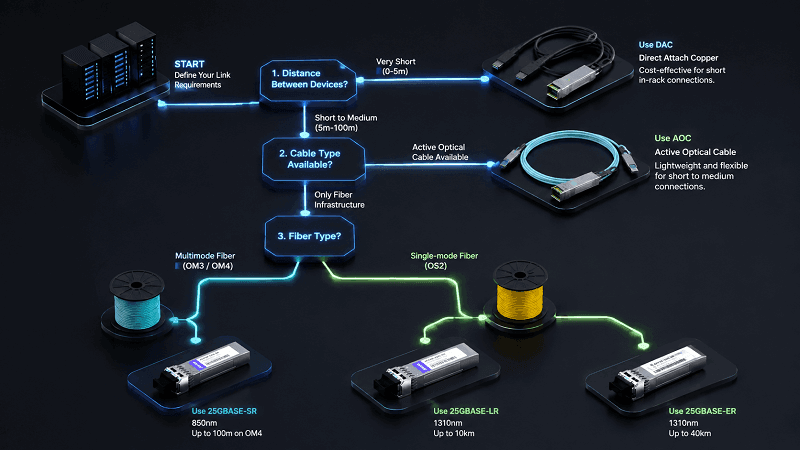
Use this decision sequence before selecting a part number:
1. Is the link inside one rack? Start with passive DAC. Move to active DAC or AOC if the route is beyond the validated passive range or copper management becomes difficult.
2. Do you have duplex OM3 or OM4? Use SR if the full channel is within 70 m on OM3 or 100 m on OM4.
3. Do you have duplex single-mode fiber? Use LR for a link that fits its optical budget. Consider ER only when the distance or loss exceeds LR capability.
4. Do you have just one single-mode strand? Use a matched BiDi pair designed for the required reach.
5. Do several services need to share the same fiber? Design around CWDM or DWDM modules, matched transport equipment, and a complete wavelength plan.
| Existing condition | Recommended first choice | Why | Check before ordering |
| Server and ToR are 2 m apart | Passive DAC | Lowest cost, power, and latency | Cable coding and supported length |
| Two rows are connected by 54 m OM4 | 25GBASE-SR | Fits the multimode reach envelope | Full channel length and connector loss |
| Buildings are 6 km apart on OS2 | 25GBASE-LR | 10 km single-mode class fits the route | Optical budget and lightning/surge design around equipment |
| Only one OS2 strand is spare | Matched BiDi pair | Uses separate wavelengths over one strand | A/B wavelengths and simplex path |
| Four 25G services share metro fiber | CWDM or DWDM design | Conserves fiber through WDM | Channel plan, mux loss, and support model |
Your server-facing 25G choice also affects the uplink design. A QSFP28 port can often break out into four 25G SFP28 links, while a 100G uplink carries four lanes in one module. Our QSFP28 100G transceiver guide explains that relationship in more detail.
SFP28 Module Compatibility, FAQs, and Next Steps
A product can fit the cage and still fail to link. Check these items before approving a 25G optic or cable:
- Host mode: Confirm that the switch or NIC port supports 25G SFP28 operation and the intended lower-speed mode, if needed.
- Firmware and coding: Verify the network operating system version and whether the platform enforces vendor EEPROM coding.
- Fiber and connector: Match OM3/OM4 or OS2 fiber, duplex or simplex paths, connector polish, and the required cable assembly.
- FEC: Check which FEC modes the NIC and switch support, then configure both ends to match. FEC is a link setting, not a feature that a transceiver independently supplies.
- Optical budget: Add fiber, connector, splice, and WDM losses before accepting a headline reach number.
- Thermal limits: Check port power allowance, airflow, ambient temperature, and commercial versus industrial module ratings.
- DOM/DDM: Use diagnostics to confirm temperature, voltage, laser bias, and transmit/receive optical power after turn-up.
For a deeper look at form-factor and speed support, read our SFP28 vs. SFP+ compatibility guide. In many platforms, an SFP+ module can run at 10G in an SFP28 port, but that is platform-dependent. An SFP28 module cannot deliver 25G in a 10G-only SFP+ port.
What are the different types of SFP28 modules?
The main categories are short-reach SR, single-mode LR and ER, single-fiber BiDi, CWDM and DWDM wavelength modules, plus DAC and AOC cable assemblies. Choose among them using the link distance, installed fiber, available strands, WDM equipment, host support, and required temperature range.
What is the difference between SFP28 SR, LR, and ER?
SR uses 850 nm multimode optics for up to 70 m on OM3 or 100 m on OM4. LR uses 1310 nm single-mode optics for 10 km. ER supports longer single-mode links, often up to 40 km, but requires a larger optical budget and usually draws more power.
Can an SFP28 port use a 10G SFP+ module?
Often, but not always. The physical shape is similar, yet the switch ASIC, port configuration, and firmware decide whether the port supports a 10G SFP+ module. Validate the exact platform before deploying it in production.
Does a 25G BiDi SFP28 module need a matched pair?
Yes. The two modules need complementary transmit and receive wavelengths. A single-fiber BiDi link will not work with two modules that use the same wavelength direction.
Should I choose DAC, AOC, or a removable optical module?
Choose passive DAC for short, same-rack links where low power and low cost matter. Choose AOC when you need a lighter cable or more distance between adjacent racks. Choose removable optics when existing fiber, longer reach, or independent cable replacement matters.
Do 25G SFP28 links require FEC?
It depends on the port, PHY, medium, and host implementation. Some environments run without FEC, while others require Firecode or Reed-Solomon FEC. Confirm the supported mode at both endpoints and make the configuration match.
Select the shortest suitable 25G medium
The best SFP28 choice is rarely the one with the longest reach or the lowest unit price. It is the option that fits the measured channel, installed fiber, host policy, and operational plan without adding needless power or complexity.
Start with four questions: How far is the full route? What cable is already installed? How many fiber strands are available? What does the switch or NIC explicitly support? Those answers narrow the SFP28 module types quickly. Then validate FEC, coding, optical budget, and temperature before the bulk order.
For a compatibility-coded selection of 25G SFP28 transceivers and cable assemblies, contact FiberMall with your switch model, target reach, and fiber details. The right 25G link should work on the first turn-up, not after a scramble for replacement modules.
Related Products:
-
 SFP28-25G-SR 25G SFP28 SR 850nm 100m LC MMF DDM Transceiver Module
$25.00
SFP28-25G-SR 25G SFP28 SR 850nm 100m LC MMF DDM Transceiver Module
$25.00
-
SFP28-25G-ESR 25G SFP28 ESR 850nm OM3 200m/OM4 300m LC MMF DDM Transceiver Module
$35.00
-
SFP28-25G32-BX10 25G BX BIDI SFP28 TX1330nm/RX1270nm 10km LC SMF DDM Transceiver Module
$42.00
-
SFP28-25G23-BX10 25G BX BIDI SFP28 TX1270nm/RX1330nm 10km LC SMF DDM Transceiver Module
$42.00
-
SFP28-25G-LR 25G SFP28 LR 1310nm 10km LC SMF DDM Transceiver Module
$45.00
-
SFP28-25G32-BX10I 25G BX BIDI SFP28 TX1330nm/RX1270nm 10km LC SMF DDM Industrial Transceiver Module
$50.00
-
SFP28-25G23-BX10I 25G BX BIDI SFP28 TX1270nm/RX1330nm 10km LC SMF DDM Industrial Transceiver Module
$50.00
-
SFP28-25G32-BX03C 25G BX BIDI SFP28 TX1330nm/RX1270nm 300m LC SMF DDM Transceiver Module
$58.00
-
SFP28-25G23-BX03C 25G BX BIDI SFP28 TX1270nm/RX1330nm 300m LC SMF DDM Transceiver Module
$58.00
-
SFP28-25G-ER 25G SFP28 ER 1310nm 40km LC SMF DDM Transceiver Module
$125.00
-
SFP28-25G32-BX40 25GBASE SFP28 BIDI ER TX1310nm/RX1270nm 40km LC SMF DDM Optical Transceiver Module
$180.00
-
SFP28-25G23-BX40 25GBASE SFP28 BIDI ER TX1270nm/RX1310nm 40km LC SMF DDM Optical Transceiver Module
$180.00