

USFP, XPO, and OSFP-XD are three next-generation pluggable optical form factors designed to address growing bandwidth demands in AI networks, from 1.6T and 3.2T to 12.8T and beyond. The short answer: OSFP-XD has commercially listed 1.6T modules, XPO is being developed as a high-density, liquid-cooled solution with commercial deployment anticipated as its ecosystem matures, and USFP is a newly announced NVIDIA–Cisco design targeting 400 Gb/s per electrical lane. Their maturity levels and intended system architectures differ substantially.
The pace of change has been striking. Between March and October 2026, the announcements of XPO and USFP intensified competition with the established OSFP-XD approach, with each ecosystem pursuing a different way to scale AI-factory bandwidth. If you are an engineer or procurement lead planning a 51.2T or 102.4T switch generation, the choice matters beyond headline speeds. Your optics strategy can influence cooling architecture, vendor relationships, and upgrade options for years.
What Are USFP, XPO, and OSFP-XD?
Before comparing specifications, it helps to understand what each acronym means and how the three designs differ.
USFP: Ultra-Dense Small Form-Factor Pluggable
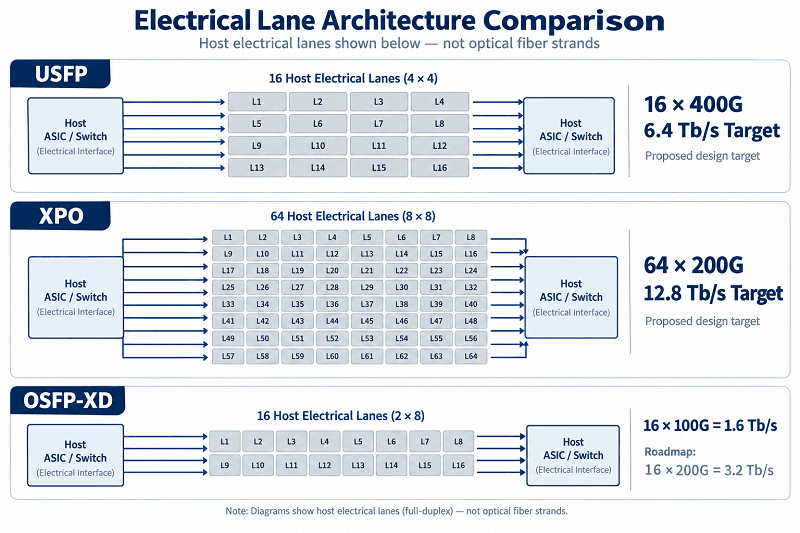
USFP, or Ultra-Dense Small Form-Factor Pluggable, is a proposed optical transceiver form factor announced by NVIDIA and Cisco at the OCP Global Summit on October 12, 2026. It is designed to support electrical signaling at up to 400 Gb/s per lane, targeting 6.4 Tb/s with 16 full-duplex electrical lanes in an OSFP-sized footprint and providing a path to 12.8 Tb/s with 32 lanes in a future configuration. These are announced design targets, not currently shipping USFP module specifications.
A quick naming note: “USFP” has also been used historically for “Ultra Small Form Factor Pluggable” in some compact networking products. In this article, USFP refers to the new NVIDIA–Cisco “Ultra-Dense” design, which is a different form-factor initiative.
XPO: eXtra-Dense Pluggable Optics
XPO, or eXtra-Dense Pluggable Optics, is a pluggable optical form factor introduced by Arista Networks in March 2026 with an ecosystem of more than 45 industry partners. Its proposed architecture combines 64 electrical lanes operating at 200 Gb/s each in a module approximately 2.7 times the width of OSFP, enabling a design capacity of 12.8 Tb/s per module. A central liquid-cooled cold plate is integrated into the module to support its high thermal density.
OSFP-XD: Octal Small Form-Factor Pluggable eXtra Dense
OSFP-XD, or Octal Small Form Factor eXtra Dense, is an extension of the OSFP family defined by the OSFP MSA. It increases the full-population electrical lane count from eight to 16, supporting 1.6 Tb/s with 16 × 100 Gb/s host electrical lanes and a path to 3.2 Tb/s with 16 × 200 Gb/s lanes. The specification also defines an eight-lane, half-populated XD-8 configuration. Unlike the newly announced USFP and XPO designs, OSFP-XD already has modules listed by optical transceiver suppliers.
USFP vs XPO vs OSFP-XD: Specification Comparison
The table below provides a side-by-side view of the three approaches. USFP and XPO figures primarily reflect announced design targets, whereas OSFP-XD values are based on its published MSA specification and supplier product listings. Lane counts and per-lane speeds refer to host-side electrical interfaces unless otherwise noted; the number of optical lanes can differ.
| Specification | USFP | XPO | OSFP-XD |
| Backer/standard | NVIDIA + Cisco (open specification planned) | Arista-led MSA (45+ partners at launch) | OSFP MSA |
| Electrical lanes | 16 (scalable to 32+) | 64 | 16 (8-lane XD-8 option) |
| Host electrical lane rate | Up to 400 Gb/s (design target; 200G support planned) | 200 Gb/s (400G roadmap) | 100 or 200 Gb/s, depending on host and module |
| Aggregate module capacity | 6.4T target; 12.8T future path | 12.8T target; 25.6T future path | 1.6T; 3.2T supported by the specified 16 × 200G interface |
| Footprint | Approximately OSFP-sized (initial design) | ~2.7× OSFP width | OSFP-family width, longer module |
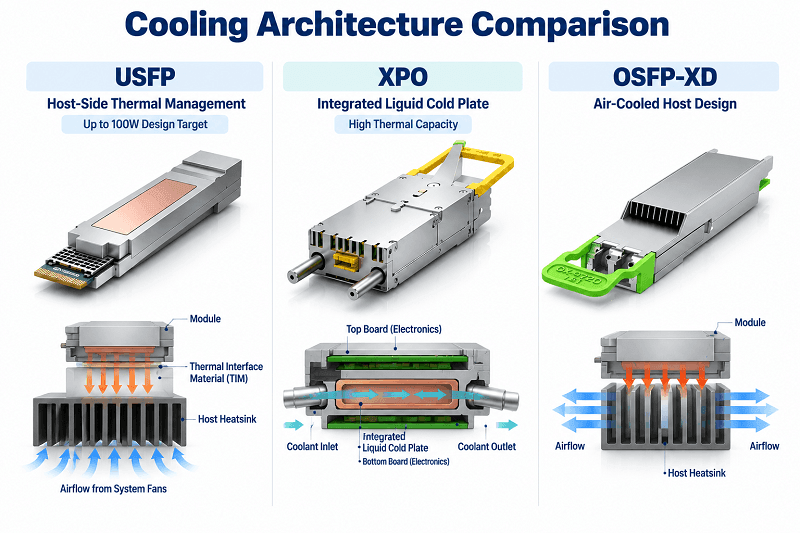
| Cooling | Host-side thermal management; no dedicated cooling loop inside the module | Integrated liquid cold plate | Supports air-cooled designs; host thermal validation required |
| Power / thermal capability | Up to 100W heat dissipation (design target) | Cold plate designed for up to ~400W or more; not typical draw | >60W electrical supply capability (~66W at 3.3V nominal); actual consumption varies |
| Front-panel density | ~4× 200G-per-lane OSFP pluggables (vendor projection) | Up to 204.8 Tb/s per Open Rack Unit (1OU), proposed architecture | Up to 32 ports per 1RU in reference designs |
| Commercial status | Announced design; no confirmed shipment date | MSA and demonstrations; production timing not firmly confirmed | Commercially listed 1.6T modules; confirm stock and host compatibility |
The key takeaway is that these are not three versions of the same design. They represent different answers to the same question: how can front-panel bandwidth continue to grow as electrical lane speeds, module power, and cooling requirements increase?
The Cooling and Density Tradeoff
Cooling is one of the main dividing lines between these form factors, and it deserves as much attention as their bandwidth specifications.
OSFP-XD: The Air-Coolable Increment
OSFP-XD is the more incremental approach. It builds on the OSFP mechanical concept, extends the module to accommodate a higher-density electrical interface, and supports host designs that use conventional air cooling. This can simplify adoption for operators with air-cooled infrastructure, although module power, airflow, heatsink performance, and chassis thermal limits still require system-level validation.
It also uses mechanical keying to prevent OSFP and OSFP-XD modules from being inserted into incompatible cages. The tradeoff is per-module capacity: the commonly listed 1.6T OSFP-XD options have lower aggregate bandwidth than the announced 6.4T USFP and 12.8T XPO targets, while OSFP-XD’s specified electrical interface provides a path to 3.2T. These different speeds should not be mistaken for direct host-port compatibility.
USFP: 100W Without an Embedded Cooling Loop
USFP takes a middle path. Its initial design targets an OSFP-sized footprint and heat dissipation of up to 100W without requiring a dedicated cooling circuit inside the removable transceiver. Instead, the host system provides the necessary thermal management, potentially through air- or liquid-cooled heatsink assemblies, while retaining the serviceability benefits of pluggable optics.
That design choice is deliberate. Avoiding an embedded liquid-cooling circuit in the removable module can help preserve a cost-effective, field-replaceable deployment model. The announced 100W figure is a design capability rather than a universal physical limit or a typical operating power measurement. NVIDIA and Cisco also project approximately 1.3× better power efficiency than 200G-per-lane pluggable optics, but that remains a vendor-reported target rather than a performance result applicable to every future USFP implementation.
XPO: Liquid Cooling at the Front Panel
XPO is the most aggressive approach to integrated cooling. Its proposed module is approximately 2.7 times as wide as OSFP, with two 32-channel circuit boards arranged around a central liquid cold plate. Blind-mate quick-disconnect fittings connect the module to the host cooling manifold. Arista’s white paper describes warm-water operation around 40–45°C and a cold-plate cooling capability of approximately 400W or more, depending on implementation; that rating should not be interpreted as the measured power draw of every XPO module.
The result is an architecture targeting the highest stated front-panel bandwidth density of these three designs: up to 204.8 Tb/s per Open Rack Unit (1OU), not necessarily per conventional EIA 19-inch rack unit. The tradeoff is operational. Liquid cooling extends into the pluggable module interface, introducing additional requirements for coolant connections, leak prevention, servicing procedures, and cooling-system integration.
Consider a hypothetical example: Marcus manages colocation infrastructure for a regional cloud provider. His facilities are almost entirely air-cooled, and retrofitting front-panel liquid cooling across multiple sites would require substantial investment. For Marcus, a compatible air-cooled 1.6T OSFP-XD deployment could be practical in the near term, while XPO’s projected 12.8T density would be harder to justify before a broader cooling upgrade. His decision comes down to a simple principle: bandwidth density has limited value if the facility cannot cool the equipment economically. This constraint could rule out XPO in the first deployment phase, despite its attractive design targets.
Maturity and Availability: What You Can Buy Today
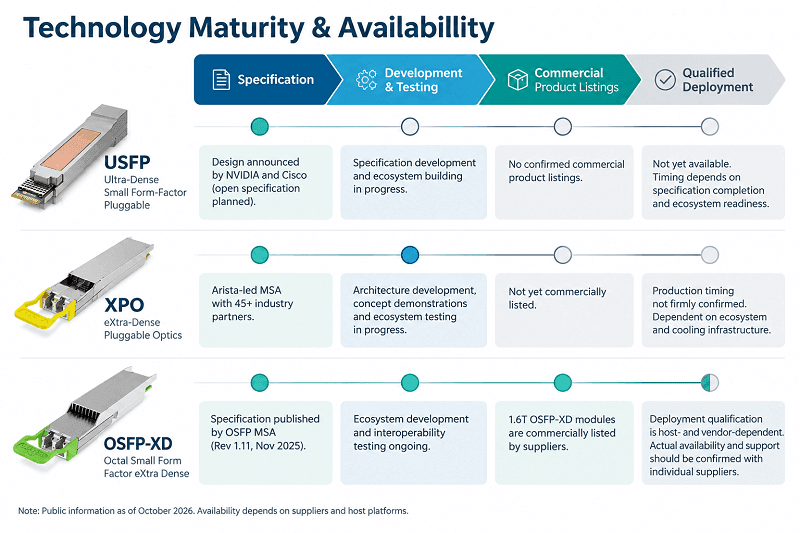
A critical point in this comparison is that the three form factors are at different stages of market readiness. A published specification, a trade-show demonstration, a supplier listing, and a qualified production shipment are not the same thing.
OSFP-XD Is Shipping Now
OSFP-XD is the most commercially established of the three compared here. Suppliers such as AscentOptics list 1.6T OSFP-XD transceivers, including DR8 and 2FR4 variants, while OSFP-XD development has also been supported by industry participants such as Eoptolink. The OSFP MSA published Revision 1.11 of the OSFP-XD specification in November 2025. Actual stock, delivery schedules, production qualification, and host-platform support should still be confirmed with individual vendors. For a 2026 or early-2027 project, OSFP-XD merits near-term evaluation, but standard 1.6T OSFP/OSFP1600 solutions should also be considered rather than treating OSFP-XD as the only available 1.6T pluggable format.
XPO Targets ~2027
XPO is at an earlier commercial stage. Arista and its partners have published technical material and demonstrated the architecture, while test-equipment providers have introduced development and compliance tools for the emerging ecosystem. Industry expectations have pointed toward production systems around 2027, but this should be treated as a projection rather than a firm, generally available shipment date. Module qualifications, host-system readiness, and liquid-cooling infrastructure will all influence deployment timing.
USFP Is a Specification
USFP is the newest of the three initiatives. NVIDIA and Cisco announced the form factor, its two-dimensional array connector, and its two-step insertion mechanism at OCP 2026, along with plans to develop an open, community-led multi-source specification. No confirmed commercial sampling or shipment schedule was provided in the announcement. Although the design targets 400G-per-lane operation, Cisco also describes a migration path supporting 200G and 400G SerDes-based systems. Broadly available 400G-per-lane host silicon and a qualified module ecosystem remain important considerations for future adoption.
This maturity gap matters when planning an AI network rollout. Consider another hypothetical scenario: Priya, a network architect at an AI infrastructure startup, is designing a 51.2T network for a 2027 training cluster. She initially considers USFP for its proposed 6.4T capacity, then realizes that module qualification, host-platform availability, and sampling schedules are not yet established. She therefore evaluates commercially listed OSFP-XD and conventional 1.6T OSFP solutions for the first phase, while keeping USFP and XPO on the roadmap for a future platform refresh. That future transition would require compatible switch hardware and mechanical and electrical interfaces—not a simple port-for-port module replacement. Her procurement lesson is straightforward: design around equipment that can be qualified for the deployment date, not around a bandwidth target alone.
Ecosystem, Backers, and the MSA Landscape
Form factors do not succeed on specifications alone. Their prospects also depend on the vendors building connectors, cages, optical engines, modules, switches, and testing equipment.
Three Camps, Three Bets
OSFP-XD belongs to the established OSFP MSA ecosystem, which spans switches, modules, and interconnect components. That gives it an established standards framework and a potential path to multi-vendor sourcing, although compatibility and the depth of supply should still be assessed for each OSFP-XD implementation.
XPO is an Arista-led MSA supported by an extensive supplier ecosystem, including companies such as Coherent, Lightmatter, Marvell, Microsoft, Molex, and Samtec. Its approach is closely associated with high-density, liquid-cooled AI networking, but the MSA structure is intended to enable participation by multiple vendors.
USFP is currently being driven by NVIDIA and Cisco, with TE Connectivity and Amphenol contributing to the proposed connector, cage, and module ecosystem. An open multi-source specification is planned. For buyers, this means evaluating the initial NVIDIA–Cisco roadmap—including Spectrum-X and Silicon One environments—while monitoring how broadly the design is adopted by other host and module suppliers.
Why the Pluggable Camp Split in Two
The broader debate reflects two philosophies for scaling high-density pluggable optics. USFP emphasizes faster electrical lanes in a compact, serviceable design without dedicated in-module liquid cooling. XPO emphasizes a much larger lane count and integrated liquid cooling while retaining a field-replaceable module. OSFP-XD, by contrast, offers an incremental extension of the existing OSFP family with a higher-density electrical interface.
That distinction matters for long-term network planning, particularly when comparing pluggable optics with co-packaged optics (CPO). Unlike these field-replaceable pluggable modules, CPO integrates optical engines closer to the switching silicon and introduces a different set of packaging, cooling, and serviceability considerations.
How to Choose: A Decision Framework
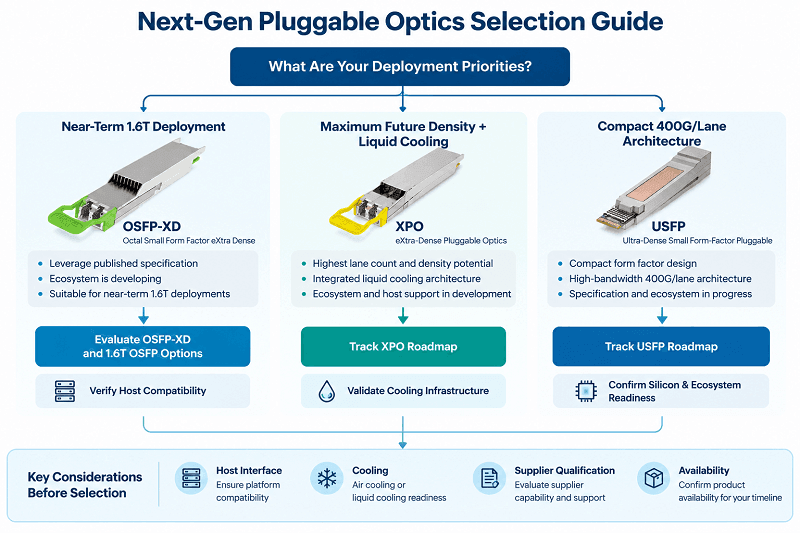
So which form factor should you choose? The honest answer is that it depends on three things more than it depends on the spec sheet.
1. Maturity. If you are deploying in 2026 or early 2027, OSFP-XD is the realistic answer. XPO and USFP are planning bets, not purchasable products.
2. Cooling. If your facility is air-cooled, OSFP-XD fits without changes. If you are already committed to liquid cooling and need maximum density, XPO is designed for you. USFP splits the difference with a host-cooled, 100W design.
3. Vendor lock-in. OSFP-XD offers the broadest multi-vendor supply. USFP ties you to NVIDIA and Cisco platforms. XPO is closely aligned with Arista’s roadmap.
If you are comparing form factors against the established OSFP and QSFP-DD options first, FiberMall’s USFP vs OSFP vs QSFP-DD guide walks through the baseline decision before you layer in these next-gen contenders.
USFP vs XPO vs OSFP-XD: Frequently Asked Questions
What is the difference between USFP, XPO, and OSFP-XD?
USFP targets 400G-per-electrical-lane signaling, initially using 16 lanes for 6.4T with a future path to 12.8T. XPO targets 12.8T through 64 electrical lanes at 200G and integrates liquid cooling into the module. OSFP-XD provides a specified 16-lane electrical interface for 1.6T and a path to 3.2T, with commercially listed 1.6T transceivers. These bandwidth figures describe different maturity levels and should not be interpreted as interchangeable module or host specifications.
Is OSFP-XD backward compatible with OSFP?
No. OSFP-XD has different mechanical and electrical interface requirements, including a longer module and keying features intended to prevent insertion into an incompatible OSFP cage, and vice versa. A compatible host port is required.
Is XPO a liquid-cooled module?
Yes. The proposed XPO architecture integrates a liquid cold plate and blind-mate quick-disconnect fittings. It is designed for systems with liquid-cooling infrastructure at the front panel, and the cold plate is intended to support approximately 400W or more of thermal load. This is a cooling design capability, not a universal measurement of module power consumption.
When will USFP be available?
NVIDIA and Cisco had not announced a confirmed commercial sampling or shipment date as of October 26, 2026. The form factor is designed to support both 200G- and future 400G-per-lane host platforms, but availability will depend on final specifications, compatible host hardware, and a qualified module ecosystem. A precise release timetable cannot yet be stated.
Which form factor should I choose for a 1.6T AI cluster?
For deployment in 2026 or early 2027, begin by evaluating qualified 1.6T modules and the specific host ports your switches and network adapters support. OSFP-XD is the more established candidate among the three form factors discussed here, but conventional 1.6T OSFP/OSFP1600 options may also be suitable. Consider USFP and XPO for future platform generations as their ecosystems mature; neither should be assumed to be a drop-in replacement for existing OSFP-XD ports.