


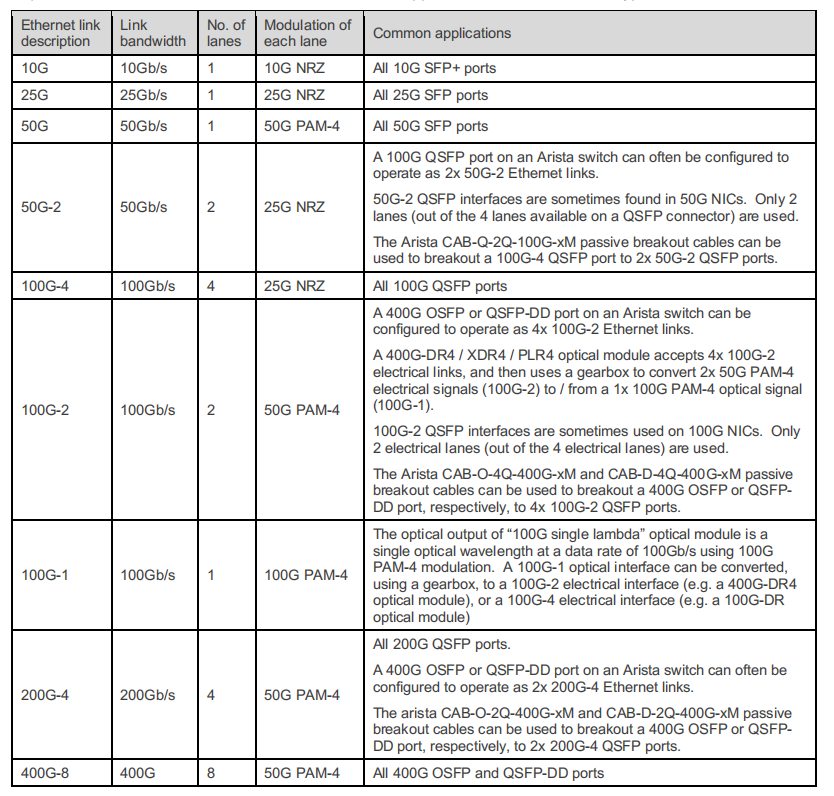
The terms 100G-2, 100G-4, 50G-2, 200G-4 and 400G-8 are abbreviations for different types of Ethernet interfaces that use different numbers of lanes and different modulation schemes to achieve different data rates. The general format is XG-Y, where X is the data rate in gigabits per second (Gbps), and Y is the number of lanes or the modulation scheme used.
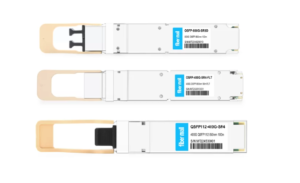
800G SR8 and 400G SR4 Optical Transceiver Modules Compatibility and Interconnection Test Report
Version Change Log Writer V0 Sample Test Cassie Test Purpose Test Objects:800G OSFP SR8/400G OSFP SR4/400G Q112 SR4. By conducting corresponding tests, the test parameters meet the relevant industry standards, and the test modules can be normally used for Nvidia (Mellanox) MQM9790 switch, Nvidia (Mellanox) ConnectX-7 network card and Nvidia (Mellanox) BlueField-3, laying a foundation for

GPT-6 Astra: How Many Optical Transceivers Did Its 100,000-GPU Training Run Actually Need?
OpenAI’s largest training run to date used more than 100,000 GPUs at its Stargate infrastructure in Texas. Everyone is benchmarking GPT-6 Astra. Far fewer people are asking what kind of network was required to connect a six-figure GPU cluster. The answer is more complicated than simply saying “100,000 GPUs equals
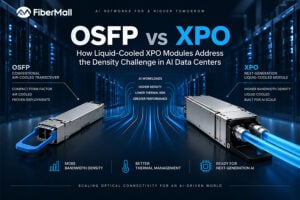
OSFP vs XPO: How Liquid-Cooled XPO Modules Address the Density Challenge in AI Data Centers
Introduction: Why AI Networks Need a New Optical Form Factor For more than a decade, the evolution of data center optical interconnects has followed a simple principle: increase bandwidth while keeping the pluggable form factor compatible with existing systems. This philosophy helped make OSFP (Octal Small Form-factor Pluggable) one of the
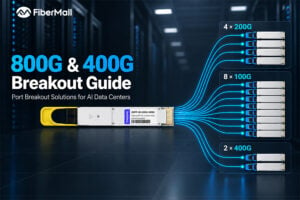
800G & 400G Breakout Guide: Port Breakout Solutions for AI Data Centers
What happens when your AI data center switches have already moved to 400G or 800G, while a large number of servers, NICs, DPUs, and existing network devices still operate at 100G or 200G? Replacing every device at the same time is rarely practical. This is where port breakout becomes important. Breakout
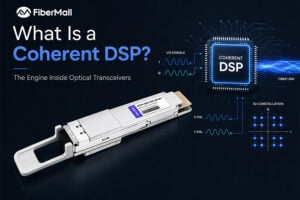
What Is a Coherent DSP? The Engine Inside Optical Transceivers
Priya runs the network operations center for a regional telecom operator. Last quarter her team deployed 400G ZR QSFP-DD modules between two data centers 95 km apart. Both link LEDs came up green on day one, and traffic passed. Everyone moved on to the next task. Three weeks later, errors
Coherent Module Compatibility: Cisco & Arista Guide (2026)
Elena manages transport for a regional cloud provider, and she learned about coherent module compatibility the hard way. She ordered a batch of third-party 400G ZR modules that were listed as “Cisco compatible,” plugged the first one into a Nexus switch, and watched it come up clean in under a
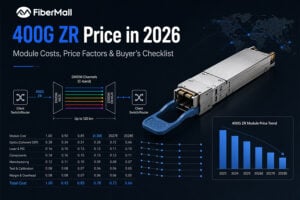
400G ZR Price in 2026: Module Costs, Price Factors & Buyer’s Checklist
A 400G ZR quote can be confusing because the numbers vary enormously depending on where you buy the module. A public OEM list price can exceed $100,000 per module, while third-party compatible 400G ZR QSFP-DD modules are often available for a small fraction of that amount. The difference is not