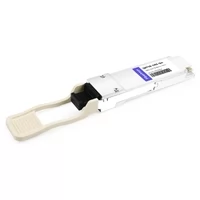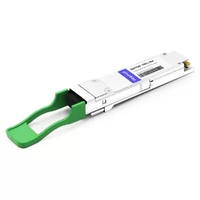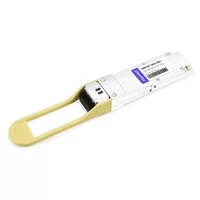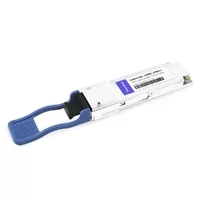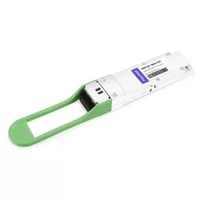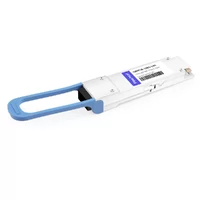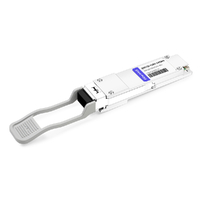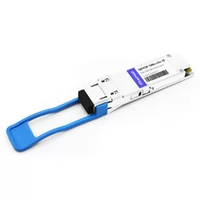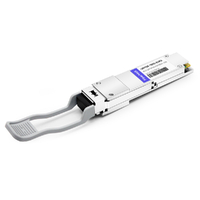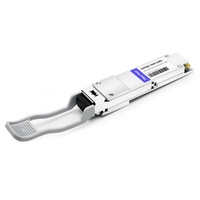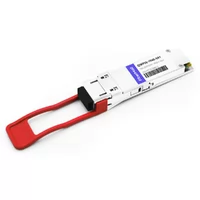

The purchase order arrived at Derek’s desk, waiting for his approval. The cost of 340 QSFP28 LR4 modules was $520 each, totaling $176,800 for a three-data-center interconnect project.
Derek selected LR4 as the standard for all his 100G links because he considered it the safest option for a 10-kilometer reach, ensuring the network functioned with full reliability. However, the network architect noticed a glaring detail: the longest physical fiber run was only 1,100 meters, and the shortest was just 180 meters. All their measurements stayed well below the 2-kilometer mark.
The team immediately replaced their LR4 order with CWDM4 modules. Priced at just $340 each, CWDM4 supported all their distance requirements while providing identical performance. The team saved $61,200. The only difference? CWDM4 tops out at 2km—and none of their links needed more.
Derek’s initial error highlights a common industry trap. The market currently offers nine different QSFP28 module types, making it difficult to select the correct option. Engineers tend to either over-spec their designs for safety or under-spec them until they hit distance limitations. This guide provides complete details about QSFP28 module types, including real-world pricing, link budgets, and a practical selection framework.
For the complete picture on QSFP28 deployment, start with our QSFP28 transceiver complete guide.
The QSFP28 Module Landscape
QSFP28 module types are divided into two distinct technological categories. Understanding this fundamental division is crucial for navigating the ecosystem.
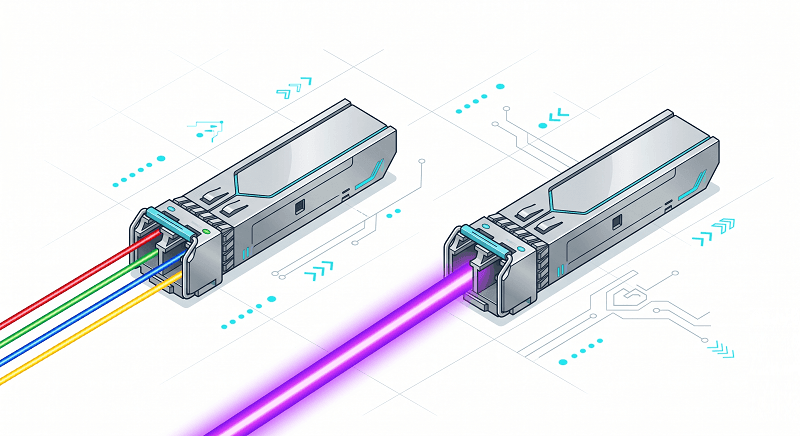
4-Lambda Modules: These legacy modules operate through four separate 25G NRZ data channels. The SR4 module transmits four 850nm light beams over parallel multimode fiber. CWDM4 and LR4 multiplex four different wavelengths onto a single duplex LC fiber. ER4 and ZR4 achieve extended reach by utilizing powerful cooled lasers. These established systems provide robust support for standard operations without requiring special Forward Error Correction (FEC) on most legacy switch ports.
Single-Lambda Modules: Representing the newer generation, these modules use a single 100G PAM4 lane operating at a 1311nm center wavelength. The DR1 standard handles connections up to 500 meters, FR1 operates up to 2 kilometers, and LR1 extends to 10 kilometers. This PAM4 modulation system transmits 100G data over a single wavelength using a Digital Signal Processor (DSP) chip. While it requires modern switch hardware, it offers users simplified optical designs, reduced expenses, and much more effective 400G breakout operations.
In 2026, approximately 85% of 100G ports still utilize QSFP28 form factors. However, the market is shifting. Single-lambda modules now capture about 30% of new data center builds, up from basically zero three years ago. Understanding both paths is essential for anyone building infrastructure today.
Multimode Workhorse: QSFP28 SR4
SR4 remains the default choice for short-reach data center links. It employs 850nm VCSEL lasers that operate over parallel multimode fiber via an MPO-12 connector. The maximum distance on OM3 fiber reaches 70 meters, while OM4 extends to 100 meters.
The underlying math is straightforward. The module utilizes four lanes operating at 25G each. Rather than relying on complex wavelength multiplexing, SR4 uses the direct transmission of multiple data streams through an MPO ribbon containing eight active fibers (four transmit, four receive).
With a power consumption of just 3.5W, SR4 boasts the lowest power requirement among all QSFP28 optical module types and rarely requires dedicated thermal management. It functions as the ideal optical solution for intra-rack and adjacent-rack connections.
Link Budget Example: SR4 on OM4
A standard SR4 module delivers an output power of -8.4 dBm per lane, while its receiver requires -10.5 dBm. This creates a link budget of 2.1 dB. Since OM4 fiber loses about 3.0 dB/km at 850nm, the total fiber loss over an 80-meter run amounts to just 0.24 dB. Factoring in two MPO connector pairs (roughly 1.0 dB loss), the overall system attenuation is approximately 1.2 dB. This leaves almost 1.0 dB of extra headroom, providing sufficient capacity for patch panels and minor fiber bends.
One key limitation: OM3 only operates reliably up to 70 meters. If your data center relies on older OM3 infrastructure, measure your actual cable runs before ordering. SR4 technology will experience severe degradation on a 90-meter OM3 link.
The connection requires DACs, which perform better than SR4 module pairs at distances between 25 and 40 meters. Use DACs for connections that link two switches together and require distances shorter than 3 meters. Use SR4 when you need flexibility or reach beyond what copper provides.
Single-Mode Trio: CWDM4, LR4, and PSM4
Single-mode QSFP28 modules cover distances from 500 meters up to 80 kilometers. Three main types handle the vast majority of legacy 4-lambda deployments.
CWDM4: The Hidden Hero
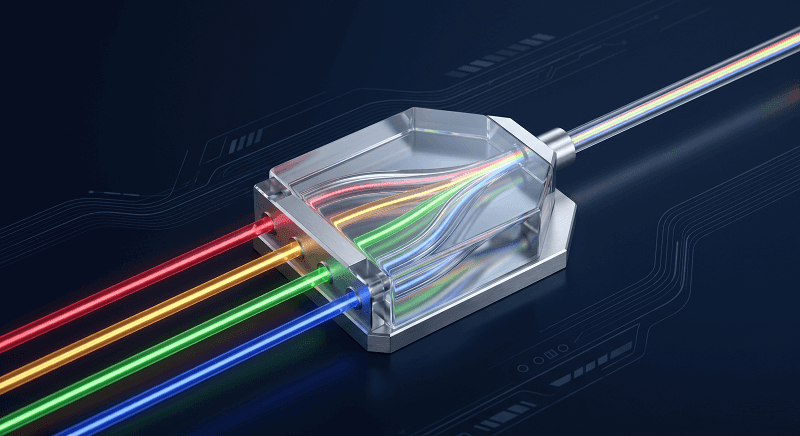
The CWDM4 module is arguably the most undervalued component in the QSFP28 product range. It transmits data using four Coarse Wavelength Division Multiplexing (CWDM) channels—1271nm, 1291nm, 1311nm, and 1331nm—through a single duplex LC fiber. Its maximum operational distance extends to 2 kilometers.
This 2-kilometer specification covers approximately 90% of data center interconnects and virtually all campus links. Because it uses uncooled DFB lasers, it costs significantly less to manufacture than LR4. As a result, the CWDM4 typically costs $280 to $380 (third-party), while LR4 operates at a much higher price point between $450 and $600. Standardizing on CWDM4 over LR4 easily generates enough savings to cover a junior engineer’s salary.
A commonly overlooked aspect of CWDM4 is its RS-FEC requirement. The IEEE 802.3bm standard mandates Reed-Solomon Forward Error Correction for CWDM4 links. Without it, bit error rates will rapidly increase. While modern switches enable RS-FEC by default for 100G fiber connections, older systems may not. You must verify this configuration during deployment.
The device consumes 3.5 watts of power. However, its link budget operates with stricter limitations than LR4. Producing a typical output of -6.5 dBm alongside a receiver sensitivity of -8.5 dBm, it offers a tight 2.0 dB budget. CWDM4 performs beautifully in clean installations with minimal patch panels, but can experience intermittent errors if excessive cross-connects disrupt the optical path.
LR4: The Long-Reach Standard
Operating over a 10-kilometer distance, LR4 uses four LAN-WDM wavelengths (1295.56nm, 1300.05nm, 1304.58nm, 1309.14nm) through duplex LC connections. The combination of cooled lasers and Thermo-Electric Cooler (TEC) systems achieves precise wavelength control across fluctuating temperature conditions.
This stability comes at a premium. Third-party LR4 modules cost between $450 and $600 and operate at 4.0 watts—exceeding CWDM4 power usage by 15%. However, the link budget provides ample capacity: with an output of -4.3 dBm and a receiver sensitivity of -10.6 dBm, it boasts a generous 6.3 dB operational range. This allows the signal to travel 10 kilometers while passing through several patch panels seamlessly.
LR4 should be strictly reserved for distances exceeding 2 kilometers or situations requiring strict latency minimization where FEC overhead must be avoided.
PSM4: The Legacy Parallel Option
PSM4 uses four parallel single-mode fibers with an MPO-12 connector, reaching 500 meters. The technology gained popularity before CWDM4 developed into its current state because hyperscale environments used single-mode MPO trunks as their standard.
PSM4 has become mostly outdated because it is no longer used in current system installations. CWDM4 reaches farther (2km vs 500m), uses simpler duplex LC cabling, and costs about the same. The only reason to consider PSM4 is if you already have single-mode MPO infrastructure and don’t want to change cable plants.
The CWDM4 Savings Story
The mid-size cloud provider required all its 100G interconnects to use LR4 specifications across its three data centers, which contained 340 ports. The average distance for the run reached 800 meters. A network architect demonstrated that CWDM4 supports a 2km distance while all ports remained below that maximum distance. The switch achieved $61200 savings in optics expenses without affecting performance. The LR4 modules, they didn’t buy? Complete overkill.
Single-Mode Module Comparison
| Module | Reach | Fiber | Connector | Power | Best For | |
| CWDM4 | 2km | SMF | Duplex LC | 3.5W | DCI, campus (<2km) | |
| LR4 | 10km | SMF | Duplex LC | 4.0W | Long reach, max stability | |
| PSM4 | 500m | SMF | MPO-12 | 3.5W | Legacy SMF MPO only |
Extended Reach: ER4, ZR4 & Coherent 100ZR
When traditional options run short at the 10km distance, two existing solutions require implementation, but one innovative solution establishes itself as a market disruptor.
The ER4 system achieves a range of 30 to 40 kilometers through its use of cooled EML lasers and enhanced FEC technology. The system operates at a higher power level of 4.5 watts. The third-party system charges customers between 1,200 and 1,800 dollars. The modules function as metro and regional network components instead of standard data center optical equipment.
The ZR4 system reaches 80 kilometers through its identical system design, which employs increased laser output. The system will have a module cost range between 2,500 and 4,000 dollars, which will require a power consumption exceeding 4.5 watts. The ZR4 modules serve as fundamental components for telecom and data center interconnection backbone networks.
The Coherent 100ZR system introduces itself as the fresh market contender. The system achieves long-distance transmission through its combination of coherent QPSK/16QAM modulation and DSP technology, which enables distances exceeding hundreds of kilometers without the need for amplification. The system operates at an excessive power level of 15 to 20 watts, which renders it incompatible with standard QSFP28 cages in most situations. The 100ZR system provides metro and regional networks with economic benefits that previously required dedicated transport systems. The system operates at C-band frequencies and supports DWDM functionality.
The two systems, ER4 and ZR4, serve as reference points for data center operators who will make infrequent purchases of these products. You should understand their existence and their corresponding costs. The system requires you to purchase CWDM4 or LR4 for 99 percent of your connections.
The New Generation: Single-Lambda DR1, FR1, LR1
The introduction of single-lambda QSFP28 modules marks a revolutionary development in 100G optical technology that surpasses the original QSFP28 design. The system employs a single 100G PAM4 lane, which operates at 1310nm for data transmission instead of using four 25G lanes.
The modulation system uses Pulse Amplitude Modulation 4-level (PAM4) technology. Each symbol carries two bits instead of one. A DSP chip manages the processes of encoding, equalization, and error correction. The result: 100G on a single wavelength with one laser and one receiver.
The DR1 standard provides a range of 500 meters. The FR1 standard has a maximum distance of 2 kilometers. The LR1 standard provides coverage up to 10 kilometers. The system maintains CAUI-4 electrical interface standards, which allow the switch to perceive four 25G data pathways. The module’s DSP aggregates them into one 100G optical stream.
Why Single-Lambda Matters
The total cost decreases because manufacturers require fewer optical components to produce their products. The industry estimates that single-lambda modules cost approximately 40 percent less than their 4-lambda counterparts. The FR1 module at 320-420 demonstrates better performance than CWDM4 which operates between 320-420 and shows increasing performance gaps at higher volume levels.
Reliability. The system uses one laser and one receiver without requiring any MUX/DEMUX components. Fewer points of failure lead to improved manufacturing output.
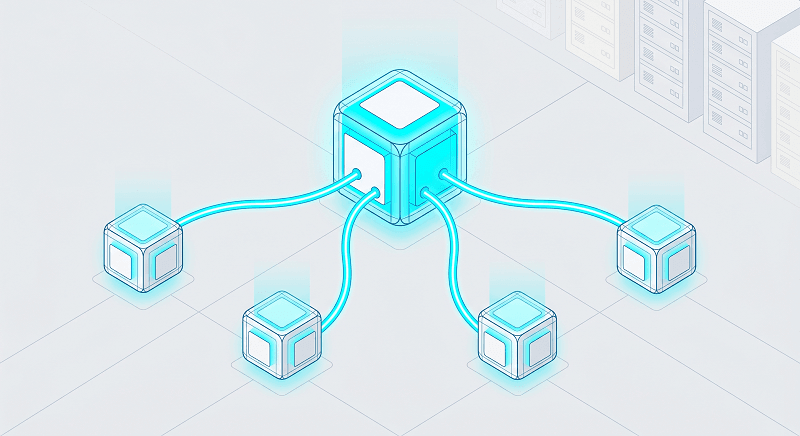
The 400G breakout. The 400G QSFP-DD FR4 module has its first hidden benefit. A 400G QSFP-DD FR4 module breaks out to four 100G FR1 modules. The system operates in a clean way because of its symmetrical design, which eliminates any speed mismatches. The system requires 400G to break out into eight 50G lanes because 4-lambda 100G requires this complex and expensive system.
The Trade-Offs
FEC is required for all systems. PAM4 needs more error correction capabilities than NRZ. The KP4 FEC system serves as the universal standard for all single-lambda modules. The system adds very little time delay, which usually remains below 100 nanoseconds, but this requirement cannot be changed. The single-lambda system will not function without KP4 FEC support from your switch.
Ecosystem maturity. The technology of single-lambda represents a recent development. Not all switch platforms provide support for DR1, FR1, and LR1. The white-box switches do not have functional DDM parsing capabilities. Some older platforms need firmware updates. Check your hardware compatibility before ordering at scale.
The system requires operational power support. The DSP chip introduces additional power requirements for the system. The FR1 standard consumes approximately 3.5 watts while the LR1 standard consumes about 4.0 watts. The system performs at the level of 4-lambda modules but does not exceed that performance. The power savings originate from the use of simplified optics during manufacturing, which occurs at the manufacturing stage instead of the port manufacturing stage.
Single-Lambda vs 4-Lambda Comparison
| Aspect | 4-Lambda (CWDM4/LR4) | Single-Lambda (FR1/LR1) |
| Modulation | NRZ | PAM4 |
| Wavelengths | 4 (CWDM or LAN-WDM) | 1 (1310nm) |
| Optical Components | 4 lasers + MUX/DEMUX | 1 laser + DSP |
| FEC | Optional (CWDM4 needs RS-FEC) | Mandatory (KP4) |
| Typical Power | 3.5-4.0W | 3.0-4.0W |
| Third-Party Price | $280-600 | $200-650 |
| 400G Breakout | 8×50G complex | 4×100G clean |
| Ecosystem | Mature | Growing rapidly |
Specialty & Alternative Options
Sometimes the best module isn’t a module at all.
The BiDi (Bidirectional) system transmits data through two different wavelengths, which travel on a single duplex fiber pair. The 100G BiDi system operates by sending data through 1270nm and receiving data through 1330nm on a single fiber connection. The advantage: half the fiber count. BiDi systems provide essential help during fiber-based upgrades because users cannot install new cables. The disadvantage exists because vendors provide limited support while the product costs more.
The Active Optical Cable (AOC) system includes optical engines that developers install inside the connector heads and connect through fiber links. The system creates a permanent connection between two modules through a cable system. The system extends its reach up to 100m. The system requires approximately 1.5W of power for each end. The short lengths of the product range from $80 to $120. AOCs shine when cable management matters — no separate modules to track, no connector cleaning between module and cable.
Direct Attach Copper (DAC) technology employs twinax copper wires, which do not need power to operate but require QSFP28 connectors. The system contains no optical components and no laser systems because it only uses copper material. A 1-meter passive DAC costs $25-40 and draws under 0.5W. DACs serve as the ideal solution for intra-rack connections. The system permits passive devices to reach three meters, while active devices can reach up to seven meters.
When to Skip Modules Entirely
| Scenario | Best Choice | Why |
| Switch-to-server, same rack | Passive DAC | $25-40, <0.5W, no optics |
| Adjacent racks, <7m | Active DAC or AOC | Simple, reliable, no fiber management |
| High-density cable management | AOC | Pre-terminated, no separate modules |
| Fiber-constrained upgrade | BiDi | Halves fiber count |
| Standard DC interconnect | CWDM4 or FR1 | Best balance of cost and reach |
Module Selection Framework
Choosing a QSFP28 module type comes down to five questions. Answer them in order.
Step 1: What’s your actual distance? Measure the fiber path, not the straight-line distance. Fiber follows cable trays, conduits, and patch panels. Add 20% headroom. If your measured distance is 1,800 meters, plan for 2,200 meters of margin.
Step 2: What fiber do you have? OM3/OM4 with MPO trunks points to SR4. Single-mode with duplex LC points to CWDM4, LR4, or single-lambda. Single-mode with MPO suggests PSM4 (or replacing the cable plant).
Step 3: What’s your link budget? Calculate total loss: fiber attenuation + connector loss + splice loss + margin. Single-mode loses ~0.35 dB/km at 1310nm. Each connector pair adds ~0.3 dB. If your budget is tight, LR4’s 6.3 dB margin beats CWDM4’s 2.0 dB.
Step 4: Does your switch support it? Not all switches handle all module types. Single-lambda modules need KP4 FEC support. Some older platforms don’t recognize DR1/FR1. NVIDIA locks out uncoded third-party modules. Check our QSFP28 compatibility guide for platform-specific details.
Step 5: What’s the TCO? Module price is just the starting point. Add cabling costs, power consumption, and cooling overhead. A $450 LR4 module on a 1km run costs significantly more than a $340 CWDM4 module offering the exact same performance.

Distance-Based Decision Matrix
| Distance | Fiber | Recommended Module | Why |
| <3m, same rack | Any | Passive DAC | Lowest cost, lowest power |
| 3-7m, adjacent racks | Any | Active DAC or AOC | No fiber management |
| 7-100m | OM4 MMF | SR4 | Cheap, proven, MPO infrastructure |
| 100-500m | SMF | CWDM4 or FR1 | CWDM4 if no FEC concerns, FR1 for 400G path |
| 500m-2km | SMF | CWDM4 or FR1 | CWDM4 mature, FR1 cheaper long-term |
| 2-10km | SMF | LR4 or LR1 | LR4 for max margin, LR1 for cost/400G |
| 10-40km | SMF | ER4 | Cooled EML, regional reach |
| 40-80km | SMF | ZR4 | Long-haul DCI |
TCO Example: 100 Ports at 1km
| Module | Module Cost | Cable Cost | Power/yr* | 3-Year TCO |
| CWDM4 | $34,000 | $2,000 | $3,066 | $39,066 |
| LR4 | $52,500 | $2,000 | $3,504 | $58,004 |
| FR1 (single-lambda) | $36,000 | $2,000 | $3,066 | $41,066 |
*Power at $0.12/kWh, 3.5W vs 4.0W per module, cooling multiplier 1.5×
At 1km, LR4 costs 48% more than CWDM4 over three years with zero functional advantage. That’s the “LR4 tax” in action.
Common Selection Mistakes
Real engineers make real mistakes. Here are the most expensive ones we’ve seen.
Over-specifying LR4: This is the #1 waste in QSFP28 procurement. If your longest run is 1.5km, CWDM4 or FR1 handles it at 40% less cost. LR4’s 10km reach is insurance you’ll never use. At 200 ports, that insurance policy costs $30,000-40,000.
Forgetting FEC requirements: CWDM4 requires RS-FEC. Single-lambda requires KP4 FEC. A financial services team spent an entire weekend troubleshooting a flapping link before discovering the access switch had FEC enabled while the aggregation switch didn’t. Thirty seconds of configuration. Two days of pain. For a deeper dive on avoiding these issues, see our QSFP28 troubleshooting guide.
The Intel wavelength offset: Intel’s LR4 modules use 1311nm on one lane while the industry standard is 1310nm. That 1nm difference causes link failures on switches with tight optical filtering. It’s not documented prominently. You find out after deployment fails.
Silicone oil leaks: Certain early batches of pre-FBN2709xxxx modules suffered from silicone oil leaking inside the optical path. After about 12 months, transmit power drops and links become unstable. The module looks fine externally, and cleaning the fiber doesn’t help. The module degrades from the inside, and RMA is the only fix.
400G Breakout Incompatibility: If you’re buying QSFP28 modules today and planning 400G upgrades tomorrow, your module choice matters. A 400G DR4 port breaks out cleanly to four 100G DR1/FR1 single-lambda modules. You cannot passively break out a WDM 400G FR4 module into standard legacy CWDM4 links.
MPO vs LC connector mismatch: SR4 and PSM4 use MPO-12. CWDM4, LR4, and single-lambda use duplex LC. If your data center patch panels are entirely MPO and you blindly order CWDM4, you’ll be buying expensive conversion cassettes or re-terminating fiber.
FAQ
What is the most popular QSFP28 module type?
The SR4 module stands as the most frequently used QSFP28 module because it offers economical costs and straightforward installation procedures. The most widely used single-mode solution for data center interconnections operates on CWDM4 technology. Single-lambda FR1 has emerged as the dominant solution for new hyperscale data center construction projects.
What circumstances make CWDM4 the better choice than LR4?
CWDM4 should be selected when your fiber runs extend less than 2km, and you require less network capacity than what LR4 offers. CWDM4 performs the same at DCI distances while costing 30-40% less than its competitors. The LR4 standard only provides value for distances that reach 2km or for locations that utilize multiple patch panels.
Is FEC necessary for CWDM4 operation?
Yes. The IEEE 802.3bm standard mandates RS-FEC for CWDM4. Most contemporary switches enable this feature automatically. However, older legacy systems might require manual configuration to prevent bit error rates from reaching unacceptable levels.
What is the difference between single-lambda and 4-lambda QSFP28?
4-lambda modules use four independent 25G NRZ lanes with four lasers. Single-lambda uses one 100G PAM4 lane with one laser and a DSP. Single-lambda costs ~40% less, has fewer failure points, and enables a cleaner 400G breakout. The trade-off is mandatory FEC and a slightly newer ecosystem.
Can I use SR4 on OM3 fiber?
Yes, but the maximum reliable reach drops to 70 meters (compared to 100 meters on OM4). Always use actual physical fiber distance for measurement purposes instead of straight-line distance.
Will QSFP28 modules work in 400G switches?
Yes. Standard 400G QSFP-DD ports are backwards compatible and natively support 100G QSFP28 modules. (Note: OSFP ports require a physical adapter). This allows you to upgrade your switch hardware first, and your optical links later.
Should I buy a DAC or an SR4 for intra-rack connections?
The passive DACs, which cost between $25 and $40, represent the best choice for connections that operate at distances less than 3 meters. The products provide a cost advantage while they consume less energy and eliminate the need for fiber management. Use SR4 when you need more than 3 meters or when cable flexibility matters.
Conclusion
QSFP28 module selection doesn’t have to be guesswork. The right choice follows a simple logic:
- Under 100m with OM4? SR4 or DAC. Don’t overthink it.
- 100m to 2km over single-mode? CWDM4 if your switch ecosystem is mature. FR1 if you’re planning 400G breakout.
- 2km to 10km? LR4 for maximum margin. LR1 for cost optimization and future-proofing.
- Beyond 10km? ER4 or ZR4. Consider coherent 100ZR for metro distances.
- Always check FEC requirements. CWDM4 needs RS-FEC. Single-lambda needs KP4. Missing this costs you weekends.
The biggest mistake isn’t choosing the wrong module type — it’s choosing a more expensive module type than your infrastructure requires. That $61,200 CWDM4 savings? It came from one simple question: “What’s the actual distance?”
For the full picture on deploying QSFP28 in your network, see our complete QSFP28 transceiver guide. Need help choosing modules for your specific switch platform? Contact our engineering team for a free compatibility check.
Related Products:
-
 QSFP28-100G-SR4 100G QSFP28 SR4 850nm 100m MTP/MPO MMF DDM Transceiver Module
$40.00
QSFP28-100G-SR4 100G QSFP28 SR4 850nm 100m MTP/MPO MMF DDM Transceiver Module
$40.00
-
QSFP28-100G-IR4 100G QSFP28 IR4 1310nm (CWDM4) 2km LC SMF DDM Transceiver Module
$110.00
-
QSFP28-100G-DR1 100G QSFP28 Single Lambda DR 1310nm 500m LC SMF with FEC DDM Optical Transceiver
$180.00
-
QSFP28-100G-PSM4 100G QSFP28 PSM4 1310nm 500m MTP/MPO SMF DDM Transceiver Module
$180.00
-
QSFP28-100G-FR1 100G QSFP28 Single Lambda FR 1310nm 2km LC SMF with FEC DDM Optical Transceiver
$215.00
-
Arista Networks QSFP-100G-LRL4 Compatible 100G QSFP28 LRL4 1310nm (LWDM4) 2km LC SMF DDM Transceiver Module
$245.00
-
QSFP28-100G-LR1 100G QSFP28 Single Lambda LR 1310nm 10km LC SMF with FEC DDM Optical Transceiver
$265.00
-
QSFP28-100G-SR1.2 Single Rate 100G QSFP28 BIDI 850nm & 900nm 100m LC MMF DDM Optical Transceiver
$280.00
-
QSFP28-100G-LR4 100G QSFP28 LR4 1310nm (LAN WDM) 10km LC SMF DDM Transceiver Module
$285.00
-
QSFP28-100G-SWDM4 100G QSFP28 SWDM4 850nm-940nm 100m LC MMF DDM Optical Transceiver
$300.00
-
QSFP28-100G-LR4-20 100G QSFP28 LR4 1310nm LWDM4 20km LC SMF DDM Transceiver Module
$300.00
-
QSFP28-100G-BDRX 100G QSFP28 BIDI 850nm & 900nm Only Receiver 100m LC MMF Optical Transceiver
$379.00
-
QSFP28-100G-SRBD Dual Rate 40G/100G QSFP28 BIDI 850nm & 900nm 100m LC MMF DDM Optical Transceiver
$449.00
-
QSFP28-100G-ER1 100G QSFP28 ER1 Single Lambda 1310nm 40km PAM4 LC SMF DDM Transceiver Module
$1250.00