
At 3:17 AM, the training run for the 70-billion-parameter model stalled. Again. The GPUs were running at 94% utilization, yet the all-reduce synchronization phase was eating 37% of the epoch time. For the platform team at Acme AI, the culprit wasn’t CUDA, wasn’t memory bandwidth, and wasn’t batch size. It was the network. Standard Ethernet could move the packets, but it couldn’t move them fast enough or consistently enough for tens of thousands of gradient tensors racing across 2,048 GPUs.
This is the problem InfiniBand was built to solve.
If you’re designing AI clusters, HPC systems, or high-performance storage fabrics, you’ve probably seen InfiniBand show up in every serious benchmark. It isn’t just faster Ethernet. It’s a different networking philosophy: lossless by design, built around RDMA, and optimized for microsecond latency rather than raw per-port cost. In this guide, you’ll learn how InfiniBand works, why it dominates GPU training clusters, how each generation compares, and what to watch for when you deploy it in 2026.
Want to skip to cable and module choices? Explore FiberMall InfiniBand cables and transceivers →

What Is InfiniBand?
InfiniBand is a high-speed, switched interconnect architecture designed for low-latency, high-throughput communication between servers, storage, and GPUs. Unlike Ethernet, which evolved from local-area networking and tolerates packet loss, InfiniBand was engineered from the ground up as a channel-based interconnect with credit-based flow control. That means packets don’t get dropped under congestion. They get held back until the receiver explicitly has buffer space.
The InfiniBand Trade Association (IBTA) maintains the specification, but the practical ecosystem is now driven almost entirely by NVIDIA after its $6.9 billion acquisition of Mellanox in 2019. Most new InfiniBand deployments use NVIDIA ConnectX host adapters and Quantum switches.
InfiniBand differs from Ethernet in three fundamental ways:
Native RDMA: Applications can read and write remote memory directly without involving the remote CPU or kernel.
Lossless transport: Credit-based flow control eliminates packet drops caused by buffer exhaustion.
Centralized fabric management: A Subnet Manager programs every switch and endpoint with paths, quality of service, and addressing.
These characteristics make InfiniBand the default fabric for the world’s largest supercomputers and most aggressive AI training clusters. If Ethernet is the general-purpose road network, InfiniBand is the private rail line built for one kind of cargo: massive, synchronized data movement with zero excuses for delay.
How InfiniBand Works: Core Architecture
An InfiniBand fabric has four main building blocks: the Host Channel Adapter (HCA), switches, cables, and the Subnet Manager. Understanding each role makes deployment decisions much clearer.
Host Channel Adapter (HCA)
The HCA is the network interface card for InfiniBand. NVIDIA’s ConnectX series is the most common example. The HCA sits in a PCIe slot and presents a verbs interface to applications through libraries like libibverbs. It handles packet generation, RDMA operations, memory registration, and transport-level reliability.
Modern HCAs are incredibly sophisticated. A ConnectX-8 can push 800 Gbps, offload MPI collectives, and support GPUDirect RDMA so GPUs can exchange data without touching host memory. The HCA is where most of InfiniBand’s magic happens.
Switches and Routers
InfiniBand switches are non-blocking, cut-through devices that forward packets based on a local forwarding table downloaded by the Subnet Manager. There’s no Spanning Tree Protocol, no MAC learning table, and no decentralized routing logic. Each switch simply looks up the destination Local Identifier (LID) and sends the packet out the correct port.
Routers connect separate InfiniBand subnets, similar to how IP routers connect Ethernet broadcast domains. Most data center deployments use a single subnet, so routers are less common than switches.
Cables and Connectors
InfiniBand uses direct-attach copper (DAC), active optical cables (AOC), and optical transceivers. The form factor depends on the generation. HDR often uses QSFP56, NDR 400G uses QSFP112 or OSFP, and XDR 800G leans heavily on OSFP. Breakout cables split one high-speed port into multiple lower-speed links, which is essential for fat-tree topologies.
Subnet Manager Role
The Subnet Manager (SM) is the brain of the fabric. It discovers all HCAs and switches, assigns LIDs, calculates shortest-path forwarding tables, and configures virtual lanes and quality of service. OpenSM is the open-source implementation. NVIDIA’s Unified Fabric Manager (UFM) adds monitoring, congestion control, and centralized management.
Without the Subnet Manager, the fabric doesn’t forward traffic. Most production clusters run a primary SM on a management node and a standby SM for redundancy. If the SM fails and no standby takes over, new paths can’t be established, though existing flows typically continue using cached forwarding tables.
Addressing: GUID, LID, and GID
Every InfiniBand port has a permanent 64-bit Global Unique Identifier (GUID). The Subnet Manager assigns a 16-bit Local Identifier (LID) per port. LIDs are used for routing within a subnet and support approximately 49,000 unicast endpoints per subnet. For larger fabrics or IPoIB traffic, Global Identifiers (GIDs) based on IPv6 addresses are used.
The InfiniBand Protocol Stack
InfiniBand organizes communication into five layers. Most network engineers only interact with the upper layers, but knowing the stack helps diagnose performance problems and explain why InfiniBand behaves differently than TCP/IP.
Physical Layer
The physical layer defines electrical and optical signaling, connectors, cables, and modulation. Early generations used NRZ signaling. NDR and XDR moved to PAM4 to double bit rate without doubling baud rate. This is why NDR 400G uses 106 Gbps per lane with PAM4 instead of the 56 Gbps NRZ lane rate you might expect.
Link Layer
The link layer handles framing, flow control, and virtual lanes. It is responsible for the credit-based mechanism that makes InfiniBand lossless. Each link can carry up to 16 virtual lanes (VL0-VL15), allowing different traffic classes to coexist without head-of-line blocking. The link layer also includes a 16-bit CRC for payload integrity.
Network Layer
The network layer routes packets between subnets using GIDs. Within a subnet, routing is LID-based and handled at the link layer. The network layer is mostly relevant when you bridge InfiniBand to IP networks or connect multiple subnets.
Transport Layer
The transport layer provides the reliability and delivery semantics that applications actually use. InfiniBand supports several transport modes:
Reliable Connected (RC): Most common for RDMA. Guarantees ordered, reliable delivery between a pair of queue pairs.
Unreliable Datagram (UD): Low-overhead, connectionless transport often used for MPI.
Reliable Datagram (RD): Scales better than RC by sharing contexts across queue pairs.
Unreliable Connected (UC) and Raw IPv6: Specialized uses.
Upper Layer Protocols
Upper layer protocols sit on top of the transport layer. The most important ones are:
RDMA: The foundation of modern InfiniBand performance.
IPoIB: Runs IP over InfiniBand for legacy applications.
MPI: Message Passing Interface, widely used in HPC.
SRP and iSER: Storage protocols over RDMA.
NVMe-oF: NVMe over Fabrics, increasingly used for high-performance storage.
InfiniBand Generations and Speeds
InfiniBand generations follow a naming convention that reflects the data signaling rate. Each generation roughly doubles the per-port bandwidth of the previous one. The progression has looked like this:
| Generation | Year | Signaling Rate | Effective Data Rate | Encoding | Common Connector |
| SDR | 2001 | 2.5 Gbps/lane | 10 Gbps (4x) | 8b/10b | CX4 / SFF-8470 |
| DDR | 2005 | 5 Gbps/lane | 20 Gbps (4x) | 8b/10b | QSFP |
| QDR | 2007 | 10 Gbps/lane | 40 Gbps (4x) | 8b/10b | QSFP |
| FDR | 2011 | 14 Gbps/lane | 56 Gbps (4x) | 64b/66b | QSFP |
| EDR | 2014 | 25 Gbps/lane | 100 Gbps (4x) | 64b/66b | QSFP28 |
| HDR | 2017 | 50 Gbps/lane | 200 Gbps (4x) | RS-FEC | QSFP56 |
| NDR | 2022 | 100 Gbps/lane | 400 Gbps (4x) | PAM4 + FEC | QSFP112 / OSFP |
| XDR | 2025 | 200 Gbps/lane | 800 Gbps (4x) | PAM4 + FEC | OSFP / twin-port |
| GDR | 2026+ | ~400 Gbps/lane | 1.6 Tbps (4x) | PAM4 + FEC | OSFP-XD / CPO |
The switch from NRZ to PAM4 at NDR changed how engineers think about signal integrity. PAM4 packs two bits per symbol, which reduces the required baud rate but demands cleaner channels, better cables, and stronger forward error correction. In practice, this means NDR and XDR deployments are far more sensitive to cable quality than HDR was.
By 2026, most new AI clusters are being designed around NDR 400G or XDR 800G. GDR at 1.6 Tbps is on NVIDIA’s public roadmap, with first systems expected in late 2026 or early 2027 using co-packaged optics and larger switch radix.
RDMA and GPUDirect: Why InfiniBand Dominates GPU Clusters
Remote Direct Memory Access (RDMA) is the feature that makes InfiniBand indispensable for AI training. Without RDMA, when one server wants to send data to another, the operating system copies the data through the CPU, the kernel network stack builds packets, the NIC transmits them, and the remote CPU reverses the process. That works fine for web traffic. It is catastrophic for all-reduce operations across thousands of GPUs.
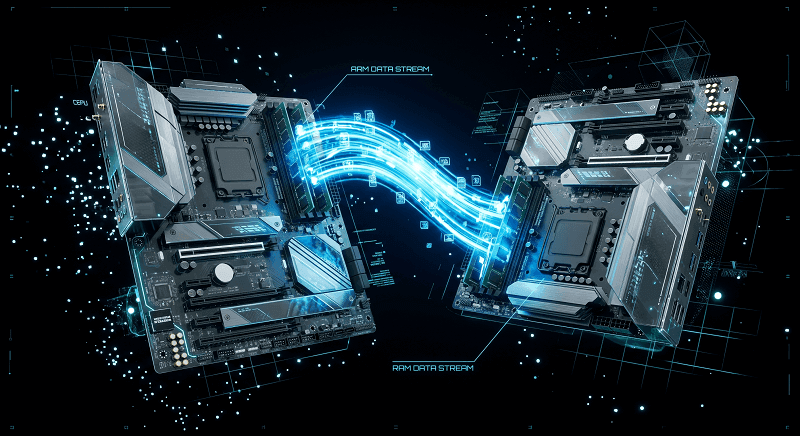
RDMA lets one HCA read from or write to remote memory directly. The CPU is bypassed. The kernel is bypassed. Data moves from user-space buffer to wire to user-space buffer with microsecond latency.
Queue Pairs and Completion Queues
RDMA uses Queue Pairs (QPs). Each QP has a Send Queue and a Receive Queue. Work Requests are posted to these queues. Completion Queues (CQs) notify the application when an operation finishes. This model is elegant but requires careful application design. You don’t just call send(). You register memory regions, build work requests, manage credits, and poll completions.
The payoff is real. A well-tuned InfiniBand RDMA path can deliver end-to-end latency under 1 microsecond, compared to 10-100+ microseconds for TCP/IP over Ethernet.
Zero-Copy and Kernel Bypass
Traditional networking copies data multiple times: from application buffer to kernel socket buffer, to NIC DMA region, to remote kernel, to remote application. RDMA eliminates most of these copies. Applications pin memory regions, and the HCA DMAs directly to or from them. CPU usage drops. Latency drops. Throughput climbs.
GPUDirect RDMA
GPUDirect RDMA extends this idea so one GPU can read and write the memory of another GPU in a different server without routing through host DRAM. NVIDIA’s NCCL library uses GPUDirect to implement ring, tree, and NVLink Bridge collectives across multi-node clusters. The result is GPU scaling efficiency often in the 85-95% range, compared to 50-70% with traditional networking.
When the team at Acme AI replaced their legacy Ethernet fabric with NDR InfiniBand and GPUDirect RDMA, their 1,024-GPU training cluster saw a 31% reduction in epoch time. The network was no longer the bottleneck. Their model iterations went from every six days to every four days. That one change paid for the fabric upgrade within the first quarter.
InfiniBand vs Ethernet
The most common question infrastructure teams ask is whether they can use Ethernet instead of InfiniBand. The honest answer: sometimes yes, sometimes no. It depends on workload, scale, and tolerance for tuning complexity.
| Factor | InfiniBand | Ethernet / RoCEv2 |
| Latency | ~0.5-1.5 µs | ~5-50+ µs |
| Loss behavior | Lossless by design (credit-based) | Best-effort unless PFC/ECN tuned |
| RDMA | Native | RoCEv2 adds RDMA over UDP |
| Congestion control | Built-in, centrally managed | Requires PFC, ECN, DCTCP tuning |
| Management | Subnet Manager programs fabric | Decentralized, operator-driven |
| Vendor ecosystem | NVIDIA-dominated | Broad, multi-vendor |
| Cost per port | ~20-30% premium | Lower upfront |
| Best for | AI training, HPC, low-latency storage | General cloud, web, many enterprise apps |
When InfiniBand Wins
Choose InfiniBand when:
You’re running large-scale distributed AI training with NCCL or MPI collectives.
Tail latency matters more than average latency.
You need lossless behavior without weeks of PFC/ECN tuning.
You want GPUDirect RDMA out of the box.
You’re building a dedicated HPC or AI fabric, not a general-purpose network.
When Ethernet/RoCEv2 Wins
Choose Ethernet when:
Your workloads are general-purpose cloud, storage, or web services.
You need interoperability across many switch vendors.
Your team already has deep Ethernet operations expertise.
Capital cost per port is the primary constraint.
You can invest in tuning RDMA over Converged Ethernet v2 (RoCEv2).
RoCEv2 can deliver much of InfiniBand’s performance, but it requires careful configuration of Priority Flow Control (PFC), Explicit Congestion Notification (ECN), and Data Center TCP (DCTCP). One misconfigured switch can introduce catastrophic tail latency. InfiniBand abstracts most of that away through the Subnet Manager and credit-based flow control.
InfiniBand in AI and HPC Data Centers
InfiniBand has become the default interconnect for the most demanding compute workloads. Here’s where it shows up in practice.

AI Training Clusters
Large language models and computer vision models are trained across hundreds or thousands of GPUs. Each training step requires all-reduce operations that synchronize gradients across every GPU. InfiniBand’s low latency and SHARPv4 in-network computing reduce all-reduce traffic by up to 9x in some topologies. NVIDIA’s own DGX SuperPOD reference architectures use InfiniBand almost exclusively.
HPC and Supercomputing
The TOP500 list is dominated by systems using InfiniBand or vendor-specific interconnects descended from it. Weather modeling, molecular dynamics, computational fluid dynamics, and finite element analysis all benefit from MPI over InfiniBand. The predictable latency and lossless transport make tightly coupled simulations feasible.
High-Performance Storage
Parallel file systems like Lustre, BeeGFS, and IBM Spectrum Scale can run over InfiniBand. NVMe-oF using RDMA delivers storage latency that rivals local NVMe for many workloads. Financial trading firms use InfiniBand-connected storage to feed tick data into co-located compute.
Cloud Infrastructure
AWS, Azure, Oracle Cloud, and Google Cloud all offer InfiniBand-backed instances for HPC and AI training. AWS’s Hpc6a and P5 instances, Azure’s HBv3 and ND H100 v5, and Oracle Cloud’s BM.GPU.H100 clusters expose InfiniBand to tenants. For teams that can’t build their own clusters, cloud InfiniBand is the fastest path to RDMA-scale performance.
InfiniBand Cables, Transceivers, and Connectors
Cabling is where a lot of InfiniBand deployments go sideways. The connector and form factor change by generation, and mixing them up causes delays, returns, and unnecessary downtime.
DAC, AOC, and Optical
DAC (Direct Attach Copper): Cheapest option for short distances, typically 1-3 meters. Passive DAC consumes almost no power but is limited by reach. Active DAC extends reach slightly but adds cost.
AOC (Active Optical Cable): Pre-terminated optical cable with transceivers built into the ends. Common for 3-30 meter links. Lower deployment complexity than separate transceivers and fiber.
Optical transceivers + fiber: Most flexible for longer distances and structured cabling. Requires matching form factor, wavelength, and fiber type.
QSFP56 vs OSFP vs QSFP112
QSFP56: Four lanes at 50 Gbps PAM4. Used for HDR 200G and 200G breakout.
QSFP112: Four lanes at 100 Gbps PAM4. Used for NDR 400G ports on many HCAs.
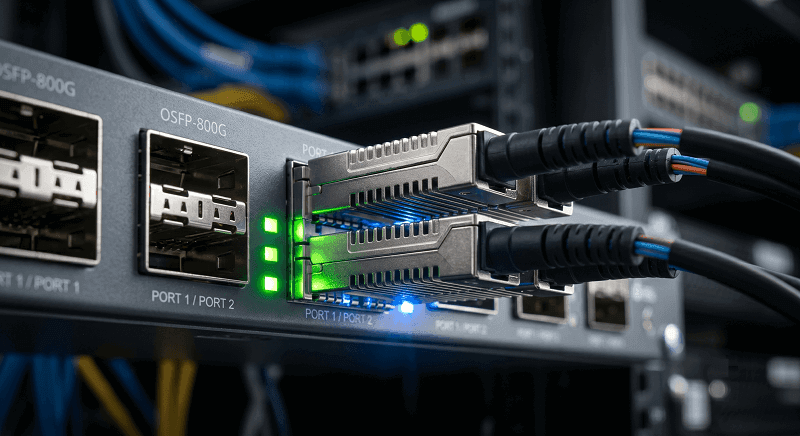
OSFP: Eight lanes at 50 or 100 Gbps. Used on NVIDIA Quantum-2 NDR switches and XDR 800G systems. Larger than QSFP-DD and not mechanically compatible.
This is the detail competitors often skip, and it’s exactly where procurement mistakes happen. A data center manager once ordered 200 QSFP112-to-QSFP112 DACs for a Quantum-2 switch rollout, only to discover the switches needed OSFP. The replacement delay cost them two weeks of cluster availability. Always confirm the switch port form factor before buying cables.
Breakout Cables
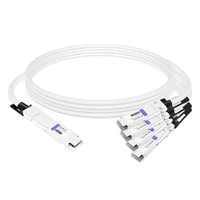
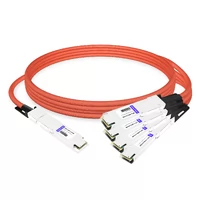
Breakout cables split one high-speed port into multiple lower-speed links. For example, a 400G QSFP112 port can break out to 2x200G QSFP56 or 4x100G QSFP28. Breakouts are essential for fat-tree spine-leaf designs where leaf switches run at lower speed than spine switches.
Distance and Power Considerations
NDR 400G optical modules can draw 12-18 watts each. XDR 800G modules push past 20 watts. At scale, module power becomes a real thermal design constraint. A 64-port XDR switch with fully populated optics can add well over 1,000 watts just from transceivers. Plan switch airflow, rack density, and power allocation accordingly.
NVIDIA InfiniBand Products and Roadmap
NVIDIA owns the modern InfiniBand ecosystem. Understanding the product lineup helps you match hardware to workload.
ConnectX-7 and ConnectX-8
ConnectX-7: Supports NDR 400G InfiniBand and 400G Ethernet. Widely deployed in 2024-2025 AI clusters.
ConnectX-8: Supports XDR 800G InfiniBand and 800G Ethernet. Introduced alongside Quantum-X800. Higher throughput, improved MPI offload, and better power efficiency per bit.
Quantum-2 Switches
Quantum-2 is NVIDIA’s NDR 400G switch platform. A single Quantum-2 QM9700 switch offers 64 ports of 400G, totaling 51.2 Tbps of switching capacity. Quantum-2 supports SHARPv4 for in-network collectives, which is a major reason it performs so well in AI training benchmarks.
Quantum-X800 and XDR
Announced in 2024 and shipping into 2025-2026, Quantum-X800 delivers 800G XDR InfiniBand. It doubles the bandwidth of Quantum-2 and introduces features like adaptive routing and enhanced congestion control for larger, more dynamic AI fabrics. A Quantum-X800 switch typically provides 64 ports of 800G, reaching over 100 Tbps of aggregate capacity.
Quantum-X1600 and ConnectX-9 Roadmap
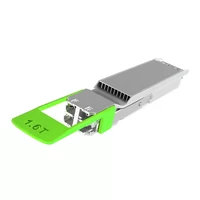
NVIDIA has publicly signaled 1.6 Tbps InfiniBand, sometimes referred to as GDR, for late 2026 or 2027. The Quantum-X1600 switch and ConnectX-9 HCA are expected to use co-packaged optics and larger port radix to push per-port bandwidth to 1.6 Tbps. This generation will likely require new connector standards and tighter integration between switch silicon and optics.
InfiniBand Deployment Checklist
Deploying InfiniBand isn’t like plugging in Ethernet. The fabric needs centralized management, qualified cabling, and validation before production traffic runs.
Pre-Deployment Assessment
Confirm workload latency and bandwidth requirements.
Choose generation: NDR 400G for most new builds, XDR 800G for top-tier AI clusters.
Validate server PCIe slots support HCA bandwidth.
Plan subnet size: remember the ~49,000 endpoint limit per subnet.
Topology Selection
Fat-tree: Most common. Scales well and provides non-blocking bandwidth if oversubscription is managed.
Dragonfly: Used in very large HPC systems. Reduces cable count at the cost of slightly more complex routing.
Torus/mesh: Specialized topologies for specific HPC workloads.
Subnet Manager Setup
Deploy primary and standby Subnet Managers.
Configure virtual lanes and QoS policies.
Set up monitoring for SM health and fabric topology changes.
Cable Qualification
Verify form factors: OSFP vs QSFP112 vs QSFP56.
Test cable compatibility with switch and HCA firmware.
Measure bit error rates before production traffic.
Label cables clearly; InfiniBand topologies get dense fast.
Validation and Burn-In
Run ibdiagnet or ib_write_bw to check fabric health and bandwidth.
Execute MPI or NCCL benchmarks to validate all-reduce performance.
Monitor for packet errors, symbol errors, and thermal issues.
Burn in for 24-72 hours before scheduling production workloads.
Cost and Procurement Considerations
InfiniBand typically costs 20-30% more per port than comparable Ethernet. But the total cost picture is more nuanced.
InfiniBand vs Ethernet TCO
InfiniBand’s higher port cost is partially offset by:
Reduced CPU overhead, meaning fewer cores wasted on networking.
Faster training convergence, improving GPU utilization.
Less operational tuning time compared to RoCEv2.
Better scaling efficiency, so you need fewer GPUs to hit the same model throughput.
For AI training clusters, the improved GPU utilization often dominates the port premium. For general-purpose infrastructure, Ethernet usually wins on TCO.
OEM vs Third-Party Optics
NVIDIA-branded optics and cables work well but carry a significant markup. Third-party MSA-compliant modules from suppliers like FiberMall can reduce cabling costs substantially while maintaining compatibility. The key is qualification: test sample modules in your actual switch and HCA firmware before committing to a large order.
Lead Times
High-speed InfiniBand optics have experienced supply constraints during AI build-outs. NDR and XDR modules can have lead times measured in months during peak demand. Plan procurement early, qualify alternatives, and keep spare cables on hand for the most common failures.
Frequently Asked Questions
What is InfiniBand used for?
InfiniBand is used for high-performance computing, large-scale AI training, low-latency storage, financial trading, and cloud HPC instances where microsecond latency and lossless transport matter.
Is InfiniBand faster than Ethernet?
InfiniBand delivers lower latency, typically under 1.5 microseconds versus 10-100+ microseconds for TCP/IP over Ethernet. Throughput per port is comparable at equivalent generations, but InfiniBand’s RDMA and lossless behavior make it faster for tightly coupled workloads.
Can InfiniBand run over Ethernet?
No. InfiniBand and Ethernet are different protocols. However, RDMA can run over Ethernet using RoCEv2, and InfiniBand HCAs like ConnectX-7 can often run in either InfiniBand or Ethernet mode.
What is the latest InfiniBand generation?
As of 2026, XDR 800G is the latest shipping generation. GDR at 1.6 Tbps is on NVIDIA’s roadmap for late 2026 or 2027.
Do I need InfiniBand for AI training?
Not always. Smaller clusters and less latency-sensitive workloads can use Ethernet or RoCEv2. Large-scale distributed training with thousands of GPUs usually benefits significantly from InfiniBand and GPUDirect RDMA.
How much does InfiniBand cost?
InfiniBand typically costs 20-30% more per port than Ethernet. Third-party compatible optics can reduce cabling costs, and improved GPU utilization often justifies the premium for AI clusters.
What cable does InfiniBand use?
InfiniBand uses DAC, AOC, and optical transceivers with form factors including QSFP56, QSFP112, and OSFP depending on generation.
Is InfiniBand lossless?
Yes. InfiniBand uses credit-based flow control, so senders only transmit when receivers have buffer space. Packets are not dropped due to congestion.
Conclusion
InfiniBand isn’t a niche interconnect anymore. It’s the backbone of the AI training clusters and supercomputers defining what’s possible in 2026. From RDMA and GPUDirect to lossless credit-based flow control and the Subnet Manager, every design choice in InfiniBand serves one goal: moving massive amounts of data with minimal delay and maximum predictability.
If you’re building AI infrastructure, the decision usually comes down to workload fit. Ethernet and RoCEv2 remain excellent for general-purpose data centers. But when training runs stall at 3 AM because gradient synchronization can’t keep up, InfiniBand is the fabric that keeps the GPUs fed.
The next step is matching your generation, topology, and cable plan to your actual cluster design. Get the form factors right, qualify your optics, and validate the fabric before production. If you need MSA-compliant InfiniBand transceivers, cables, and breakout options tested for NVIDIA compatibility, FiberMall can help you spec and source the right parts.
Related Products:
-
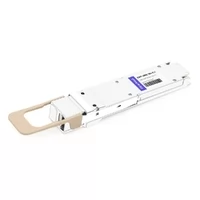
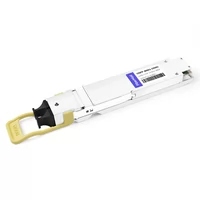
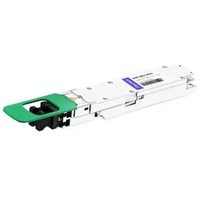
 NVIDIA MMA4Z00-NS400 Compatible 400G OSFP SR4 Flat Top PAM4 850nm 30m on OM3/50m on OM4 MTP/MPO-12 Multimode FEC Optical Transceiver Module
$400.00
NVIDIA MMA4Z00-NS400 Compatible 400G OSFP SR4 Flat Top PAM4 850nm 30m on OM3/50m on OM4 MTP/MPO-12 Multimode FEC Optical Transceiver Module
$400.00
-
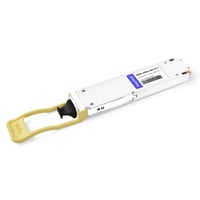
NVIDIA MMS4X00-NS400 Compatible 400G OSFP DR4 Flat Top PAM4 1310nm MTP/MPO-12 500m SMF FEC Optical Transceiver Module
$450.00
-
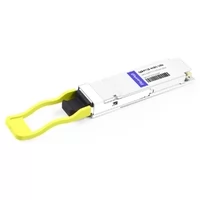
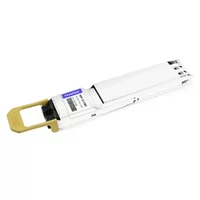
NVIDIA MMA1Z00-NS400 Compatible 400G QSFP112 VR4 PAM4 850nm 50m MTP/MPO-12 OM4 FEC Optical Transceiver Module
$385.00
-
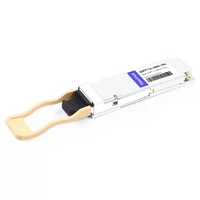
NVIDIA MMS1X00-NS400 Compatible 400G NDR QSFP112 DR4 PAM4 1310nm 500m MPO-12 with FEC Optical Transceiver Module
$500.00
-
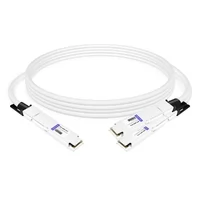
NVIDIA MCP7Y70-H001 Compatible 1m (3ft) 400G Twin-port 2x200G OSFP to 4x100G QSFP56 Passive Breakout Direct Attach Copper Cable
$120.00
-
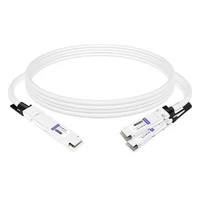
NVIDIA MCP7Y60-H001 Compatible 1m (3ft) 400G OSFP to 2x200G QSFP56 Passive Direct Attach Cable
$99.00
-
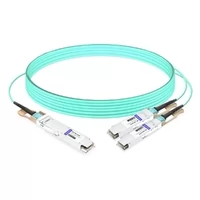
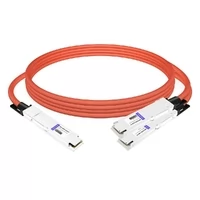
NVIDIA MFA7U10-H003 Compatible 3m (10ft) 400G OSFP to 2x200G QSFP56 twin port HDR Breakout Active Optical Cable
$750.00
-
NVIDIA MMA4Z00-NS Compatible 800GBASE 2 x SR4/SR8 OSFP PAM4 850nm 100m DOM Dual MPO-12 MMF Optical Transceiver Module
$550.00
-
NVIDIA MMA4Z00-NS-FLT Compatible 800GBASE 2 x SR4/SR8 OSFP RHS/Flat Top PAM4 850nm 100m DOM Dual MPO-12 MMF Optical Transceiver Module
$600.00
-
NVIDIA MMS4X00-NM Compatible 800GBASE 2 x DR4/DR8 OSFP IHS/Closed Finned Top PAM4 1310nm 500m DOM Dual MTP/MPO-12 SMF Optical Transceiver Module
$600.00
-
NVIDIA MMS4X00-NM-FLT Compatible 800GBASE 2 x DR4/DR8 OSFP Flat Top PAM4 1310nm 500m DOM Dual MTP/MPO-12 SMF Optical Transceiver Module
$650.00
-
NVIDIA MMS4X50-NM Compatible 800G 2x FR4 OSFP IHS/Closed Finned Top PAM4 1310nm 2km DOM Dual Duplex LC SMF InfiniBand NDR Optical Transceiver Module
$1000.00
-
NVIDIA MCP7Y00-N001 Compatible 1m (3ft) 800Gb Twin-port OSFP to 2x400G OSFP InfiniBand NDR Breakout Direct Attach Copper Cable
$160.00
-
NVIDIA MCA7J60-N004 Compatible 4m (13ft) 800G Twin-port OSFP to 2x400G OSFP InfiniBand NDR Breakout Active Copper Cable
$800.00
-
NVIDIA MMS4A00 (980-9IAH1-00XM00) Compatible 1.6T 2 x DR4/DR8 OSFP224 PAM4 1311nm 500m IHS/Finned Top Dual MPO-12 SMF Optical Transceiver Module
$1500.00
-
NVIDIA MMS4X50-NM Compatible 1.6T 2xFR4/FR8 OSFP224 PAM4 1310nm 2km IHS/Finned Top Dual Duplex LC SMF Optical Transceiver Module
$1800.00
-
NVIDIA MMS4A00-RHS Compatible 1.6T 2xDR4/DR8 OSFP224 PAM4 1311nm 500m RHS/Flat Top Dual MPO-12/APC InfiniBand XDR SMF Optical Transceiver Module
$2000.00
-
NVIDIA MCA7K20-X001 Compatible 1m (3ft) Twin-port 2x800Gb/s OSFP224 IHS/Finned Top to 4x400Gb/s OSFP224 RHS/Flat Top InfiniBand XDR Active Copper Splitter Cable
$2059.00