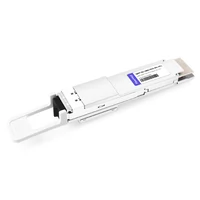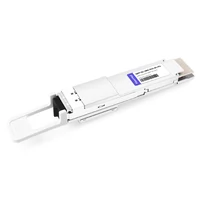

Yet the technology still confuses a lot of network engineers, partly because it gets described in vendor press releases instead of plain engineering terms.
Dana runs networking for a regional cloud provider with three data centers spread across 90 kilometers of dark fiber. Last year, her finance team flagged something they had never questioned before: the transponder shelves between those sites were consuming more than a rack of space and drawing significant power, all to deliver connectivity that had increasingly become a standard part of the network.
When she priced 400G ZR pluggables as an alternative, the economics changed significantly. The dedicated transponder shelves could be removed, the link capacity increased, and the optical transport architecture became considerably simpler.
Her situation is not unusual. Coherent pluggables have moved from a specialized telecom technology into a widely deployed option for data center interconnect (DCI), metro transport, and increasingly regional networking. The market has expanded rapidly over the past several years, and industry forecasts continue to project strong growth as 400G and 800G coherent pluggables gain adoption.
Yet the technology still confuses many network engineers, partly because it is often described through vendor-specific terminology rather than straightforward engineering concepts.
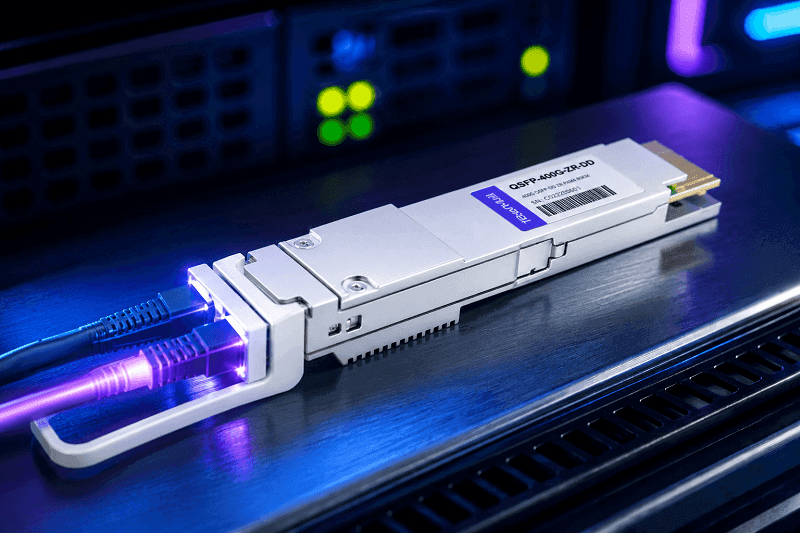
This guide sorts it out. You’ll learn what a coherent optical module actually is, how the detection scheme works under the hood, and how to compare the full family from 100G ZR to 800G ZR+. You’ll also get a practical selection framework and an overview of current pricing considerations, so you can decide whether coherent optics belong in your network and which module best fits your requirements. If you’re newer to optical modules in general, our optical transceiver guide covers the basics first.
If you’re weighing coherent against direct-detect optics for a link that’s on your roadmap, talk to our engineers about which family best fits your distance, capacity, fiber plant, and budget.
What Is a Coherent Optical Module?
A coherent optical module is a pluggable transceiver that encodes information in the amplitude and phase of an optical carrier while using two orthogonal polarization states to increase capacity. A built-in digital signal processor (DSP), together with a coherent receiver, reconstructs the transmitted optical signal and compensates for key transmission impairments. This is why coherent modules can support much longer distances and higher spectral efficiency than conventional intensity-modulated, direct-detection optics.
The word “coherent” comes from the receiver mixing the incoming optical signal with light from a local oscillator laser. This process allows the receiver to recover phase and polarization information in addition to amplitude. Direct-detection receivers, by comparison, primarily detect changes in optical intensity.
The trade-off is complexity, cost, and power. A coherent module contains substantially more optical and electronic processing than a conventional short-reach transceiver.
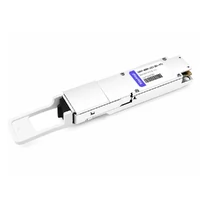
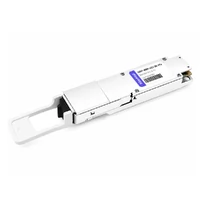
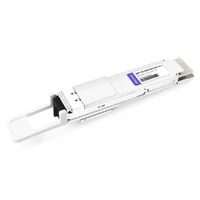
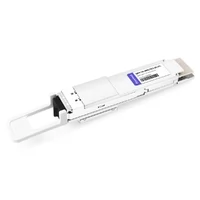
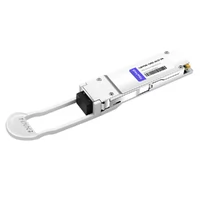
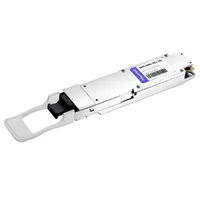
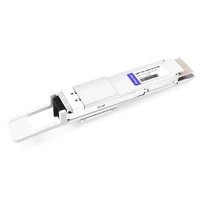
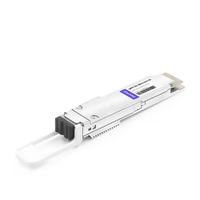
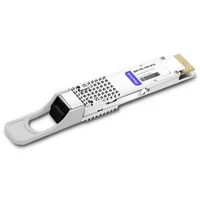
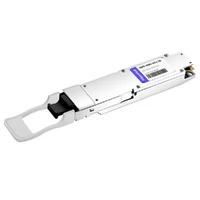
So what does one look like in practice? Coherent modules are available in standard pluggable form factors. Common examples include CFP2-DCO, QSFP-DD, OSFP, and QSFP28 for newer 100G ZR implementations.
They fit into compatible high-speed switch, router, and transport-system ports, but they generally require more electrical power and thermal headroom than conventional direct-detect optics. A 400G ZR QSFP-DD module, for example, commonly operates in roughly the 15–20 W range, while many conventional 100G QSFP28 direct-detection modules consume only a few watts.
The defining feature is the coherent DSP. It performs signal shaping, equalization, forward error correction (FEC), carrier recovery, polarization demultiplexing, and compensation for impairments such as chromatic dispersion (CD) and polarization mode dispersion (PMD).
That digital processing dramatically reduces or eliminates the need for traditional optical dispersion-compensation modules. It does not, however, eliminate fiber attenuation or the need for optical amplification on sufficiently long links.
One clarification helps here. Coherent pluggables are often called DCOs, or digital coherent optics. This distinguishes them from architectures such as analog coherent optics (ACO), where some DSP functionality resides outside the optical module. Modern ZR and ZR+ pluggables are predominantly DCO designs, but coherent optical technology is not universally limited to DCO architectures.
How Does a Coherent Optical Module Work?
The simplest way to picture coherent detection is to compare it to receiving a radio signal using a well-controlled reference oscillator rather than simply detecting whether a signal is present. The optical receiver combines the incoming signal with a locally generated laser signal, allowing it to recover amplitude and phase information across both polarization states.
Direct detection primarily measures optical intensity.
The Components Inside
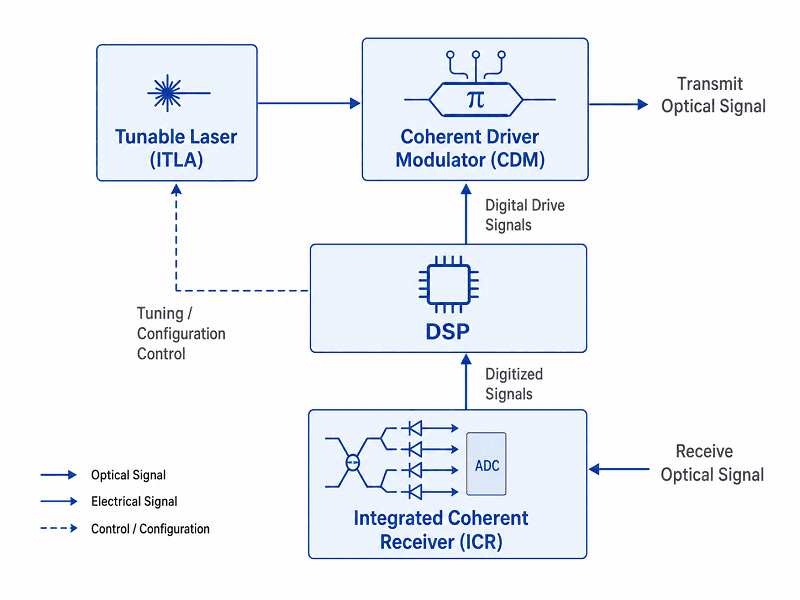
A coherent module has four functional blocks:
- A tunable laser (ITLA) that generates a stable, single-wavelength carrier. C-band tunability is standard, with L-band support appearing in newer 800G parts.
- A coherent driver modulator (CDM) that encodes data onto the light by adjusting its phase and amplitude.
- An integrated coherent receiver (ICR) that mixes the received signal with the local oscillator through a 90-degree optical hybrid and balanced photodetectors.
- The DSP, which does the heavy lifting on both transmit and receive.
Modulation Formats
Coherent modules use advanced modulation to push more bits through each wavelength. QPSK (quadrature phase shift keying) and 16QAM (quadrature amplitude modulation) are the workhorses. Dual-polarization versions, written as DP-QPSK or DP-16QAM, double the rate by encoding data on two orthogonal polarizations simultaneously.
Higher-order modulation like 16QAM packs more bits per symbol but demands better optical signal-to-noise ratio. That trade-off between rate and reach is why the industry publishes rate-reach curves for each module. A module that does 400G over 80 kilometers might do 300G over 150 kilometers on the same hardware.
The DSP: Why It Changed Everything
Before coherent DSPs, engineers compensated fiber dispersion with physical hardware: dispersion compensation fiber, DCM modules, optical filters. Coherent DSPs replace all of that with digital signal processing that runs continuously inside the module.
At the transmitter, the DSP shapes the signal and applies pre-compensation. At the receiver, it equalizes the signal, unwinds chromatic dispersion and PMD, separates the two polarizations, recovers the carrier phase, and applies soft-decision FEC. The practical result is reach measured in hundreds or thousands of kilometers without an amplifier farm in between.
The DSP also makes the module programmable. The same hardware can be configured for different rates and modulation formats, which is exactly what ZR+ and OpenZR+ modules exploit.
Coherent vs Direct Detection (IMDD): What’s Actually Different
Most optical modules in data centers today are intensity-modulated, direct-detection (IMDD) parts. The laser is either on or off, or in the case of PAM4, it carries four intensity levels. That works fine for short reaches. It runs out of steam past roughly 10 kilometers because intensity-only receivers can’t undo fiber impairments.
Coherent detection is dramatically more sensitive. Receiver sensitivity for coherent modules typically lands around -35 to -45 dBm, compared to -18 to -22 dBm for direct detection. That 20 dB advantage translates directly into reach.
| Feature | Coherent Module | Direct-Detection (IMDD) Module |
| Detection | Amplitude + phase + polarization | Intensity only |
| Typical modulation | DP-QPSK, DP-16QAM | NRZ, PAM4 |
| Receiver sensitivity | -35 to -45 dBm | -18 to -22 dBm |
| Typical reach | 80 km to 2,000+ km | 100 m to ~10 km |
| Spectral efficiency | High (1 wavelength = 400G/800G) | Lower (parallel lanes or lambdas) |
| Power per module | 5W to 25W+ | 1W to ~5W |
| Cost per module | Higher | Lower |
The gap in sensitivity is the whole story. Direct detection sees the light, but it can’t tell you the phase or polarization state, so the receiver can’t compensate for what the fiber did to the signal. Coherent receivers reconstruct everything and digitally clean it up.
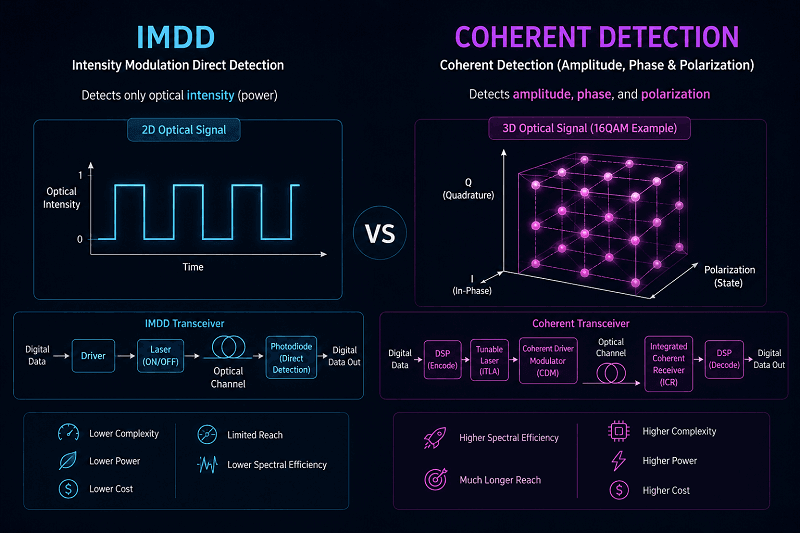
There is a practical nuance. Within a data center, IMDD modules still dominate because reach of 100 meters to 2 kilometers is all you need. Coherent makes sense when you leave the building, connect separate facilities, or transport WDM wavelengths across a metro area. Trying to use coherent modules inside a rack would be wasteful; trying to use PAM4 across a metro link would be impossible.
If you’re comparing specific direct-detect 100G or 400G options for the short-reach side of your network, our QSFP28 transceiver guide and QSFP-DD transceiver guide break down the module types.
Not sure which camp your link falls into? Send us your distances and link budget and the FiberMall engineering team will map them against both module families side by side.
The Coherent Module Family at a Glance
The naming in this space looks intimidating, but the family has a clear logic. Each generation is defined by a rate, a reach, a form factor, and a standard. Here’s the whole family in one table.
| Module | Line Rate | Modulation | Reach (typical) | Form Factor | Power | Standard |
| 100G ZR | 100G | DP-DQPSK | 80 km unamp. / ~300 km amp. | QSFP28 | ~5W | IEEE 100GBASE-ZR |
| 400G ZR | 400G | DP-16QAM | 80-120 km | QSFP-DD, OSFP | 15-20W | OIF 400ZR |
| ZR+ | 100-400G | Flexible | 450-600+ km | QSFP-DD, OSFP | 20-25W | Vendor-defined |
| OpenZR+ | 100-400G | Flexible | 480-1,000+ km | QSFP-DD, OSFP | 20-25W | OpenZR+ MSA |
| 800G ZR | 800G | Flexible / PCS | 80-500 km | OSFP, QSFP-DD | 20-30W | OIF 800ZR |
| 800G ZR+ | 800G | Flexible | Longer-haul | OSFP | 25-30W+ | Vendor / emerging |
A few patterns jump out. Reach grows as you move from standard ZR to the plus variants. Power climbs with rate and reach. And the same physical form factors keep reappearing, which is convenient for port planning.
The rest of this guide walks through each family member, then covers standards, selection, cost, and troubleshooting.
400G ZR: The Workhorse of DCI
If there is one coherent module that changed the market, it’s 400G ZR. The OIF 400ZR implementation agreement standardized a 400G, single-wavelength, pluggable coherent module aimed squarely at data center interconnect. It runs DP-16QAM at about 60 Gbaud with C-band tunability and constant-composition FEC.
The headline number is reach: 80 to 120 kilometers on amplified links, with 40 to 80 kilometers achievable unamplified. That covers the vast majority of metro DCI links, which is why hyperscalers adopted it so quickly. 400ZR is now the most widely deployed coherent technology in history.
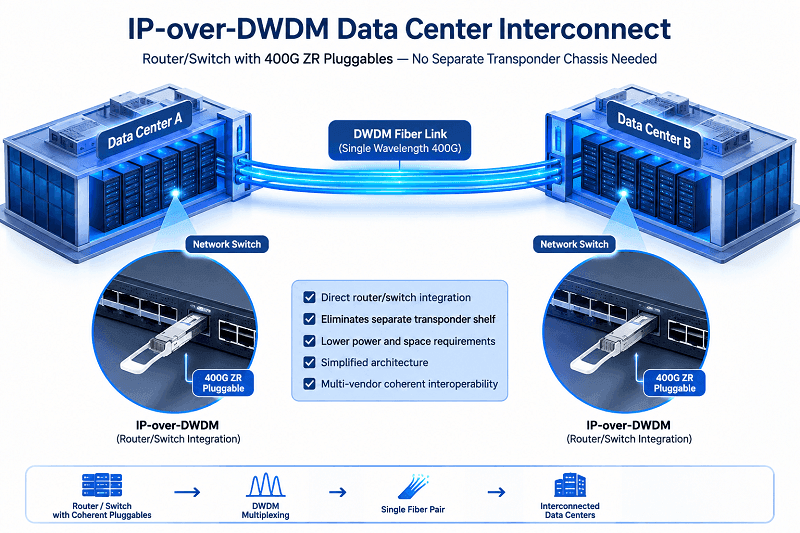
From an operations standpoint, the appeal is that a 400G ZR plugs directly into a QSFP-DD port on a switch or router. No separate transponder chassis. No dedicated optical transport layer.
The switch does IP, and the module handles the DWDM optics. Engineers call this IP-over-DWDM, and it’s the model that killed the transponder shelf for most metro use cases.
Back to Dana. Her three data centers needed 400G between pairs, about 90 kilometers apart, over existing dark fiber. Each pair previously used a 400G transponder shelf with line-side optics.
Swapping to 400G ZR QSFP-DD modules meant two modules per site instead of two full shelves, plus a mux to combine wavelengths. The project paid for itself on power savings alone inside a year.
For the full technical breakdown of the module itself, form factors, and compatibility, the QSFP-DD guide goes deeper on the hardware side.
ZR+ and OpenZR+: When 120 Kilometers Isn’t Enough
400G ZR stops at roughly 120 kilometers. That’s fine for most DCI, but metro and regional networks often need 400 kilometers or more. That’s where ZR+ and OpenZR+ come in.
ZR+ is the generic term for extended-reach 400G pluggables that use stronger forward error correction and more launch power than the OIF 400ZR spec requires. The catch is that ZR+ is vendor-defined. Different vendors implement it differently, so interoperability between vendors is not guaranteed.
OpenZR+ is the multi-source agreement version. It defines flexible line rates from 100G to 400G, OpenFEC, and flexible baud rates, which lets a single module adapt its rate to the reach it needs. A module might run 400G over 200 kilometers and drop to 200G when the link stretches to 700 kilometers.
For network engineers, the practical difference comes down to vendor lock-in. OpenZR+ gives you the option to mix module vendors on an open line system. Vendor-specific ZR+ locks you into a single supplier’s ecosystem, though it can reach further because it’s tuned for one hardware design.
One note on reach numbers: published figures assume clean fiber and proper amplification. Real-world reach depends on fiber age, span losses, and connector hygiene, all of which we’ll touch on in the troubleshooting section.
100G ZR: Coherent Moves to the Edge
Most coverage of coherent optics focuses on 400G and 800G, but 100G ZR quietly opened up a whole new deployment class. IEEE 100GBASE-ZR standardized a 100G coherent module in a QSFP28 form factor, using single-carrier DP-DQPSK and SC-FEC at around 5 watts.
The reach is 80 kilometers unamplified and up to roughly 300 kilometers amplified. For service providers running 10G edge and aggregation networks, that means replacing a 10G link with 100G using the existing fiber plant and existing QSFP28 ports. Ten times the capacity on infrastructure that’s already in the ground.
A mid-size telecom operator we talked to ran exactly this playbook in 2025. Their regional aggregation network carried 10G channels between 40 small sites. They migrated to 100G ZR QSFP28 modules one ring at a time.
Because the modules fit the QSFP28 ports their aggregation routers already had, the hardware cost was limited to the modules themselves. Their total capacity went up 10x, and the per-bit cost dropped sharply.
The catch with 100G ZR is reach and density. It can’t match 400G ZR on throughput per module, and 5 watts in a QSFP28 is at the thermal ceiling for that form factor. Still, for access and edge networks where 100G per wavelength is enough, it’s a low-risk way to bring coherent performance to places that never had it.
The QSFP28 transceiver guide covers the full range of 100G QSFP28 options if you’re comparing coherent ZR against the direct-detect SR4 and LR4 types.
800G ZR / ZR+: Coherent for the AI Era
AI clusters changed the bandwidth math. Training runs now span thousands of GPUs across buildings, and those scale-across links are too long for direct-detect optics but too short to justify traditional transport gear. Coherent 800G ZR fits squarely in that gap.
Shipments tell the story. Industry forecasts expect 800ZR and 800ZR+ ports to exceed 200,000 units in 2026, and 800ZR+ in particular began large-scale rollouts in early 2026 at major hyperscalers. Cignal AI expects 800ZRx growth to outpace every earlier coherent generation.
The technical step forward is 200G-baud-class DSPs and L-band support. An 800G ZR on L-band plus a second on C-band can double a single fiber pair’s capacity from 32 to 64 Tbps. For AI facilities running out of fiber between campuses, that’s a very big deal.
An AI infrastructure lead we spoke with described it bluntly. Their GPU cluster needed 800G links across a 40-kilometer campus interconnection, and the fiber count between the two buildings was fixed. Running 800G ZR on both C-band and L-band wavelengths let them double capacity without pulling new fiber, which was not a realistic option given the trenching cost. The alternative, another transponder shelf pair, would have taken four rack units per site and far more power.
800G ZR ships in OSFP and QSFP-DD form factors, both high-power designs. If you’re planning the mechanical and thermal side of an 800G buildout, the OSFP transceiver guide covers the form factor in detail.
Coherent Module Standards: OIF 400ZR, OpenZR+, OpenROADM & CMIS
Coherent modules live under a stack of standards, and understanding which one applies matters more than memorizing acronyms.
The OIF 400ZR implementation agreement defines the interoperable 400G ZR baseline: DP-16QAM, C-band tuning, fixed FEC, and a defined interface. If two vendors both meet OIF 400ZR, their modules interoperate for the standard 400G ZR profile. OIF 800ZR does the same job for the 800G generation.
OpenZR+ is an MSA that extends the OIF work with flexible rates and OpenFEC, enabling multi-vendor operation over open line systems at extended reaches. It’s the profile to check when you want rate-reach flexibility rather than a fixed 400G.
OpenROADM is a separate MSA focused on the line system itself. It defines open, interoperable DWDM transport components, including transponders and ROADMs, so operators can mix equipment from different vendors in a single network.
CMIS, the Common Management Interface Specification, handles module management. It’s the software layer that lets a switch read telemetry from a coherent module, set the wavelength, configure FEC, and pull diagnostics like pre-FEC BER and OSNR. When someone says “the module isn’t talking to the switch,” it’s usually a CMIS version or power-class mismatch.
A module can meet one standard but not another. An OIF 400ZR-compliant module is not automatically OpenZR+-compatible, even though the hardware looks identical. Check the data sheet against your network’s line system requirements before buying.
How to Choose a Coherent Optical Module
Selection comes down to a decision tree with six steps. Work through them in order and you’ll land on the right module type more often than not.
1. Define the Reach
Start with the longest link you need to support, including margin. Under 120 kilometers, 400G ZR is usually the answer. Between 120 and 500 kilometers, you’re in ZR+ or OpenZR+ territory. Beyond that, look at higher-rate or dedicated long-haul optics, or reconsider whether a transponder shelf is actually warranted.
2. Pick the Line Rate
Match the rate to the switch ports and the bandwidth you need today plus headroom. 100G ZR suits edge and aggregation. 400G ZR is the DCI sweet spot. 800G ZR is for AI scale-across and high-density metro.
3. Check the Fiber Plant
Coherent modules use single-mode fiber with duplex LC or, for some 400G/800G builds, MPO-16 connectivity. Verify your fiber is single-mode, check the link budget, and confirm connector types. The MPO connector guide helps if you’re planning parallel-fiber cabling.
4. Select the Form Factor
Match the form factor to the ports on your switch or router:
- QSFP28 for 100G ZR
- QSFP-DD for 400G ZR, especially if you’re migrating from QSFP28 infrastructure
- OSFP if you need the higher power class for ZR+ or 800G and want thermal headroom
- CFP2-DCO for older telecom chassis

5. Choose the Standard for Interoperability
If you want to mix vendors, require OIF 400ZR or OpenZR+ compliance. If you’re locked into one vendor’s ecosystem, ZR+ is acceptable. Write the required standard into your RFP so you’re not surprised later.
6. Verify Power and Thermal Support
Confirm the port provides the power class your module needs. 400G ZR at 15 to 20 watts needs Power Class 7 or 8 support. 800G ZR at 20 to 30 watts needs even more headroom. A module that exceeds the port’s power class either runs degraded or doesn’t come up at all.
Coherent Module Cost & Pricing (2026)
Coherent modules are not cheap, but their price trends are heading in a predictable direction. The market research firm QYResearch puts the global coherent optical module market at about $6.75 billion in 2026, and pricing pressure on 400G ZR is real.
Realistic price ranges in 2026:
- 400G ZR (QSFP-DD): roughly 400 to 500 per module at bulk scale, but 4,000 to 6,500 when bought individually from online channels
- ZR+ modules: typically 7,500 to 15,000 depending on reach and vendor
- 800G ZR: 8,000 to 16,000+
- 800G ZR+: 12,000 to 20,000+
- Next-gen 1.2T+ coherent: 2,500 to 3,500 at bulk, far higher at retail
The spread between bulk and retail is worth understanding. A hyperscaler negotiating a multi-year supply agreement gets a very different number than an enterprise buying two modules off a website. If you’re planning a coherent deployment, negotiate on volume and commit to a standard that supports multi-vendor sourcing.
Here’s the cost comparison that usually settles the transponder-shelf debate. A pair of 400G ZR modules at bulk pricing might cost $1,000 total. A 400G transponder shelf with optics costs an order of magnitude more, consumes full racks, and draws multiples of the power. For metro DCI, pluggable coherent wins on total cost of ownership almost every time.
ASP for coherent modules declines roughly 15% per year as volumes scale. That means the 800G prices above should look noticeably better by 2028, which is exactly the pattern 400G ZR followed after 2022.
Compatibility & Troubleshooting
Coherent modules fail in predictable ways, and most of them trace back to four causes.
Power class mismatches are the most common. If the switch port is configured for a lower power class than the module requires, the module either reports overcurrent or never initializes. Check the CMIS power-class field in the module EEPROM against the port configuration.
Vendor locking shows up as the dreaded unsupported-transceiver error. On Cisco IOS-XE and NX-OS, the command service unsupported-transceiver allows third-party modules, but it also disables some diagnostics. Arista’s EOS has similar controls. Understand what you give up before you flip it.
CMIS version drift causes mysterious telemetry failures. A module speaking CMIS 4.0 won’t always negotiate cleanly with a host expecting CMIS 5.0. Update switch firmware and verify the module’s CMIS version matches.
Connector contamination remains the leading cause of degraded links, including coherent ones. Coherent receivers are sensitive, but a dirty LC or MPO connector adds insertion loss and reflection that eats into your link budget. A $5 cleaning pen and a scope check can save a weekend.
The diagnostics that matter on a coherent link are pre-FEC BER and OSNR. Pre-FEC BER tells you how much error correction the DSP is consuming. A rising trend means the link is degrading before it fails.
OSNR tells you the signal-to-noise situation at the receiver. If OSNR is low and the module can’t adapt, the link will eventually drop.
The Coherent Roadmap: From 800G to 1.6T+
The direction of travel is clear. 200G-baud lanes are arriving, which is how 800G single-wavelength modules work and how 1.6T will be reached.
Expect 1.6T coherent modules built on 200G-baud-class DSPs to ramp in the late 2020s, initially for hyperscale DCI and AI scale-across.
L-band is becoming standard rather than an afterthought. Pairing C-band and L-band wavelengths effectively doubles fiber capacity, and operators are planning for it now rather than retrofitting later.
The supply chain is the real constraint. Coherent DSPs from suppliers like Marvell and Acacia, plus indium phosphide laser capacity, are the bottleneck. If you’re planning a large coherent deployment, lead times matter. Secure supply agreements early, especially for 800G parts.
CPO, co-packaged optics, gets attention at every conference, but pluggables are not going away. Forecasts still show pluggable coherent optics as the dominant segment for years, with CPO addressing specific AI scale-up niches. If you’re standardizing on pluggable coherent modules now, you’re making a safe bet.
FAQ
What is a coherent optical module?
A coherent optical module is a pluggable transceiver that encodes data on the amplitude, phase, and polarization of light and uses a digital signal processor at the receiver to recover the full optical field. This enables much longer transmission distances and higher spectral efficiency than direct-detection modules.
How does coherent optics work?
Coherent detection mixes the incoming optical signal with a local oscillator laser at the receiver. The mixing recovers amplitude, phase, and polarization information, which a DSP then processes to compensate for fiber impairments like chromatic dispersion and polarization mode dispersion.
Coherent vs DWDM: are they the same thing?
Not quite. DWDM is a technique for carrying many wavelengths on one fiber. Coherent is a modulation and detection scheme.
In practice, coherent modules are usually deployed on DWDM systems, and they combine the two. A 400G ZR module tunes across the C-band, so it’s a coherent module that works within a DWDM grid.
400ZR vs OpenZR+: which should I use?
Use 400ZR when you need standardized, interoperable 400G over 80 to 120 kilometers. Use OpenZR+ when you need flexible rates, longer reach, and multi-vendor sourcing. OpenZR+ costs more and draws more power, but it adapts its rate to the link.
Does 400G ZR need a DWDM mux?
Yes, in most deployments. A 400G ZR module is one wavelength on the C-band. To combine it with other wavelengths onto a shared fiber, you need a DWDM multiplexer. For a single point-to-point link, you can run it on dark fiber without a mux, but you won’t be using the fiber efficiently.
How far can coherent modules transmit?
Standard 400G ZR reaches 80 to 120 kilometers amplified. ZR+ and OpenZR+ reach 450 to 1,000+ kilometers. High-end long-haul coherent transponders reach 2,000+ kilometers, and submarine systems exceed 5,000 kilometers. The exact number depends on modulation format, FEC, and link quality.
What is the power consumption of a 400G ZR module?
A 400G ZR QSFP-DD module typically draws 15 to 20 watts. OSFP variants can run slightly higher to support ZR+ profiles. At those power levels, port-level power-class support becomes a deployment requirement.
Conclusion
Coherent optical modules have moved from specialized telecom gear to the default answer for DCI, metro, and increasingly AI-scale networking. The technology is built on one idea: encode data on phase and polarization as well as intensity, then let a DSP clean up what the fiber did to the signal. That single mechanism explains the sensitivity, reach, and spectral efficiency advantages over direct detection.
The family is simpler than the acronyms suggest.
100G ZR brings coherent to the edge. 400G ZR is the DCI workhorse. ZR+ and OpenZR+ add reach and flexibility. 800G ZR and ZR+ carry the AI era.
Each maps to a form factor, a standard, and a price point, and the decision framework of reach, rate, fiber, form factor, and standard will guide most selections.
If you’re planning a coherent deployment, start with the reach and rate requirements, verify the fiber plant and power budget, and specify the interoperability standard you need. Get those right and the module choice follows.
For help sizing a DCI or metro build, or to talk through the DWDM and transceiver options that fit your network, contact our networking experts. We can help you compare coherent and direct-detect options side by side for your specific distances and budgets. If you already know you need WDM transport, browse our DWDM transceiver lineup to see the short-reach side of the equation.
Related Products:
-
 OSFP-800G-DCO-ZR+-HTx 800G Coherent High TX Power OSFP DCO ZR+ C-band Tunable Optical Transceiver Module
$12000.00
OSFP-800G-DCO-ZR+-HTx 800G Coherent High TX Power OSFP DCO ZR+ C-band Tunable Optical Transceiver Module
$12000.00
-
OSFP-800G-DCO-ZR-HTx 800G Coherent High TX Power OSFP DCO ZR C-band Tunable Optical Transceiver Module
$11000.00
-
QSFP-DD-800G-DCO-ZR+-HTx 800G Coherent High TX Power QSFP-DD DCO ZR+ C-band Tunable Optical Transceiver Module
$12000.00
-
QSFP-DD-800G-DCO-ZR-HTx 800G Coherent High TX Power QSFP-DD DCO ZR C-band Tunable Optical Transceiver Module
$11000.00
-
QSFP-DD-400G-DCO-ZR+-HTx 400G Coherent High TX Power QSFP-DD DCO OpenZR+ C-band Tunable Optical Transceiver Module
$5500.00
-
QSFP-DD-400G-DCO-ZR-HTx 400G Coherent High TX Power QSFP-DD DCO ZR C-band Tunable Optical Transceiver Module
$5200.00
-
QSFP28-100G-DCO-ZR 100G Coherent QSFP28 DCO C-band Tunable Optical Transceiver Module
$3600.00
-
OSFP-400G-DCO-ZR+ 400G Coherent OSFP-DCO ZR+ C-band Tunable Optical Transceiver Module
$7000.00
-
QSFP-DD-400G-DCO-ZR+ 400G Coherent QSFP-DD DCO C-band Tunable Optical Transceiver Module
$4680.00
-
QSFP-DD-400G-DCO-ZR 400G Coherent QSFP-DD DCO C-band Tunable Optical Transceiver Module
$4550.00
-
QSFP-DD-100G-DCO 100G Coherent QSFP-DD DCO C-band Tunable Optical Transceiver Module
$5500.00
-
OSFP-400G-DCO-ZR 400G Coherent OSFP-DCO ZR C-band Tunable Optical Transceiver Module
$7000.00