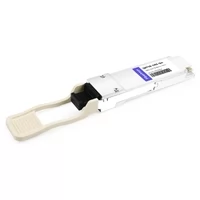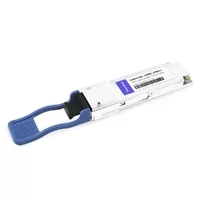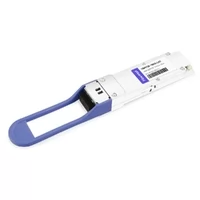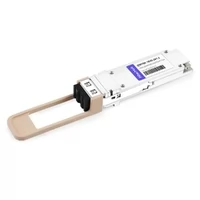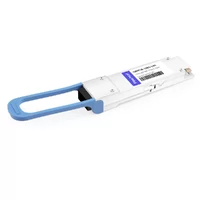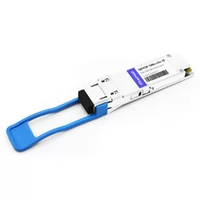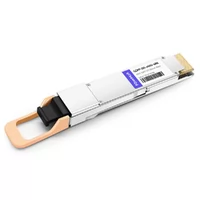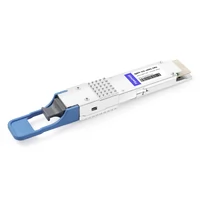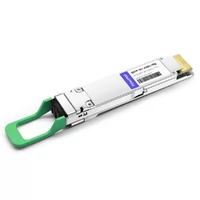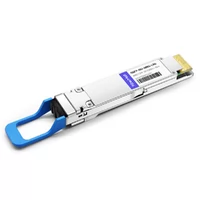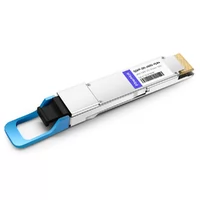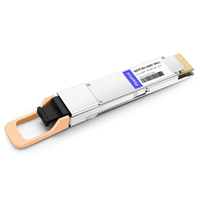

A financial services firm in London had $400,000 worth of QSFP28 optics in service and inventory.
SR4 modules for intra-rack links. LR4 modules for inter-facility connections. CWDM4 modules for the metro ring.
They were running out of bandwidth. They needed 400G. The obvious assumption was to start over: new form factor, new modules, new switches, new everything.
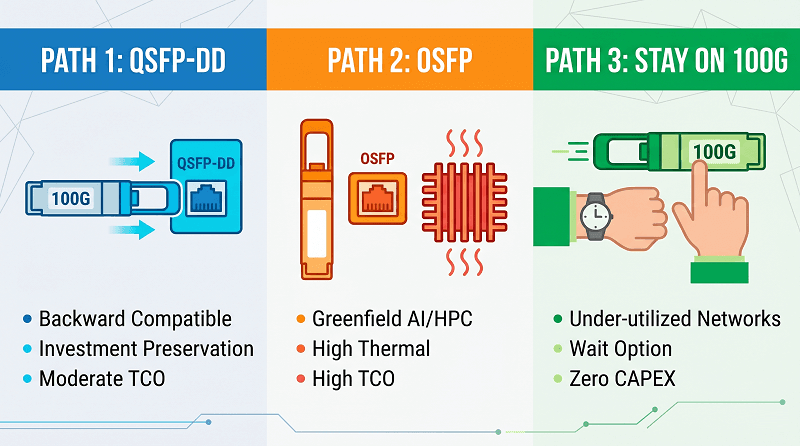
Their network architect pushed back. He chose QSFP-DD switches instead of OSFP. The existing QSFP28 modules slid directly into the new QSFP-DD ports and continued running at 100G.
Over an 18-month rollout, they preserved $340,000 of their optics investment. The only things they replaced were the switches and the spine links that actually needed 400G.
That is the difference between a migration and a rip-and-replace.
Most QSFP28 to 400G migration guides treat this as a technical decision about form factors. It is not. It is a business decision about capital preservation, risk management, and timing.
This guide gives you a phased migration framework with real TCO numbers, a technical readiness checklist, and an honest assessment of when you should stay on 100G. If you’re planning a 100G spine-leaf design today and thinking about tomorrow’s bandwidth, here’s how to get there without writing off your existing investment.
The Three Migration Paths
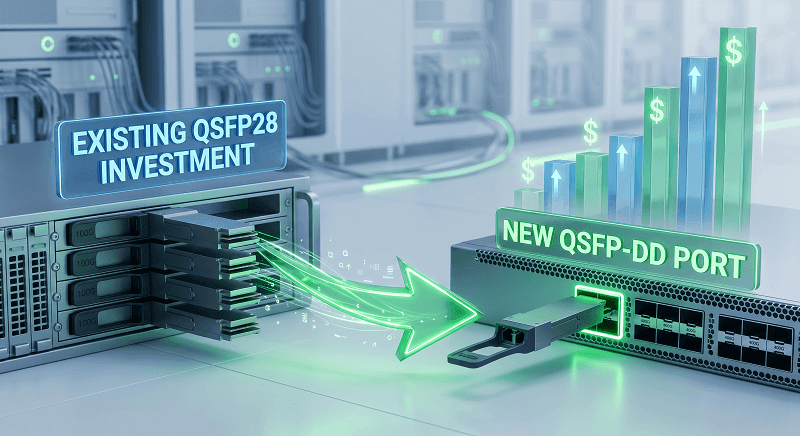
Everyone frames this as QSFP-DD versus OSFP. That is incomplete. There are three paths, and the third one is often ignored because it does not drive an immediate switch refresh.
Path 1 — QSFP-DD (The Brownfield Default)
QSFP-DD is backward compatible with QSFP28 and QSFP+ at the mechanical port level. It preserves the QSFP cage footprint and latch mechanism, while adding a second row of electrical contacts to support eight high-speed lanes instead of four.
What this means practically: your existing QSFP28 SR4, LR4, CWDM4, and DAC modules can plug into a QSFP-DD port and run at their native 100G speed, assuming the switch NOS, port configuration, and vendor coding support them.
No mechanical adapters. No forced optics replacement. But you still need to validate port speed configuration, firmware support, and module coding with your switch vendor.
A native 400G QSFP-DD module commonly uses an 8×50G PAM4 electrical host interface. Depending on the optic type, the optical side may be 8×50G, 4×100G, or another architecture. Typical 400G QSFP-DD optics draw around 10 to 14 watts, depending on reach and module design. That is roughly 2.5x to 3x the power of a 100G QSFP28 module, but it delivers 4x the bandwidth. The power-per-bit math usually works in your favor.
Best for: Organizations with existing QSFP28 infrastructure that want to preserve their optics investment.
Path 2 — OSFP (The Greenfield Choice)
OSFP is a different form factor. It is wider, deeper, and not natively backward compatible with QSFP28. If you choose OSFP, your existing QSFP28 modules cannot be reused directly in OSFP ports. Some platforms may support QSFP-to-OSFP adapters, but that adds cost, mechanical complexity, and vendor-specific validation.
The trade-off is thermal headroom. OSFP provides more physical volume and stronger thermal design margins, which can be valuable for high-power coherent optics and dense AI/HPC deployments. The roadmap also aligns well with 800G and 1.6T platforms.
For greenfield AI training clusters built from scratch, OSFP can make sense.
For brownfield enterprise networks with a large QSFP28 optics base, it is usually the more expensive path.
Best for: Greenfield AI/HPC clusters with no legacy optics investment and specific high-power or future-density requirements.
Path 3 — Stay on QSFP28 (The Wait Option)
It is not the most exciting answer. It is often the right one.
100G is still sufficient for a surprising number of workloads. If your network utilization is under 50%, you are not running AI training clusters, and your existing switches have three years of service life left, waiting is often the financially rational decision.
By the time you actually need 400G, QSFP-DD optics will be cheaper, 800G switching will be more mature, and the economics may be better.
We have seen teams rush into 400G at 35% utilization and spend two years paying for capacity they did not use.
Best for: Under-utilized networks, budget-constrained teams, and stable enterprise workloads.
Migration Path Comparison
| Path | Backward Compatible | Optics Preservation | Switch Premium | Power Per Module | Best For |
| QSFP-DD | Yes | 60-100% | Moderate | 10-14W | Existing QSFP28 infrastructure |
| OSFP | No | 0% | Higher | 16-22W | Greenfield AI clusters |
| Stay on QSFP28 | N/A | 100% | None | 3.5-4.5W | Under-utilized networks |
TCO Analysis — The Real Numbers
The form factor decision is really a TCO decision. Let’s look at actual numbers.
Brownfield Scenario: 100 Racks, 2,000 Ports
This is a mid-size hyperscale deployment. You’ve got a mix of SR4 for intra-rack, LR4 for inter-rack, and CWDM4 for longer reaches.
| Cost Factor | QSFP-DD Path | OSFP Path |
| Existing optics replacement | $0 (preserved) | $1,200,000 (full replacement) |
| Adapter costs for legacy | $0 | 160,000(200-400 x 400 ports) |
| Switch chassis premium | +$180,000 | +$360,000 |
| 3-year power delta | Baseline | +$95,000 |
| Total 3-Year TCO | ~$3.2M | ~$3.86M |
The QSFP-DD path saves roughly $660,000 in a 2,000-port environment. That’s not a marginal difference. At smaller scale the absolute numbers shrink, but the percentage stays similar.
Per-Tbps 3-Year TCO
Normalizing by bandwidth makes the comparison clearer.
| Architecture | 100G QSFP28 | 400G QSFP-DD |
| Transceivers per Tbps | 10 × $8,000 | 3 × $4,500 |
| Switch port allocation | $15,000 | $4,500 |
| Power (3 years) | ~$118 | ~$95 |
| Cabling and patching | ~$2,000 | ~$800 |
| Facility overhead | ~$1,500 | ~$500 |
| Total 3-year TCO | ~$26,618 | ~$10,395 |
A 100G design requires 10 ports per Tbps of raw capacity. A 400G design technically requires 2.5 ports per Tbps, but in real deployments you round up to 3 deployable ports.
The per-Tbps delta is about $16,200. Across a large multi-terabit fabric, that difference can fund a substantial portion of your switch upgrade.
Power Per Bit
QSFP-DD modules draw more power per module. That is true. A 400G QSFP-DD optic may draw 10 to 14 watts, while a 100G QSFP28 optic typically draws around 3.5 to 4.5 watts.
But power per bit tells a different story.
A QSFP28 module delivering 100G at 4W consumes 0.04 watts per Gbps. A QSFP-DD module delivering 400G at 12W consumes 0.03 watts per Gbps.
That is a 25% reduction in watts per Gbps, or about a 33% improvement in Gbps per watt.
More watts per module. Fewer watts per bit.
Here is where teams get caught off guard.
An AI startup in San Francisco built a new training cluster and specified OSFP for everything. Clean slate. No legacy. It seemed logical.
Then they needed to connect that cluster to their existing QSFP28 storage fabric. QSFP-to-OSFP adapters cost $200 to $400 each. With 128 ports needing connectivity, that became a $25,000 to $50,000 surprise.
Greenfield is not always as green as it looks.
The Phased Migration Framework
Big-bang migrations fail. Phased migrations succeed. Here’s a framework that works.
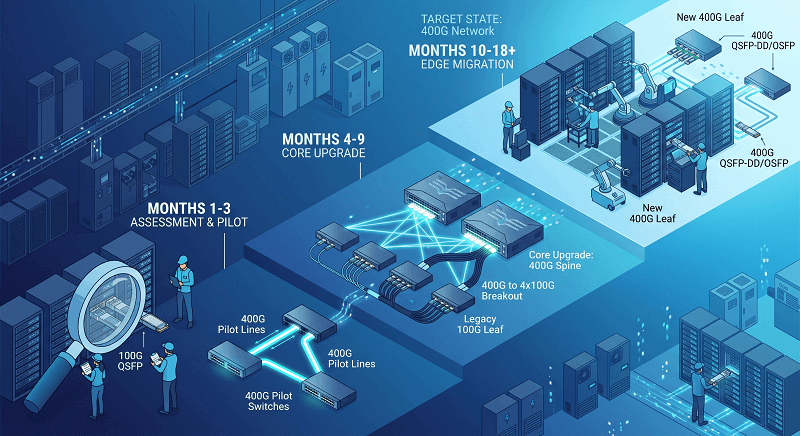
Phase 1: Assessment and Pilot (Months 1-3)
Start with data, not shopping.
Traffic analysis. Are your spine links consistently above 70% utilization during peak hours? If not, you might not need 400G yet. Look at 95th percentile numbers, not averages. We’ve seen teams with 45% average utilization and 85% peak utilization — those peaks are what drive the upgrade decision.
Optics audit. Catalog every QSFP28 module in your environment. Part numbers, vendors, distances, quantities. This inventory is your negotiating asset. Knowing you have $300K in reusable optics changes how you evaluate switch vendors.
Switch evaluation. Can your current leaf switches handle 400G uplinks? Most can’t. But your spine switches might. Some teams can upgrade just the spine layer and leave leaves at 100G for another cycle.
Pilot deployment. Pick one spine pair or one data hall. Deploy QSFP-DD switches, move a subset of traffic, and observe for 30 days. Budget this phase at 10 to 15% of total migration cost.
Phase 2: Core Upgrade (Months 4-9)
This is where most of the work happens.
Deploy QSFP-DD spine switches across your fabric. Upgrade inter-fabric links to 400G where traffic demands it. Keep existing QSFP28 modules running at the leaf level — they work fine in QSFP-DD ports.
For mixed environments, use 400G-to-4x100G breakout AEC cables to connect new 400G spine ports to existing 100G leaf switches. This is your bridge technology. One 400G port feeds four 100G links, letting you maintain connectivity without replacing leaf switches prematurely.
Budget this phase at 50 to 60% of total cost.
Phase 3: Edge Migration (Months 10-18)
Upgrade leaf switches as server NICs transition to 200G or 400G. This phase is driven by server refresh cycles, not network architecture. If your servers still have 25G NICs, there’s no urgent reason to upgrade the leaf.
As you decommission old 100G switches, reclaim the rack space. QSFP-DD switches typically deliver 4x bandwidth in the same footprint, so you’ll free up significant real estate.
Budget this phase at 25 to 35% of total cost.
Go/No-Go Gates
Gate 1: Pilot success rate above 99.9% uptime for 30 consecutive days.
Gate 2: No critical compatibility issues at scale. If your pilot works but your production environment has firmware bugs, stop and fix before proceeding.
Gate 3: Budget variance under 10%. If Phase 1 costs 30% more than planned, something is wrong with your assumptions. Reassess before Phase 2.
Technical Checklist — 10 Things to Validate Before Ordering
Use this checklist before you sign any purchase orders.
- Switch ASIC supports the required 400G electrical interface. Not all switches with QSFP-DD cages support every 400G mode equally. Verify that the ASIC supports the required 8×50G PAM4 or 4×100G PAM4 host interface and the breakout modes you plan to use.
- Chassis thermal design supports 10–14W or higher per 400G port. At full load with 32 or 64 ports, module heat can be substantial. Verify airflow direction, port-side cooling, ambient temperature limits, and rack-level cooling capacity.
- QSFP-DD backward compatibility is verified for your switch vendor. The form factor supports QSFP28 insertion, but vendor implementation matters. Some switches require specific port-speed configuration, firmware versions, or transceiver coding.
- Existing fiber supports the new optic type. 400G SR8 uses MPO-16 APC with 16 total fibers. Your existing MPO-12 trunks used for 100G SR4 will not directly support 400G SR8. 400G FR4 and LR4 generally use duplex LC single-mode fiber, so those links may not require fiber plant changes.
- Power budget accounts for higher per-port power. A fully populated QSFP-DD switch can draw significantly more module power than a QSFP28 equivalent. Check PDU allocations, rack power limits, and redundancy assumptions.
- Cable management handles higher-density fiber and copper. MPO-16 connectors, high-density patching, and 400G breakout cables require careful bend-radius control and labeling. Verify patch panel capacity before the migration starts.
- Management plane supports mixed 100G/400G fabrics. Your orchestration, telemetry, and monitoring tools must handle both speeds in the same fabric without mislabeling ports, thresholds, or link health.
- Monitoring tools support CMIS. QSFP28 modules typically use SFF-8636, while native QSFP-DD modules generally use CMIS. If your monitoring platform only understands SFF-8636, you may lose visibility into DOM, lane-level diagnostics, and module health.
- Spare optics strategy accounts for longer lead times. 400G optics often have longer procurement cycles than mature 100G optics. Stock critical spares early, especially for vendor-coded modules and longer-reach optics.
- Staff are trained on PAM4 troubleshooting. PAM4 has different failure modes from NRZ. FEC behavior, pre-FEC BER, post-FEC BER, signal integrity, lane margining, and module diagnostics require updated operational knowledge. Do not assume 100G troubleshooting experience transfers directly.
Cable Infrastructure Changes
Most migration guides ignore the cabling. That’s a costly oversight.
MPO-12 vs MPO-16. QSFP28 SR4 uses MPO-12 with 4 active fibers. QSFP-DD SR8 uses MPO-16 with 8 active fibers. Your existing MPO-12 trunk cables cannot carry 400G SR8. If you’re standardized on SR4 for intra-data-center, you need new fiber infrastructure for SR8.
Duplex LC stays the same. FR4, LR4, and ER4 still use duplex LC single-mode fiber. If you’re running LR4 for inter-facility links, your fiber plant is probably fine. Just swap the modules.
Fiber count math. A 400G SR8 link needs twice the fiber strands of a 100G SR4 link. If you’re planning a migration across 500 links, that’s a significant increase in fiber consumption. Plan your trunk capacity accordingly.
Breakout strategy. 400G-to-4x100G AEC cables are the unsung hero of mixed migrations. They let you connect a 400G QSFP-DD spine port to four existing 100G QSFP28 leaf ports without replacing either end’s optics. The AEC has a built-in gearbox that converts 8x50G PAM4 to four 4x25G NRZ lanes. At 250 per cable, they’re cheaper than replacing switches.
For detailed cable compatibility requirements, see our QSFP-DD cable compatibility guide.
When to Stay on QSFP28
You probably don’t need to migrate yet.
That’s not what switch vendors want to hear. But it’s often true. Here are the stop signals.
Network utilization consistently under 50%. If you’re not filling your 100G pipes, 400G is just expensive future-proofing that you pay for today.
No AI or ML workloads driving bandwidth growth. Traditional enterprise workloads — web, database, storage — rarely saturate 100G at the access layer.
Budget cycle can’t absorb switch replacement. A phased migration still requires capital. If your budget is locked for 18 months, wait.
Existing switches have 3+ years of useful life. Modern switches are reliable. If your current spine switches are two years old and under warranty, there’s no technical reason to replace them.
Staff lacks PAM4 and CMIS experience. Training takes time. If your team is already stretched thin, adding a new modulation scheme and management interface is risky.
Power and cooling already at rack limits. QSFP-DD increases per-rack thermal load. If you’re already at 80% cooling capacity, migration requires HVAC upgrades too.
A manufacturing company in Germany migrated to 400G at 35% average utilization. Their CIO wanted to be “future-ready.”
They spent $180,000 on new spine switches and optics. Two years later, their utilization had only climbed to 42%. The 100G spine they replaced still had three years of useful life.
Future-ready is good. Premature is expensive.
FAQ
Can I use QSFP28 modules in QSFP-DD ports?
Yes. QSFP-DD is mechanically and electrically backward compatible with QSFP28 and QSFP+. Your existing 100G modules plug in and run at native speed. The QSFP-DD port detects the module type automatically and configures the appropriate lane count.
How long does a typical QSFP28 to 400G migration take?
A phased brownfield migration typically takes 12 to 18 months. Months 1-3 for assessment and pilot, months 4-9 for core spine upgrade, and months 10-18 for edge migration as server NICs transition. Big-bang approaches can compress this to 3-6 months but carry significantly higher risk.
Is OSFP better than QSFP-DD for 400G?
Only for specific scenarios. OSFP has better thermal headroom for ZR+ coherent optics and a cleaner roadmap to 1.6T. But for brownfield deployments with existing QSFP28 infrastructure, OSFP requires complete optics replacement and $200-400 adapters per legacy port. QSFP-DD is the better choice for most organizations migrating from QSFP28.
What is the power consumption difference between QSFP28 and QSFP-DD?
A 100G QSFP28 module draws 3.5 to 4.5 watts. A 400G QSFP-DD module draws 10 to 14 watts. While per-module power increases roughly 3x, the power per Gbps decreases by about 43%. A fully populated 32-port QSFP-DD switch adds approximately 300 to 500 watts compared to a QSFP28 equivalent.
Can I mix 100G and 400G in the same fabric?
Yes, and most migrations do. QSFP-DD switches run existing QSFP28 modules at 100G while new QSFP-DD modules run at 400G. Use 400G-to-4x100G breakout cables to connect 400G spine ports to 100G leaf switches. Mixed fabrics are the norm during migration, not the exception.
Do I need to replace my fiber cables for 400G?
It depends on the optic type. 400G FR4, LR4, and ER4 use duplex LC single-mode fiber, just like their 100G counterparts. No cable changes needed. 400G SR8 uses MPO-16 multimode fiber, which requires new cabling if you’re upgrading from 100G SR4 (MPO-12). Audit your fiber infrastructure before finalizing optic selection.
When should I migrate to 400G instead of waiting for 800G?
Migrate when your 100G links consistently exceed 70% utilization during peak hours, or when new AI/ML workloads require the bandwidth. Don’t migrate just because 400G is available. 800G is still emerging in 2026, with limited switch availability and 50-100% price premiums over 400G. For most organizations, 400G is the right speed for the next 3-5 years.
Key Takeaways
QSFP-DD preserves your optics investment. The $660,000 TCO difference versus OSFP in a 2,000-port environment is real money.
Phased migration over 12-18 months beats big-bang. Pilot, then core, then edge. Each phase has a go/no-go gate.
Validate the 10 technical checkpoints before ordering. ASIC support, thermal capacity, and CMIS monitoring are non-negotiable.
If you’re under 50% utilization, wait. Premature migration wastes capital on capacity you don’t need.
Migration isn’t about buying the newest technology. It’s about moving to the right technology at the right time with the right economics.
Need QSFP-DD modules, breakout cables, or migration planning support? Contact our team — we stock QSFP-DD SR8, FR4, LR4, and ER4 modules coded for Cisco, Arista, Juniper, H3C, and NVIDIA platforms, plus 400G-to-4x100G AEC breakout cables for mixed environments. For a deeper technical background on the destination technology, see our QSFP-DD transceiver guide. For current pricing, check our QSFP-DD price guide. And if you’re still building your 100G foundation, our complete QSFP28 guide covers the starting point.
Related Products:
-
 QSFP28-100G-SR4 100G QSFP28 SR4 850nm 100m MTP/MPO MMF DDM Transceiver Module
$40.00
QSFP28-100G-SR4 100G QSFP28 SR4 850nm 100m MTP/MPO MMF DDM Transceiver Module
$40.00
-
QSFP28-100G-PSM4 100G QSFP28 PSM4 1310nm 500m MTP/MPO SMF DDM Transceiver Module
$180.00
-
QSFP28-100G-LR1 100G QSFP28 Single Lambda LR 1310nm 10km LC SMF with FEC DDM Optical Transceiver
$265.00
-
QSFP28-100G-SR1.2 Single Rate 100G QSFP28 BIDI 850nm & 900nm 100m LC MMF DDM Optical Transceiver
$280.00
-
QSFP28-100G-LR4 100G QSFP28 LR4 1310nm (LAN WDM) 10km LC SMF DDM Transceiver Module
$285.00
-
QSFP28-100G-LR4-20 100G QSFP28 LR4 1310nm LWDM4 20km LC SMF DDM Transceiver Module
$300.00
-
QSFP28-100G-SRBD Dual Rate 40G/100G QSFP28 BIDI 850nm & 900nm 100m LC MMF DDM Optical Transceiver
$449.00
-
QSFP28-100G-BDRX 100G QSFP28 BIDI 850nm & 900nm Only Receiver 100m LC MMF Optical Transceiver
$379.00
-
QSFP-DD-400G-SR8 400G QSFP-DD SR8 PAM4 850nm 100m MTP/MPO OM3 FEC Optical Transceiver Module
$149.00
-
QSFP-DD-400G-DR4 400G QSFP-DD DR4 PAM4 1310nm 500m MTP/MPO SMF FEC Optical Transceiver Module
$400.00
-
QSFP-DD-400G-FR4 400G QSFP-DD FR4 PAM4 CWDM4 2km LC SMF FEC Optical Transceiver Module
$500.00
-
QSFP-DD-400G-LR4 400G QSFP-DD LR4 PAM4 CWDM4 10km LC SMF FEC Optical Transceiver Module
$600.00
-
QSFP-DD-400G-PLR4 400G QSFP-DD PLR4 PAM4 1310nm 10km MTP/MPO-12 SMF FEC Optical Transceiver Module
$750.00
-
QSFP-DD-400G-SR4.2 400Gb/s QSFP-DD SR4 BiDi PAM4 850nm/910nm 100m/150m OM4/OM5 MMF MPO-12 FEC Optical Transceiver Module
$750.00