

- Mia
FiberMall
Answered on 2:46 am
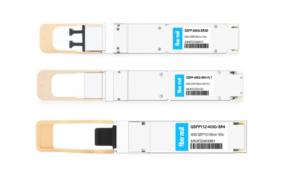
Yes, there are some dual speed 100G/40G optics that can help you avoid costly replacement when you upgrade your network. These optics can operate at either 100G or 40G depending on the mode and configuration of the switch port. They also use the same duplex LC-connectorized multi-mode fiber infrastructure as 10G and 40G optics, so you don’t need to replace your existing fiber cable infrastructure.
The QSFP-100G-CWDM4 (up to 2km over duplex SMF) and QSFP-100G-PSM4 (up to 500m over parallel SMF), are dual-rate optics which be used in both 40G and 100G modes.
People Also Ask
USFP Capacity Explained: From 6.4T to 12.8T AI Fabric Bandwidth
USFP is designed to scale from 6.4T to 12.8T by increasing its electrical lane count while supporting 400 Gb/s per lane. Its first planned transceivers use 16 full-duplex lanes, delivering 6.4 Tb/s of aggregate capacity. The connector architecture is designed to support future expansion to 32 lanes, potentially enabling 12.8
CWDM Complete Guide: Coarse Wavelength Division Multiplexing
Consider an illustrative scenario: a nine-building hospital campus has one spare fiber pair, and a new imaging center is opening in six weeks. Installing additional duct would take eight months. Daniel, the network engineer on the project, needs nine 10G services running over the fiber pair the hospital already owns.
DWDM Troubleshooting: Diagnose by Measurement, Not Guesswork
A link runs clean for two years. Then one Tuesday, two edge channels start throwing errors while the other thirty-eight remain healthy. The amplifier raises an alarm, so someone replaces it. The errors return a week later because the amplifier was never the problem. That sequence is common enough to
400G per Lane: The Next Optical Signaling Generation, Explained
400G per lane refers to a nominal data rate of 400 gigabits per second (Gb/s) carried by a single electrical lane or optical data channel, depending on the interface being discussed. It represents the next step beyond the 200G-per-lane signaling used in 1.6T-class modules. For electrical interfaces, the industry often
400G ZR+ Coherent Transceivers: Why They Overheat Adjacent Ports — and How to Fix It
400G ZR+ coherent transceivers are changing how operators build high-capacity optical networks. By integrating coherent signal processing into compact QSFP-DD and OSFP modules, they enable long-distance 400G connectivity directly from compatible switches and routers, reducing dependence on separate optical transport equipment. But this integration creates a thermal challenge. A conventional
Related Articles

800G SR8 and 400G SR4 Optical Transceiver Modules Compatibility and Interconnection Test Report
Version Change Log Writer V0 Sample Test Cassie Test Purpose Test Objects:800G OSFP SR8/400G OSFP SR4/400G Q112 SR4. By conducting corresponding tests, the test parameters meet the relevant industry standards, and the test modules can be normally used for Nvidia (Mellanox) MQM9790 switch, Nvidia (Mellanox) ConnectX-7 network card and Nvidia (Mellanox) BlueField-3, laying a foundation for
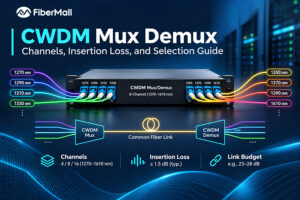
CWDM Mux Demux: Channels, Insertion Loss, and Selection Guide
The 18-channel CWDM mux demux can look like the safest purchase: room to grow, one part number, and no second trip to procurement. Then the link budget arrives. An 18-channel unit may add around 5.0 to 5.4 dB of insertion loss, while an 8-channel unit may add around 2.4 dB.

USFP Capacity Explained: From 6.4T to 12.8T AI Fabric Bandwidth
USFP is designed to scale from 6.4T to 12.8T by increasing its electrical lane count while supporting 400 Gb/s per lane. Its first planned transceivers use 16 full-duplex lanes, delivering 6.4 Tb/s of aggregate capacity. The connector architecture is designed to support future expansion to 32 lanes, potentially enabling 12.8
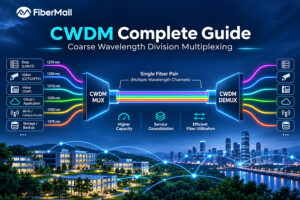
CWDM Complete Guide: Coarse Wavelength Division Multiplexing
Consider an illustrative scenario: a nine-building hospital campus has one spare fiber pair, and a new imaging center is opening in six weeks. Installing additional duct would take eight months. Daniel, the network engineer on the project, needs nine 10G services running over the fiber pair the hospital already owns.
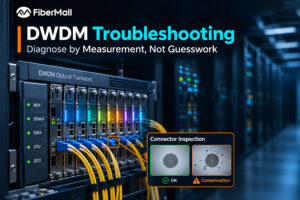
DWDM Troubleshooting: Diagnose by Measurement, Not Guesswork
A link runs clean for two years. Then one Tuesday, two edge channels start throwing errors while the other thirty-eight remain healthy. The amplifier raises an alarm, so someone replaces it. The errors return a week later because the amplifier was never the problem. That sequence is common enough to
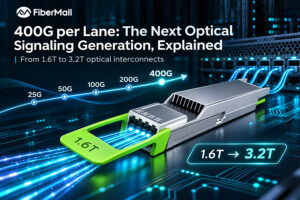
400G per Lane: The Next Optical Signaling Generation, Explained
400G per lane refers to a nominal data rate of 400 gigabits per second (Gb/s) carried by a single electrical lane or optical data channel, depending on the interface being discussed. It represents the next step beyond the 200G-per-lane signaling used in 1.6T-class modules. For electrical interfaces, the industry often
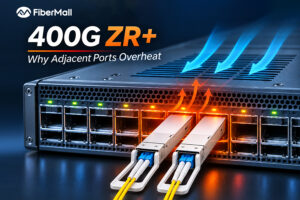
400G ZR+ Coherent Transceivers: Why They Overheat Adjacent Ports — and How to Fix It
400G ZR+ coherent transceivers are changing how operators build high-capacity optical networks. By integrating coherent signal processing into compact QSFP-DD and OSFP modules, they enable long-distance 400G connectivity directly from compatible switches and routers, reducing dependence on separate optical transport equipment. But this integration creates a thermal challenge. A conventional
Related Posts
- Understanding Network Interface: Key Concepts and Importance Explained
- Understanding 10G-PON, XGS-PON, GPON, and 10G-EPON in Passive Optical Networks
- 100G Lambda MSA New Specifications for 20km/30km/40km 100 GbE Unveiled
- Discover the Future of Networking with the Powerful 400GbE Switch.
- Everything You Need to Know About the 100G QSFP28 ER4: The Ultimate Optical Transceiver Module
