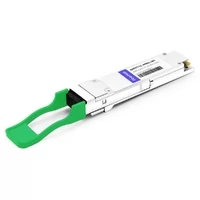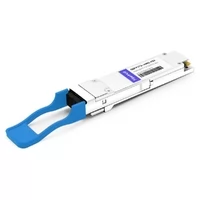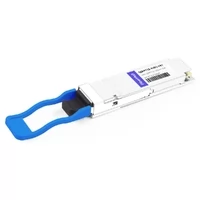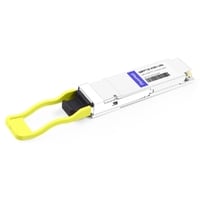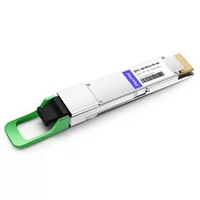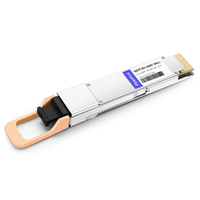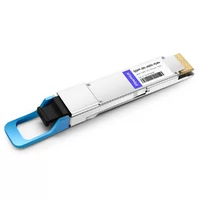

A network architect in Northern Virginia told me his team spent six weeks debating whether their new 400G spine should use QSFP-DD or QSFP112. I asked what finally settled it. He said they realized the decision had almost nothing to do with the optic itself.
That’s the first thing to understand about qsfp-dd vs qsfp112. Both modules deliver 400 Gbps. The real question is which hardware ecosystem you’re buying into. Switch ASICs, power budgets, backward compatibility, and your 800G roadmap all matter more than the headline speed.
In this guide, I’ll compare the two form factors on lane architecture, rack-scale power, migration risk, and vendor support. Then I’ll give you a decision tree that shows which choice fits your deployment. If you already know your switch platform, explore FiberMall’s optical transceiver solutions to compare compatible modules.
Quick reference:
- QSFP-DD: 8 × 50G PAM4 lanes, double-density cage, backward compatible with QSFP28/56, path to 800G.
- QSFP112: 4 × 112G PAM4 lanes, standard QSFP envelope, lower power, no 800G variant.
- The deciding factor: what your switches and NICs already support.
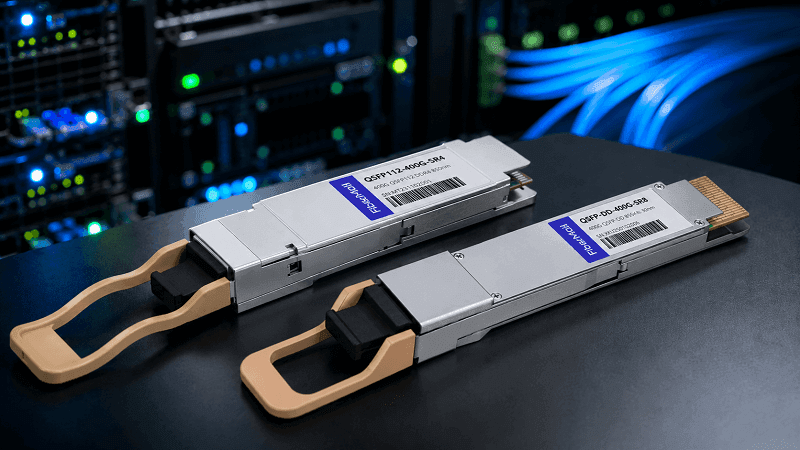
What Is QSFP-DD?
QSFP-DD stands for Quad Small Form-factor Pluggable Double Density. It reaches 400G with eight electrical lanes running 50G PAM4 each.
The double-density part refers to the electrical connector. A QSFP-DD cage has an extra row of contacts behind the standard QSFP footprint. That doubles the lane count without changing the front-panel width.
Key characteristics:
- Lane count: 8 × 50G PAM4 for 400G; 8 × 100G PAM4 for QSFP-DD800.
- Cage depth: Deeper than standard QSFP to accommodate the second row of contacts.
- Signal integrity: Lower per-lane baud rate gives more timing margin.
- Backward compatibility: Most cages electrically accept QSFP28 and QSFP56 modules.
- Upgrade path: Direct route to 800G via QSFP-DD800.
Backward compatibility is the other headline feature. Most QSFP-DD cages can electrically accept QSFP28 and QSFP56 modules. You can stage a migration without replacing every leaf switch on day one. For the full family context, see our guide to the complete QSFP transceiver family.
What Is QSFP112?
QSFP112 stands for Quad Small Form-factor Pluggable 112. It reaches 400G with four electrical lanes at 112G PAM4 each.
Physically, it keeps the same 18.4 × 89.4 × 8.5 mm envelope as QSFP28 and QSFP56. So a QSFP112 transceiver fits into a standard QSFP cage. The difference is entirely electrical.
Key characteristics:
- Lane count: 4 × 112G PAM4 for 400G.
- Envelope: Same as QSFP28/QSFP56, 18.4 × 89.4 × 8.5 mm.
- Host requirement: Switch or NIC ASIC must support 112G PAM4 SerDes.
- Management interface: CMIS 5.0 or 5.2 is typical; verify vendor implementation.
- Upgrade path: None within the same form factor.
The trade-off is concentration. All 400G travels through four high-speed SerDes lanes. That cuts lane count and simplifies PCB routing, but it demands a host ASIC that can run 112G PAM4 signaling and a module with proper equalization and DSP.
QSFP112 is a 400G-only form factor. There’s no 800G variant in the same envelope, so any future bandwidth upgrade means new switch hardware. For module-level detail, read our complete QSFP112 400G guide.
Lane Architecture: 8×50G vs 4×112G
At 400G, the qsfp-dd vs qsfp112 debate is really a choice between two ways to move the same bits.
| Feature | QSFP-DD | QSFP112 |
| Electrical lanes | 8 × 50G PAM4 | 4 × 112G PAM4 |
| Aggregate bandwidth | 400 Gbps | 400 Gbps |
| Per-lane stress | Lower | Higher |
| PCB routing | More traces | Fewer traces |
| Signal integrity margin | Wider | Tighter |
| Power per lane | Lower | Higher |
QSFP-DD spreads the load. More lanes at a lower baud rate means the SerDes has more timing margin and the PCB can tolerate more loss. QSFP112 compresses the load. Fewer lanes at a higher baud rate saves board space but needs better materials, retimers, and equalization.
Both approaches work in production. The engineering question is which one your switch or NIC was designed for.
Power, Heat, and Rack-Scale Economics
Individual module wattage rarely tells the full story. At rack scale, the qsfp-dd vs qsfp112 power gap becomes a thermal and electrical design problem.
A typical qsfp112 transceiver draws 8–12W. A typical qsfp-dd transceiver draws 10–14W. That 2–4W gap per module looks small until you multiply it across a pod.
| Scale | QSFP112 load | QSFP-DD load | Savings |
| 32-port leaf switch | 256–384W | 320–448W | 64W+ |
| 128-port spine layer | 1,024–1,536W | 1,280–1,792W | 256W+ |
| 1,000-port cluster | 8,000–12,000W | 10,000–14,000W | 2,000W+ |
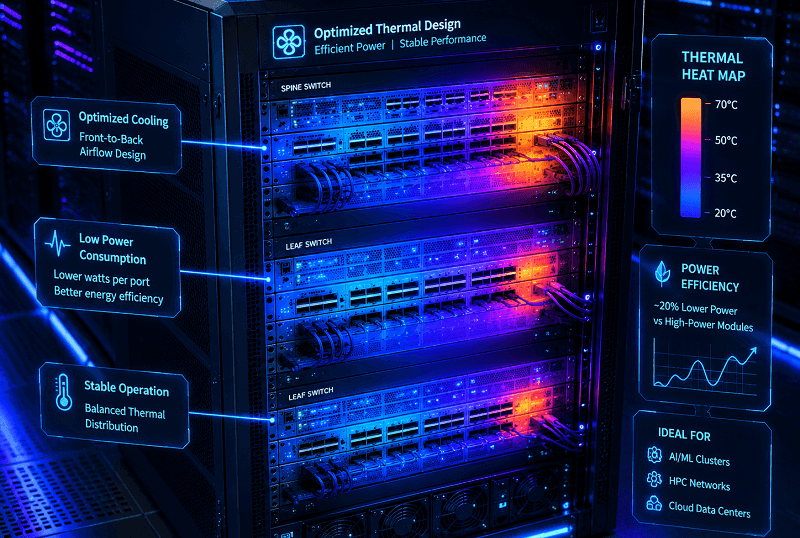
David runs infrastructure for an AI training lab in Phoenix. In early 2026, his team modeled a 1,200-port 400G fabric. Switching from QSFP-DD to QSFP112 cut the optical power budget by about 2.4 kW. At their PUE of 1.35, that saved roughly 3.2 kW of total facility load. It wasn’t the only reason they chose QSFP112, but it gave them headroom to add more GPU racks without expanding cooling.
Those savings are real. Still, they only matter if your hardware can run QSFP112 in the first place.
Backward Compatibility and Cage Lock-In
The compatibility story is where qsfp-dd vs qsfp112 diverges most sharply. Here’s what actually happens when you mix form factors:
- QSFP-DD cage + QSFP28/QSFP56 module: Usually works electrically. The cage accepts standard QSFP modules.
- QSFP-DD cage + QSFP112 module: Physical fit, but electrical operation requires 112G PAM4 host support.
- QSFP112/standard QSFP cage + QSFP112 module: Works only if the host ASIC supports 112G PAM4.
- QSFP112/standard QSFP cage + QSFP-DD module: Won’t fit. The QSFP-DD cage is deeper because of the second row of contacts.
QSFP-DD cages are designed to accept standard QSFP modules electrically. That means a QSFP28 100G module can often run in a QSFP-DD port. The same is true for QSFP56 200G modules. This is a big deal during a brownfield migration.
QSFP112 modules physically fit into a QSFP cage, but they need a host that supports 112G PAM4 signaling. A QSFP28 switch won’t recognize a QSFP112 module. The cage matches, but the electrical interface doesn’t.
You also can’t put a QSFP-DD module into a QSFP112-only port. The QSFP-DD cage is deeper because of the second row of contacts. The module simply won’t seat.
Sarah manages a regional cloud data center in Dallas. In 2025, she refreshed her leaf-spine fabric in two phases. Phase one kept the existing QSFP28 leaf switches and added QSFP-DD spine ports that could accept them. Phase two replaced the leaves with 400G hardware. QSFP-DD made that staged migration possible. QSFP112 would have forced her to swap both layers at once.
The 800G Question
If you think you’ll need 800G within the life of your hardware, the qsfp-dd vs qsfp112 choice gets simpler.
QSFP-DD has a direct path to 800G through QSFP-DD800. It uses the same double-density cage with eight lanes at 100G PAM4. The same switch chassis can often be upgraded with new line cards.
QSFP112 has no 800G roadmap. Once you need more than 400G per port, you’re buying new switches and new NICs. There’s no module swap that gets you there.
That doesn’t make QSFP112 a bad choice. If your servers and storage top out at 400G for the next three to five years, an 800G path might be over-engineering. But if you’re building a spine layer that will outlive your server refresh cycle, QSFP-DD is the safer long-term bet.
Marcus, a procurement lead for a Midwest AI lab, learned this the hard way. His team ordered QSFP-DD switches because the form factor felt like the safe enterprise default. Then they discovered their NVIDIA ConnectX-7 adapters terminated in QSFP112 ports. They could not plug the NICs into the switches. They returned the switches, ate a restocking fee, and bought QSFP112-based hardware instead.
Vendor Ecosystem and Platform Support
Your switch vendor may have already made the qsfp-dd vs qsfp112 decision for you. Platform support breaks down roughly like this:
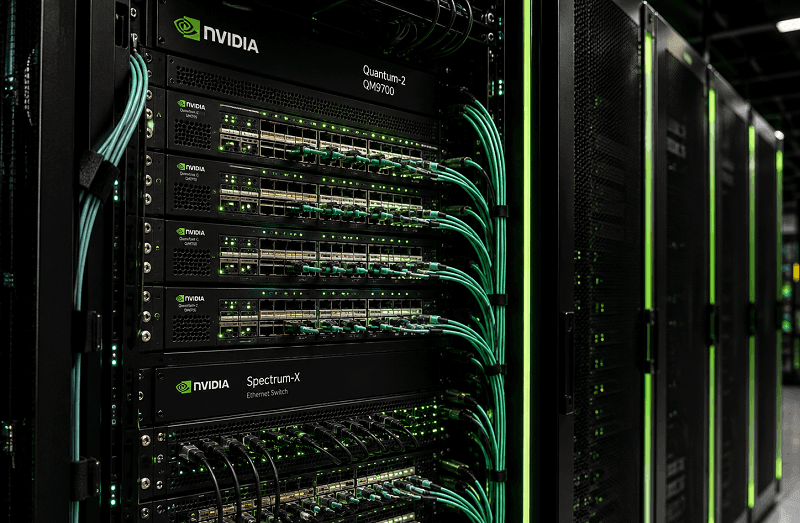
- NVIDIA: QSFP112 is the default for 400G. ConnectX-7 and ConnectX-8 adapters, Spectrum-4 Ethernet switches, and Quantum-2 InfiniBand switches all use the form factor. If you’re building an AI cluster around NVIDIA hardware, QSFP112 is usually the path of least resistance.
- Arista: Supports both. The 7060X5 and 7800R3 series can use QSFP112, and Arista’s broader 400G/800G portfolio leans on QSFP-DD. Their multi-rate ports can often negotiate down to 200G or 100G, which helps in mixed environments.
- Cisco: QSFP-DD across a wide range of Nexus 9000 platforms. QSFP112 support exists on select line cards, but the platform matrix is narrower. Always check the specific line card and supervisor before you order.
- Juniper: QSFP-DD on the PTX10008 and select QFX platforms. QSFP112 support is more limited. If you’re a Juniper shop, verify both the hardware and the JunOS release.
- Third-party MSA modules: Work in most platforms if they implement CMIS correctly. The failure mode we see most often is incomplete digital diagnostic monitoring. A module might link up but fail to report temperature, voltage, or Rx power accurately. That breaks monitoring scripts and creates false alarms.
For a wider view of how QSFP-DD fits against other 400G/800G form factors, see our QSFP-DD vs OSFP vs QSFP56 vs QSFP112 comparison.
How to Choose: Decision Tree
Use this sequence when you are stuck between the two form factors:
1. Are your NICs or switches already fixed as QSFP112-only? Choose QSFP112. The hardware decision comes first.
2. Do you need 800G on the same hardware within three years? Choose QSFP-DD.
3. Are you migrating from QSFP28/56 and want to reuse existing modules? Choose QSFP-DD.
4. Is power or thermal your top constraint? Choose QSFP112.
5. Is this an AI cluster built around NVIDIA adapters? Choose QSFP112.
6. Do you need maximum vendor interoperability? QSFP-DD currently has broader switch support.
The qsfp-dd vs qsfp112 400g decision is not about which module is better. It is about which module matches the hardware you already own and the roadmap you actually plan to follow.
Need help matching modules to your switch platform? Contact our networking experts for a compatibility check before you buy.
FAQ
What does QSFP-DD stand for?
QSFP-DD stands for Quad Small Form-factor Pluggable Double Density.
What does QSFP112 stand for?
QSFP112 stands for Quad Small Form-factor Pluggable 112.
Can a QSFP112 module work in a QSFP-DD port?
Physically, yes. A QSFP112 module can insert into a QSFP-DD cage. Electrically, it only works if the host supports 112G PAM4 lanes. Without that support, the link will not come up.
Can a QSFP-DD module work in a QSFP112 port?
No. The QSFP-DD cage is deeper because of the second row of contacts. A QSFP-DD module will not fit into a standard QSFP112 cage.
Which uses less power, QSFP-DD or QSFP112?
QSFP112 typically uses 2–4W less per module. The gap grows at rack scale.
Is QSFP112 backward compatible with QSFP28?
Only physically. A QSFP112 module fits in a QSFP28 cage, but it will not operate because the switch lacks 112G PAM4 SerDes support.
Which is better for AI clusters?
QSFP112 is usually the better fit for AI clusters built around NVIDIA ConnectX-7/8 adapters and Spectrum-4 or Quantum-2 switches.
Will QSFP112 support 800G?
No. QSFP112 is a 400G-only form factor. For 800G, look at QSFP-DD800 or OSFP.
Conclusion
The qsfp-dd vs qsfp112 choice is a hardware-ecosystem decision first and an optics decision second. QSFP-DD gives you backward compatibility with QSFP28/56 and a path to 800G. QSFP112 gives you lower power, a smaller physical envelope, and a natural fit with NVIDIA’s AI networking stack.
Pick QSFP-DD when you’re upgrading brownfield infrastructure or when you need an 800G roadmap. Pick QSFP112 when you’re building greenfield AI clusters, your NICs already demand it, or power and thermal budgets are tight.
Either way, verify the platform matrix before you place the order. The cheapest mistake in networking is buying the right module for the wrong port. If you’re unsure which form factor your switches actually support, pull the platform datasheet and check the electrical lane speed, not just the cage type.
If you’re ready to source modules, explore FiberMall’s optical transceiver solutions or contact our networking experts for a platform-specific compatibility review.
Related Products:
-
 FiberMall QSFP112-400G-VR4 Compatible 400G QSFP112 VR4 PAM4 850nm 50m MTP/MPO-12 OM4 FEC Optical Transceiver Module
$385.00
-
LQSFP112-400G-FR4 400G LPO QSFP112 FR4 PAM4 CWDM 2km Duplex LC SMF FEC Optical Transceiver Module
$1350.00
-
LQSFP112-400G-DR4 400G LPO QSFP112 DR4 PAM4 1310nm 500m MTP/MPO-12 with KP4 FEC Optical Transceiver Module
$1200.00
-
LQSFP112-400G-SR4 400G LPO QSFP112 SR4 PAM4 850nm 50m MTP/MPO-12 OM3 FEC Optical Transceiver Module
$800.00
-
QSFP112-400G-LR4 400G QSFP112 LR4 PAM4 CWDM 10km Duplex LC SMF FEC Optical Transceiver Module
$1000.00
-
QSFP112-400G-FR4 400G QSFP112 FR4 PAM4 CWDM 2km Duplex LC SMF FEC Optical Transceiver Module
$600.00
-
QSFP112-400G-FR1 4x100G QSFP112 FR1 PAM4 1310nm 2km MTP/MPO-12 SMF FEC Optical Transceiver Module
$800.00
-
QSFP112-400G-DR4 400G QSFP112 DR4 PAM4 1310nm 500m MTP/MPO-12 with KP4 FEC Optical Transceiver Module
$500.00
-
QSFP112-400G-SR4 400G QSFP112 SR4 PAM4 850nm 100m MTP/MPO-12 OM3 FEC Optical Transceiver Module
$400.00
-
QSFP-DD-400G-SR8 400G QSFP-DD SR8 PAM4 850nm 100m MTP/MPO OM3 FEC Optical Transceiver Module
$149.00
-
QSFP-DD-400G-DR4 400G QSFP-DD DR4 PAM4 1310nm 500m MTP/MPO SMF FEC Optical Transceiver Module
$400.00
-
QSFP-DD-400G-VR4 400G QSFP-DD VR4 PAM4 850nm 50m MPO-12 OM4 FEC Optical Transceiver Module
$350.00
-
QSFP-DD-400G-FR4 400G QSFP-DD FR4 PAM4 CWDM4 2km LC SMF FEC Optical Transceiver Module
$500.00
-
QSFP-DD-400G-XDR4 400G QSFP-DD XDR4 PAM4 1310nm 2km MTP/MPO-12 SMF FEC Optical Transceiver Module
$550.00
-
QSFP-DD-400G-SR4 QSFP-DD 400G SR4 PAM4 850nm 100m MTP/MPO-12 OM4 FEC Optical Transceiver Module
$450.00
-
QSFP-DD-400G-LR4 400G QSFP-DD LR4 PAM4 CWDM4 10km LC SMF FEC Optical Transceiver Module
$600.00
-
QDD-4X100G-FR-Si QSFP-DD 4 x100G FR PAM4 1310nm 2km MTP/MPO-12 SMF FEC CMIS3.0 Silicon photonics Optical Transceiver Module
$650.00
-
QDD-4X100G-FR-4Si QSFP-DD 4 x 100G FR PAM4 1310nm 2km MTP/MPO-12 SMF FEC CMIS4.0 Silicon photonics Optical Transceiver Module
$750.00
-
QSFP-DD-400G-SR4.2 400Gb/s QSFP-DD SR4 BiDi PAM4 850nm/910nm 100m/150m OM4/OM5 MMF MPO-12 FEC Optical Transceiver Module
$750.00
-
QSFP-DD-400G-PLR4 400G QSFP-DD PLR4 PAM4 1310nm 10km MTP/MPO-12 SMF FEC Optical Transceiver Module
$750.00