
Marcus, a data center engineer in Frankfurt, watched his 100G spine switch deployment sail through validation. Then facilities called. The rack was drawing 40% more power than budgeted.
He had sized for the switch ASICs and cooling. But he’d treated each QSFP28 module as a rounding error. At 3.5–5.5 W apiece across 32 ports, those “rounding errors” added up to more than a kilowatt. That was the moment he started thinking about qsfp power consumption per gigabit, not just watts per module.

If you’re planning a 40G, 100G, 400G, or 800G deployment, you’ve probably stared at module datasheets and wondered why a 400G QSFP-DD draws three times the power of a 100G QSFP28 while somehow being the better choice. The answer is efficiency. Newer generations move more bits per watt. This guide breaks down qsfp power consumption per gigabit across every major form factor, explains what drives the numbers, and shows how to size a real rack power budget.
Need power-efficient QSFP modules for your next deployment? Explore FiberMall’s optical transceiver solutions or contact our networking experts for a power-budget review.
Why QSFP Power Consumption per Gigabit Beats Total Module Power
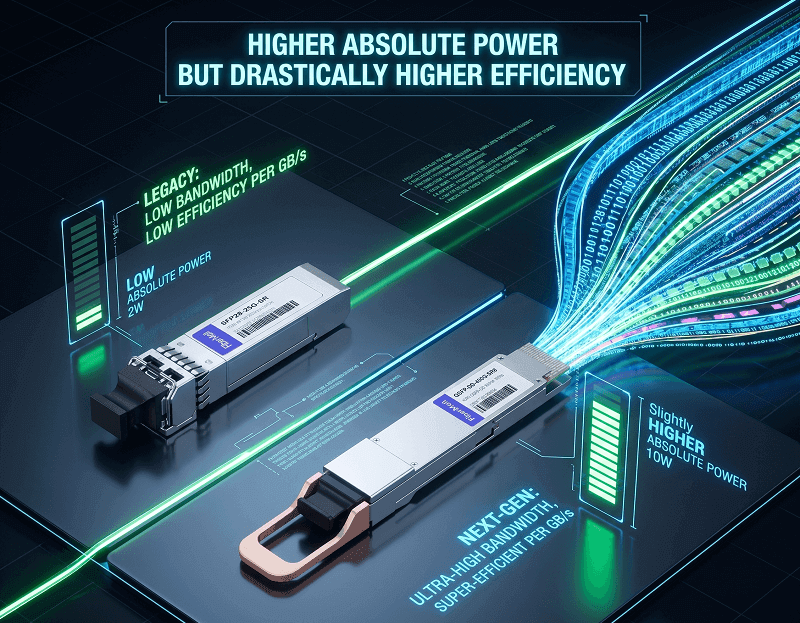
A QSFP+ module might draw 2 W. A QSFP-DD module might draw 12 W. The newer module is clearly hungrier, right? Not when you count bits.
The 40G module delivers 40 Gbps. The 400G module delivers 400 Gbps. On a per-gigabit basis, the newer module often uses half the energy.
Data center power is finite. Rack PDUs, busbars, and facility contracts are sized in kilowatts. If you only look at watts per module, you miss the bandwidth that module provides.
A network architect comparing four 100G QSFP28 modules against one 400G QSFP-DD sees 14–20 W against 7–12 W for the same aggregate bandwidth. That’s not a small difference at scale, and it’s why qsfp power consumption per gigabit matters more than a watts-per-module glance.
The standard metric for this is milliwatts per gigabit (mW/Gbps). Some engineers prefer picojoules per bit (pJ/bit). The two are interchangeable: 1 pJ/bit equals 1 mW/Gbps.
Both normalize power against data rate so you can compare generations fairly. That makes optical transceiver power efficiency a first-class design constraint, not a footnote. MapYourTech covers the pJ/bit metrics and green network design angle in more detail.
QSFP Power Consumption per Gigabit by Generation
QSFP+ (40G): 1.5–3.5 W
QSFP+ was the first widely deployed quad-lane form factor. It packs four 10 Gbps lanes into a single module. Typical qsfp+ power consumption runs 1.5–3.5 W depending on reach. A short-reach SR4 module usually sits at 1.5–2 W, while a long-reach LR4 module can climb to 3–3.5 W.
The per-gigabit math is straightforward. A 2 W, 40 Gbps module consumes about 50 mW/Gbps. That is roughly 50 pJ/bit.
By modern standards, it is the least efficient generation in the QSFP family. Still, for existing 40G leaf-spine networks, it can be perfectly adequate.
QSFP28 (100G): 3.5–5.5 W
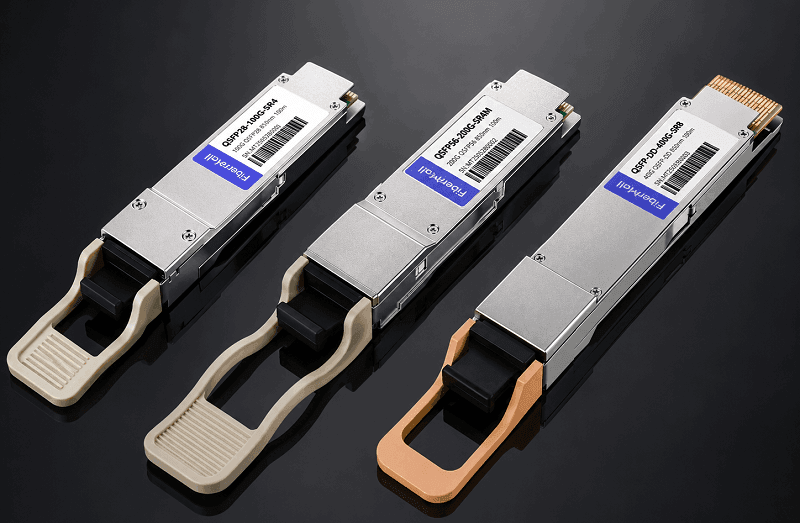
QSFP28 keeps the same 38-pin connector as QSFP+, so it shares the QSFP+ mechanical envelope. It runs each lane at 25 Gbps. The module power jumps, but the data rate jumps more. Typical qsfp28 power consumption is 3.5–5.5 W.
A standard SR4 or LR4 module draws 3.5–4.5 W, and extended-reach ER4 or ZR variants can reach 5.5–6.5 W. For the full host-side pinout, see FiberMall’s QSFP pinout MSA SFF-8436 guide.
Per gigabit, a 4 W QSFP28 module lands around 40 mW/Gbps. That is a solid improvement over QSFP+.
It is also the generation where thermal design starts to matter. A 32-port switch filled with QSFP28 modules can dissipate 120–180 W in optics alone. For a deeper dive into QSFP28 thermal planning, see FiberMall’s QSFP28 power consumption thermal guide.
QSFP56 (200G): 4.5–7.5 W
QSFP56 doubles the lane rate to 50 Gbps using PAM4 modulation. The module needs a DSP for equalization and forward error correction, so absolute power rises. A short-reach SR4 module is usually 4–5 W. Mid- and long-reach variants run 5.5–7.5 W.
On a per-gigabit basis, QSFP56 improves again. A 6 W, 200 Gbps module hits 30 mW/Gbps. That is roughly 25% better than QSFP28.
The catch is heat density. The same faceplate area now dissipates more power, so airflow and heatsink design become critical.
QSFP-DD (400G): 7–15 W
QSFP-DD adds a second row of contacts to support eight lanes. With 50 Gbps PAM4 per lane, it reaches 400 Gbps. qsfp-dd power consumption generally ranges from 7 to 15 W.
Short-reach DR4 modules can be 7–9 W. FR4/LR4 modules typically run 10–12 W. Coherent ZR/ZR+ modules can push 14–18 W. AscentOptics publishes a detailed QSFP-DD power consumption breakdown by reach class.
A 10 W, 400 Gbps module consumes 25 mW/Gbps. That is half the per-bit energy of QSFP28. The absolute module power is higher, but the efficiency story is compelling. For more on how QSFP-DD compares to earlier form factors, read FiberMall’s QSFP-DD vs QSFP28 vs OSFP comparison.
QSFP-DD and OSFP (800G): 12–25 W
800G modules use either QSFP-DD with eight 100 Gbps lanes or OSFP with similar lane counts. Short-reach SR8/DR8 modules are typically 12–16 W. Longer-reach FR8/LR8 and coherent optics can reach 20–28 W. For migration planning, read FiberMall’s 800G QSFP-DD migration guide.
Per gigabit, 800G continues the trend. A 16 W, 800 Gbps module lands at 20 mW/Gbps. That is better than 400G in many cases because the bandwidth doubles faster than the power. The industry target for next-generation 800G silicon photonics modules is below 10 W, which would push efficiency under 12.5 mW/Gbps.
QSFP Power Consumption per Gigabit Comparison Table
| Form Factor | Data Rate | Typical Power | W/Gbps | mW/Gbps | pJ/bit | Common Use Case |
| QSFP+ | 40 Gbps | 1.5–3.5 W | 0.0375–0.0875 | 37.5–87.5 | 37.5–87.5 | Legacy 40G leaf-spine |
| QSFP28 | 100 Gbps | 3.5–5.5 W | 0.035–0.055 | 35–55 | 35–55 | 100G spine, DCI |
| QSFP56 | 200 Gbps | 4.5–7.5 W | 0.0225–0.0375 | 22.5–37.5 | 22.5–37.5 | 200G aggregation |
| QSFP-DD (400G) | 400 Gbps | 7–15 W | 0.0175–0.0375 | 17.5–37.5 | 17.5–37.5 | Hyperscale 400G |
| QSFP-DD/OSFP (800G) | 800 Gbps | 12–25 W | 0.015–0.031 | 15–31 | 15–31 | AI clusters, 800G fabric |
The W/Gbps column expresses qsfp watts per gbps in decimal form. The table reveals the central trend.
Each generation raises absolute module power. It also raises bandwidth faster. The result is lower power per gigabit.
The exact number depends on reach, modulation, and whether the module uses silicon photonics or EML lasers.
What Drives QSFP Power Consumption per Gigabit
Modulation: NRZ vs. PAM4
QSFP+ and QSFP28 use NRZ signaling. Each symbol carries one bit.
QSFP56, QSFP-DD, and 800G modules use PAM4. Each symbol carries two bits.
PAM4 doubles spectral efficiency but needs more complex transmitters, receivers, and DSPs. That complexity adds watts.
DSP and FEC
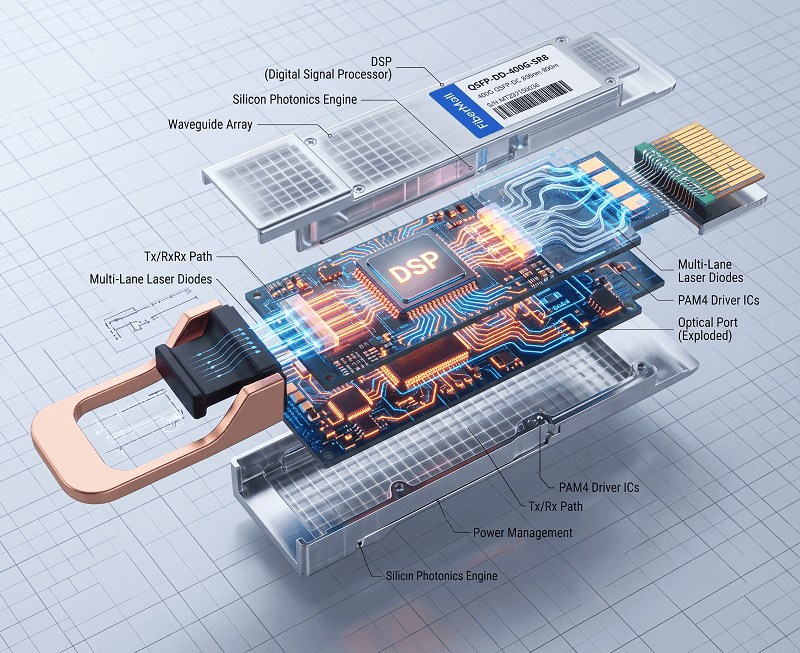
The digital signal processor is often the largest single power consumer in a modern module. It handles equalization, clock recovery, and forward error correction. In coherent 400G ZR modules, the DSP can account for 50–60% of total power. Smaller CMOS nodes help, but DSP power remains the dominant lever.
Reach Class
Short-reach modules use simpler lasers and lower transmit power. Long-reach modules need higher-performance lasers, stronger drivers, and often more DSP compensation. A 400G-DR4 module might draw 8 W. A 400G-ZR coherent module can draw 15–18 W for the same form factor.
Laser Technology
Electro-absorption modulated lasers (EML) have been the workhorse for 100G and 400G. Silicon photonics (SiPh) integrates more functions on a single chip and can cut power by 15–30%. Many next-generation 800G designs are moving to SiPh for exactly this reason.
Temperature
Module power rises with ambient temperature. A QSFP28 module rated at 4 W at 25°C might draw 4.8 W at 70°C. Hot aisles matter.
Poor airflow can push modules past their thermal limits and trigger shutdown or reduced performance. All of these variables feed into qsfp power consumption per gigabit, which is why two modules with the same form factor can report very different power numbers.
Low-Power Alternatives Worth Considering
Not every link needs a full-featured optical transceiver. For short distances, other options can slash power. LINK-PP covers broader data-center strategies to reduce power consumption of optical transceivers.
- Passive DAC. A QSFP28 passive direct attach copper cable draws effectively zero power from the module side. It’s the lowest-power option for rack-top or adjacent-rack connections under 3 meters.
- Active DAC and AOC. Active copper cables draw 1–2 W total. Active optical cables draw 2–4.5 W per end. They cover longer distances than passive DAC while still using far less power than pluggable optics.
- Linear Pluggable Optics (LPO). LPO removes the DSP from the module and relies on the host switch ASIC for signal processing. Early LPO designs claim 30–50% power savings. The trade-off is tighter compatibility requirements and shorter reach.
- Co-Packaged Optics (CPO). CPO places optical engines directly adjacent to the switch ASIC, eliminating the long electrical traces to front-panel ports. The long-term target is 3–7 pJ/bit. It’s not yet mainstream, but it’s the direction the industry is heading for 1.6T and beyond.
Real-World QSFP Power Consumption per Gigabit Rack Budget
Let us compare a 32-port switch filled with different generations. We will assume typical mid-range modules and ignore switch ASIC power to focus on optics.
| Generation | Modules | Power per Module | Total Optics Power | Aggregate Bandwidth | mW/Gbps |
| QSFP28 | 32 | 4.5 W | 144 W | 3.2 Tbps | 45 |
| QSFP56 | 32 | 6 W | 192 W | 6.4 Tbps | 30 |
| QSFP-DD (400G) | 32 | 10 W | 320 W | 12.8 Tbps | 25 |
| QSFP-DD (800G) | 32 | 16 W | 512 W | 25.6 Tbps | 20 |
The QSFP-DD 800G switch draws the most total power, but it moves eight times the bandwidth of the QSFP28 switch. On a per-gigabit basis, it is more than twice as efficient. For a facility manager, the question is not “which module uses the least power?” It is “which delivers the required bandwidth within my power envelope?”
Aisha, a cloud architect in Singapore, faced exactly that question. Her team needed 12.8 Tbps of fabric capacity. They could fill two 32-port QSFP28 switches or one 32-port QSFP-DD switch.
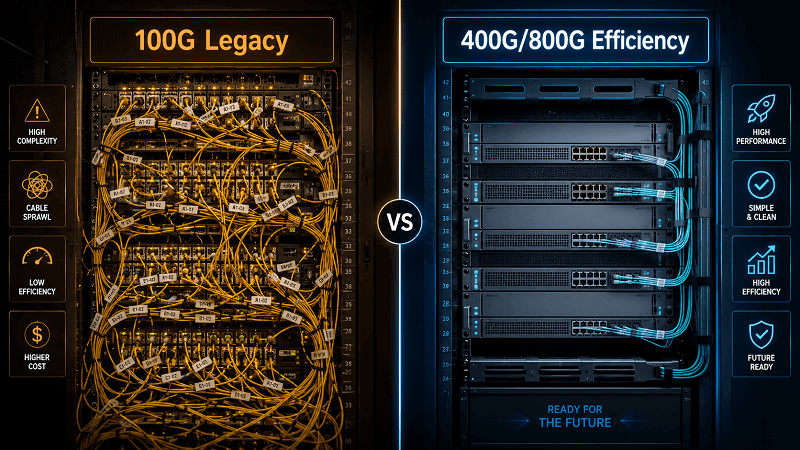
The QSFP-DD option used roughly 30% less rack power and half the switch count. The decision was easy once they normalized for bandwidth.
When Higher Module Power Is Still the Right Choice
Higher absolute power is not always bad. It depends on what you get for it. A 400G coherent QSFP-DD ZR module draws 15–18 W, but it replaces a much larger CFP2-DCO coherent module that might draw 25 W. The smaller form factor saves faceplate space and enables higher density.
Similarly, moving from 100G to 400G can reduce the number of fibers, patch panels, and switch ports. Fewer components often mean less total system power even if each module draws more. System-level efficiency matters more than module-level efficiency.
FAQ
What’s a typical QSFP power consumption per gigabit target?
For new designs, 15–25 mW/Gbps is competitive. Legacy 40G networks often live with 40–80 mW/Gbps. The goal is to minimize this number while meeting reach and reliability requirements.
Why does a 400G module draw more power than a 100G module?
It moves four times the bits. Absolute watts rise, but power per gigabit usually falls. A 10 W 400G module delivers 25 mW/Gbps, while a 4 W 100G module delivers about 40 mW/Gbps.
Does temperature really change QSFP power consumption?
Yes. A module rated at 4 W at 25°C can draw 4.5–5 W at 70°C. Hot spots and poor airflow push devices toward their thermal limits.
Are DAC cables always lower power than optics?
For short links under 3 meters, passive DAC draws almost no power. Active DAC and AOC use more than passive DAC but still less than most pluggable optics.
Is 800G more efficient than 400G per gigabit?
Often yes. A 16 W 800G module hits about 20 mW/Gbps, while a 10 W 400G module hits 25 mW/Gbps. Silicon photonics targets could push 800G below 12.5 mW/Gbps.
Conclusion
The story of qsfp power consumption per gigabit is counterintuitive at first. Each new generation draws more watts per module. It also moves far more bits. The result is steady efficiency gains: from roughly 50 mW/Gbps at 40G, to 35–55 mW/Gbps at 100G, to 15–31 mW/Gbps at 800G.
When you plan a deployment, size for bandwidth first, then normalize by power per gigabit. Consider reach, modulation, DSP, and temperature. Don’t ignore low-power alternatives like DAC, AOC, and LPO for short links. Remember that system-level design often beats module-level comparisons.
If you are sourcing QSFP+, QSFP28, QSFP56, or QSFP-DD modules, explore FiberMall’s optical transceiver solutions or contact our networking experts for a power-budget review before your next upgrade.
Related Products:
-
 QSFP28-100G-SR4 100G QSFP28 SR4 850nm 100m MTP/MPO MMF DDM Transceiver Module
$40.00
-
QSFP28-112G-SR4 112G OTU4 QSFP28 SR4 850nm 100m MTP/MPO MMF DDM Transceiver Module
$50.00
-
H3C QSFP-100G-eSR4-MM850 Compatible 100G QSFP28 eSR4 850nm 200m on OM3/300m on OM4 MTP/MPO MMF DDM Transceiver Module
$75.00
-
QSFP28-100G-IR4 100G QSFP28 IR4 1310nm (CWDM4) 2km LC SMF DDM Transceiver Module
$110.00
-
FiberMall QSFP112-400G-VR4 Compatible 400G QSFP112 VR4 PAM4 850nm 50m MTP/MPO-12 OM4 FEC Optical Transceiver Module
$385.00
-
QSFP112-400G-LR4 400G QSFP112 LR4 PAM4 CWDM 10km Duplex LC SMF FEC Optical Transceiver Module
$1000.00
-
QSFP112-400G-FR4 400G QSFP112 FR4 PAM4 CWDM 2km Duplex LC SMF FEC Optical Transceiver Module
$600.00
-
QSFP112-400G-FR1 4x100G QSFP112 FR1 PAM4 1310nm 2km MTP/MPO-12 SMF FEC Optical Transceiver Module
$800.00
-
QSFP112-400G-DR4 400G QSFP112 DR4 PAM4 1310nm 500m MTP/MPO-12 with KP4 FEC Optical Transceiver Module
$500.00
-
QSFP112-400G-SR4 400G QSFP112 SR4 PAM4 850nm 100m MTP/MPO-12 OM3 FEC Optical Transceiver Module
$400.00
-
OSFP-800G-DR8D-FLT Compatible 800GBASE 2 x DR4/DR8 OSFP Flat Top PAM4 1310nm 500m DOM Dual MTP/MPO-12 SMF Optical Transceiver Module
$650.00
-
OSFP-800G-SR8D-FLT Compatible 800G 2 x SR4/SR8 OSFP RHS/Flat Top PAM4 850nm 100m DOM Dual MPO-12 MMF Optical Transceiver Module
$600.00
-
OSFP-800G-SR8D Compatible 800GBASE 2 x SR4/SR8 OSFP PAM4 850nm 100m DOM Dual MPO-12 MMF Optical Transceiver Module
$550.00
-
OSFP-800G-2FR4L 800G 2 x FR4 OSFP IHS/Closed Finned Top PAM4 1310nm 2km DOM Dual Duplex LC SMF InfiniBand NDR Optical Transceiver Module
$1000.00
-
OSFP-800G-DR8D Compatible 800GBASE 2 x DR4/DR8 OSFP PAM4 1310nm 500m DOM Dual MTP/MPO-12 SMF Optical Transceiver Module
$550.00
-
QSFP-DD-800G-DR8 800G-DR8 QSFP-DD PAM4 1310nm 500m DOM MTP/MPO-16 SMF Optical Transceiver Module
$1000.00