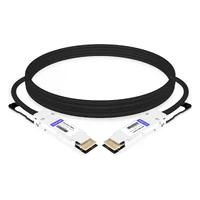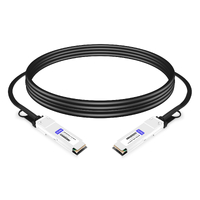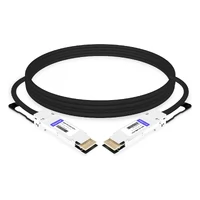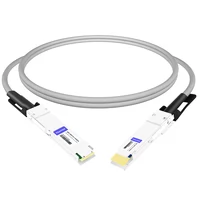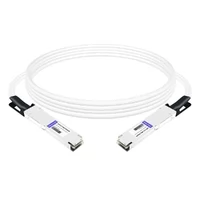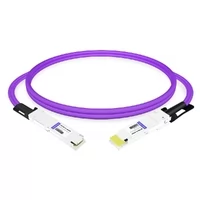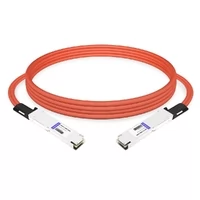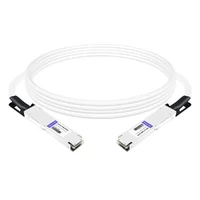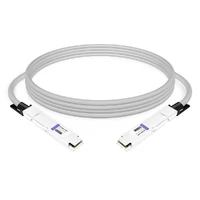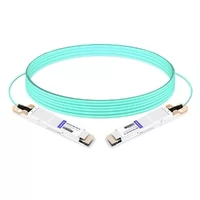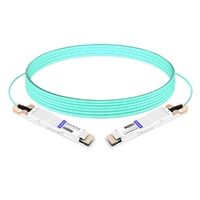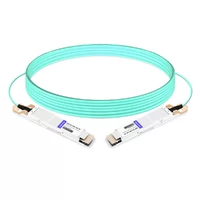

DAC and AOC cables both provide fixed, plug-and-play connections between two ports, but they solve different problems. A DAC (direct attach copper) cable carries electrical signals over twinax copper and offers advantages in cost, power consumption, and latency for short in-rack connections. An AOC (active optical cable) converts electrical signals into optical signals inside the cable assemblies and is better suited for distances of 7 to 100 m, EMI-sensitive environments, and applications requiring thinner, lighter cabling.
The most expensive cabling mistake is rarely the cable itself. It is the rework that follows when a 3 m passive DAC fails to establish a reliable link at 800G.
The old rule—copper for short links and fiber for long ones—was adequate at 10G. It is no longer sufficient at 100G, 400G, or 800G, where passive copper reach decreases as signaling rates increase and active electrical cables (AECs) have become a practical third option.
DAC vs AOC Cable at a Glance
The choice between DAC and AOC comes down to one fundamental trade-off: copper is generally cheaper and more power-efficient over short distances, while fiber offers greater reach, lower weight, and immunity to electromagnetic interference along the optical path.
| Factor | DAC | AOC |
| Medium | Shielded twinax copper | Typically multimode fiber with embedded optical engines |
| Signal path | Electrical end to end | Electrical to optical to electrical |
| Typical reach | About 0.5–7 m passive; 5–15 m active copper, depending on speed and design | About 1–100 m for many data center products |
| Power per end | Negligible signal-path power for passive DAC; generally under 1 W for active DAC; approximately 1–4 W for AEC | About 1–2.5 W at 100G; approximately 7–10 W at 400G and 14–17 W at 800G, depending on product design |
| Relative cost | Lowest | Often several times the cost of an equivalent DAC |
| Latency | Very low, primarily determined by cable propagation | Includes optical-engine processing; additional latency varies by design |
| EMI | Susceptible; requires shielding and appropriate cable routing | Optical transmission path is immune to EMI |
| Weight and bend radius | Generally heavier and stiffer, with a larger bend radius | Generally lighter and thinner, with a smaller bend radius |
| Best use | In-rack, top-of-rack, and short-reach scale-up connections | Inter-rack, row-to-row, and EMI-sensitive connections |
Reach and power consumption vary with data rate, cable construction, and host platform. Use the sections below before specifying a cable.
How DAC and AOC Cables Work
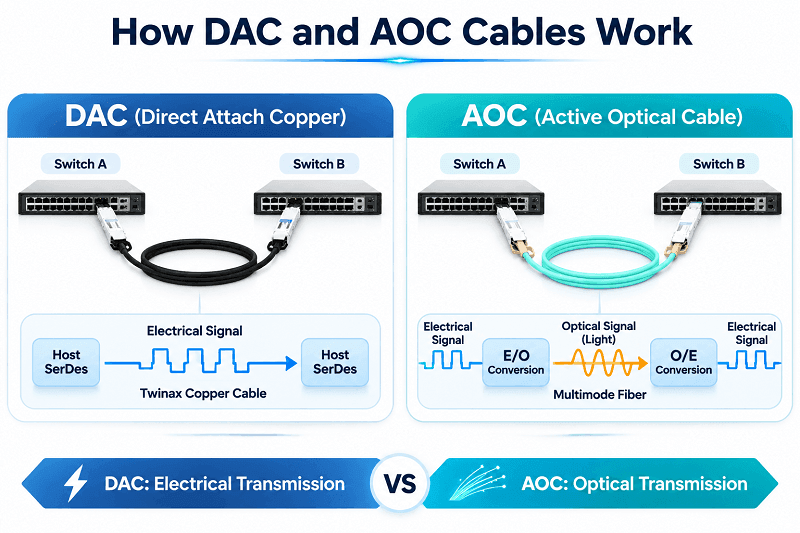
A DAC cable is a shielded twinaxial copper assembly with transceiver-style connectors permanently attached to both ends. The connectors use form factors designed to fit the corresponding cages for SFP+, SFP28, QSFP28, QSFP56, QSFP-DD, or OSFP interfaces. The electrical signal travels directly through the copper conductors, avoiding the optical transmitters and receivers required by optical connections. This reduces component complexity, cost, and power consumption.
Each end typically contains an EEPROM that identifies the cable’s vendor, length, and type, allowing the host to recognize the cable and apply the appropriate signal settings.
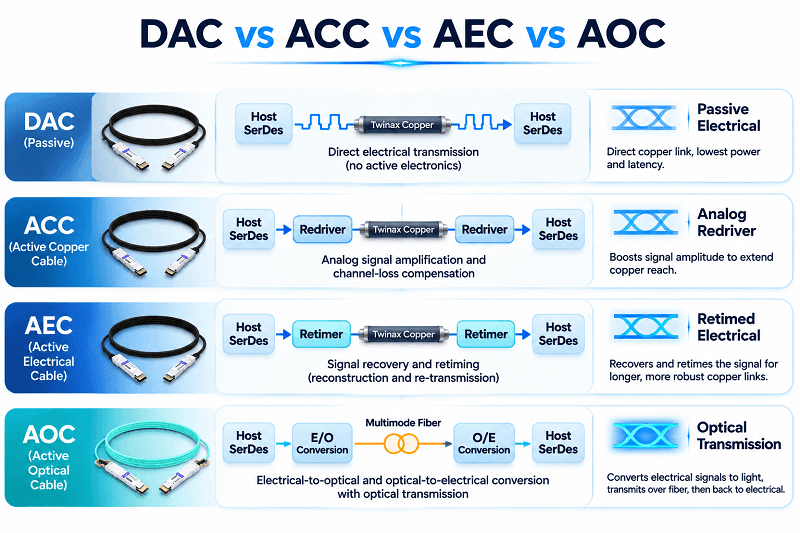
Passive DAC has no signal-conditioning electronics and relies on the host SerDes to drive the electrical signal. Active copper adds a redriver (ACC) or a retimer (AEC) to extend transmission reach. For more details, see FiberMall’s DAC, AOC, and ACC guide.
An AOC looks like a DAC to the switch. Inside each connector shell, an electrical-to-optical engine converts electrical signals into optical signals and transmits them through a fiber bundle. A matching optical-to-electrical engine at the far end converts the light back into electrical signals. Unlike passive DAC, an AOC contains active optical components and requires power from the host at both ends.
This design explains both the advantages and the costs. The optical transmission path is immune to electromagnetic interference, and AOC assemblies can be designed with smaller diameters and tighter bend radii than comparable twinax DACs. The trade-off is a higher purchase price and greater power consumption, especially at 400G and 800G, where optical engines can consume approximately 7–10 W and 14–17 W per end, respectively. Always check the manufacturer’s datasheet because power figures vary by product and speed.
The Five Differences That Matter
1. Distance and Reach
Reach is the first selection criterion, and it is where generic advice often fails. Passive DAC reach decreases as lane rates increase because higher signaling rates are more sensitive to insertion loss and crosstalk in copper channels. The practical planning ranges are approximately:
| Speed | Common form factor | Passive DAC | Active copper (ACC/AEC) | AOC |
| 10G | SFP+ | About 5-7 m | About 7-10 m | 1-100 m |
| 25G | SFP28 | About 3-5 m | About 5-9 m | 1-100 m |
| 40G | QSFP+ | About 5-7 m | About 7-10 m | 1-100 m |
| 100G | QSFP28 | About 3-5 m | About 5-9 m | 1-100 m |
| 200G | QSFP56 | About 2-4 m | About 4-7 m | 1-100 m |
| 400G | QSFP-DD/OSFP | About 2-3 m | About 3-7 m | 1-100 m |
| 800G | QSFP-DD/OSFP | About 1-2 m | About 2-5 m | About 3-100 m |
| 1.6T | OSFP | About 0.5-1 m | About 1-3 m | About 3-100 m |
These figures are indicative planning ranges, not universal specifications. Wire gauge, cable construction, host SerDes quality, connector design, and FEC settings all affect the usable distance. A 26 AWG cable generally reaches farther than a 30 AWG cable at the same speed, but it is thicker and more difficult to route.
AOC covers roughly 1–100 m in many data center applications, with some lower-speed variants reaching up to 300 m. Actual reach depends on the fiber type, optical design, and product specifications. For distances beyond the maximum supported AOC reach, use pluggable optical transceivers and structured fiber cabling.
IEEE 802.3ck-2022 defines Ethernet physical-layer specifications based on 100 Gb/s electrical signaling, including interfaces for 100G, 200G, and 400G Ethernet. As signaling rates increase, higher insertion loss and crosstalk constraints make passive copper cable reach more challenging.
2. Power and Cooling
Power is the second selection criterion, and its impact compounds at scale. A passive DAC consumes negligible power for signal transmission, although its management circuitry may draw a small amount. An active DAC typically consumes less than 1 W per end. AEC typically consumes approximately 1–4 W per end.
AOC power consumption varies significantly by data rate and product design. Typical figures are approximately 1–2.5 W per end at 100G, 7–10 W at 400G, and 14–17 W at 800G.
Consider a 64-port switch fully populated with 800G AOCs. At 17 W per end, the near-side cable ends alone consume approximately 1.1 kW, before accounting for the far-side ends and cooling requirements.
Every watt saved in IT equipment reduces total facility power consumption according to the data center’s Power Usage Effectiveness (PUE). For example, in a facility with a PUE of 1.5, saving 1 W of IT power reduces total facility power consumption by approximately 1.5 W.
That is why AI infrastructure operators use copper wherever the topology allows. It is also why AOC’s reach advantage must justify its additional power consumption and cost on short connections.
3. Cost per Link and Total Cost of Ownership
DAC is typically 60–80% cheaper per link than AOC at the same length, although actual pricing depends on data rate, cable construction, vendor, and compatibility requirements. AOC can cost approximately four times as much as an equivalent DAC assembly.
A pair of optical transceivers plus a separate fiber jumper can cost approximately 4–6 times as much as a DAC assembly, depending on the products selected.
The initial purchase price is only part of the total cost of ownership. Installation time, cable management, power consumption, cooling, maintenance, and replacement costs should also be considered when selecting a cabling solution.
4. Latency
Passive DAC introduces minimal additional processing latency because the electrical signal travels directly through the copper cable without optical conversion. Its main latency contribution is signal propagation through the cable.
AOC requires electrical-to-optical and optical-to-electrical conversion. Its optical engines may also introduce additional signal-processing latency, depending on the internal architecture. DSP-based AOCs can have higher processing latency than simpler implementations.
The exact latency depends on cable length, optical-engine design, DSP architecture, and FEC implementation. Always refer to the manufacturer’s specifications when latency is a critical selection factor.
Both DAC and AOC can provide very low-latency connections compared with the total latency introduced by network processing and switching. Latency becomes a more important selection factor in high-frequency trading, certain HPC fabrics, and tightly coupled AI training environments.
5. EMI, Weight, Bend Radius, and Airflow
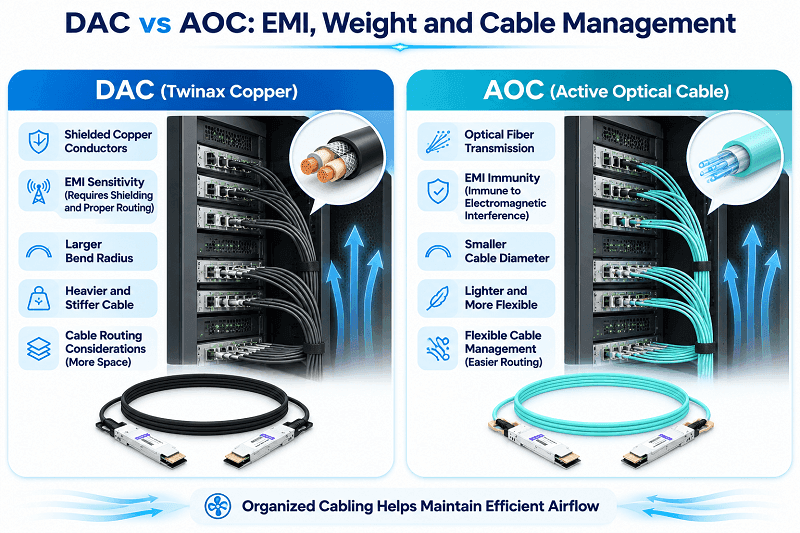
Copper is susceptible to electromagnetic interference and can also generate electromagnetic emissions. Shielding helps control these effects, but routing near power distribution equipment or motors still requires care. Fiber is dielectric, so the optical transmission path in an AOC is immune to EMI.
Weight and bend radius matter more than many comparison tables suggest. AOC assemblies are generally lighter and thinner than comparable DAC assemblies, making them easier to route through dense racks and cable trays.
AOC cables typically have smaller diameters and tighter allowable bend radii than equivalent twinax DAC cables. However, actual dimensions and minimum bend radii depend on cable construction and manufacturer specifications. Always follow the specified minimum bend radius to avoid excessive optical loss or cable damage.
Twinax DAC cables are generally thicker and stiffer, and their bend radius is typically specified as a multiple of the cable diameter. This can make dense cable trays more difficult to manage.
In a fully populated rack, these differences affect airflow, cable management, installation efficiency, and how quickly a technician can replace a connection.
DAC vs AOC vs AEC: The Missing Middle Option
The DAC-versus-AOC comparison overlooks an increasingly important segment of the high-speed cable market. AEC uses retimers, typically located near both ends of the cable, to recover and retime high-speed electrical signals. This allows copper cables to support longer distances, often around 3–7 m, while consuming less power than many AOC solutions over comparable short distances.
ACC is a simpler active copper option. It typically uses analog redrivers to compensate for channel loss and improve signal amplitude without full signal retiming. This can make ACC less expensive, although its ability to compensate for signal degradation is more limited than that of a retimer-based solution.
AEC uses retimers to recover and regenerate signal timing, improving signal integrity over longer copper channels. It generally offers better signal conditioning than ACC, at a higher cost and with potentially higher processing latency.
LightCounting projected the combined AOC, DAC, and AEC market to grow from $1.2 billion in 2023 to $2.8 billion in 2028. In that forecast, AEC was expected to grow at roughly 45% per year, DAC at about 25%, and AOC at about 15%.
Separate industry estimates put the broader high-speed copper cable market near $5 billion in 2026, with AEC accounting for an estimated 35–40%. These figures may use different market definitions and should not be directly compared with the combined AOC, DAC, and AEC forecast above.
That growth reflects a real topology problem: passive copper is too short for many adjacent-rack connections, while AOC can involve more power consumption and cost than necessary for those links. FiberMall’s market forecast tracks the segment split.
When to Use DAC vs AOC (Decision Framework)
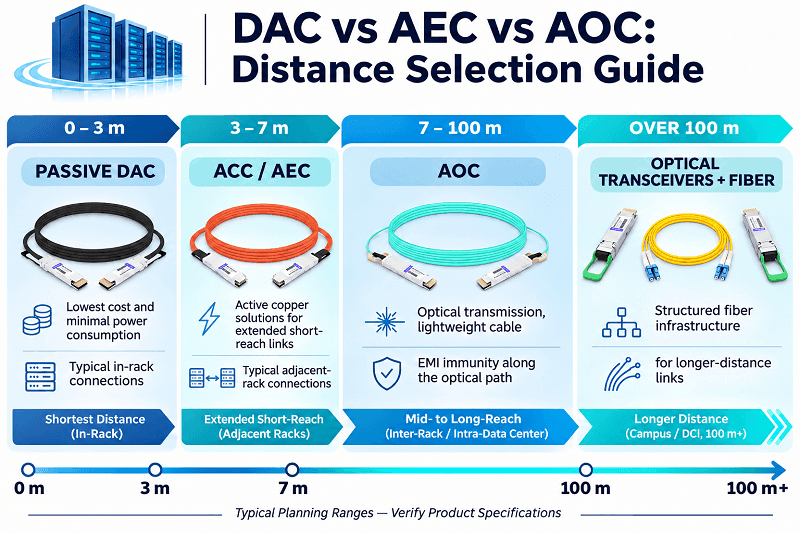
Start with distance, then consider power consumption, cable routing, and diagnostic requirements. The following ranges provide a practical starting point for most data center connections, but actual selection should follow the supported specifications of the host and cable.
| Distance | First Choice | Why |
| 0–3 m | Passive DAC | Lowest cost, negligible power consumption, and minimal additional latency |
| 3–7 m | ACC or AEC | Extends copper reach while maintaining relatively low power consumption |
| 7–100 m | AOC | Lightweight, immune to EMI along the optical path, and suitable for longer connections |
| Over 100 m | Optical transceivers + fiber | Better suited to distances beyond the reach of typical data center AOCs |
These are practical selection guidelines rather than strict technical limits. Some AOCs support shorter distances, while certain active copper products can reach beyond the ranges shown.
AI Factory Topology: Scale-Up vs Scale-Out
AI racks typically divide their cabling requirements into two domains. Scale-up links connect GPUs and switches within the same rack, often using copper backplanes or short active copper cable assemblies. Scale-out links connect racks, rows, and spine layers, where AECs, AOCs, and pluggable optical transceivers are used according to link distance and network architecture.
NVIDIA’s GB200 NVL72 is a clear example. Industry teardowns estimate that each rack uses roughly 5,000 copper cable connections and about two miles of cabling to support its NVLink scale-up architecture. Copper is used because the distances are short and the power budget is tight. Between racks, the same cluster may use AECs, AOCs, or optical transceivers, depending on the required reach and network design. NVIDIA’s networking documentation is the place to confirm cable and transceiver compatibility for a specific platform.
Map your topology before selecting a cable type. A single DAC-or-AOC decision for the entire cluster can result in unnecessary costs on longer links or insufficient reach on shorter ones. For InfiniBand-specific cabling, see FiberMall’s InfiniBand DAC and AOC guide.
Speed-by-Speed Selection
At 10G and 25G, passive DAC covers most in-rack links, and AOC handles runs beyond about 7 m. At 100G, passive DAC is practical to about 3-5 m, so use AEC for 5-7 m and AOC beyond that.
At 200G and 400G, passive copper shrinks to about 2-4 m, and AEC becomes the default for adjacent racks. At 800G and 1.6T, passive DAC is often a 1-2 m in-rack solution, with AEC or AOC for anything longer.
For 100G QSFP28 specifics, see FiberMall’s QSFP28 DAC vs AOC guide. For 400G and 800G QSFP-DD and OSFP builds, the QSFP-DD cable guide covers breakout mappings and length matrices.
- Choose DAC if the link is inside a rack, the run is under 3 m, power and cost matter, and you can fix the length at order time.
- Choose AEC if the link crosses to an adjacent rack, the run is 3-7 m, and you want copper power economics.
- Choose AOC if the run is 7-100 m, the route is congested or EMI-heavy, or you need thinner cable and diagnostics.
Compatibility, Coding, and Troubleshooting
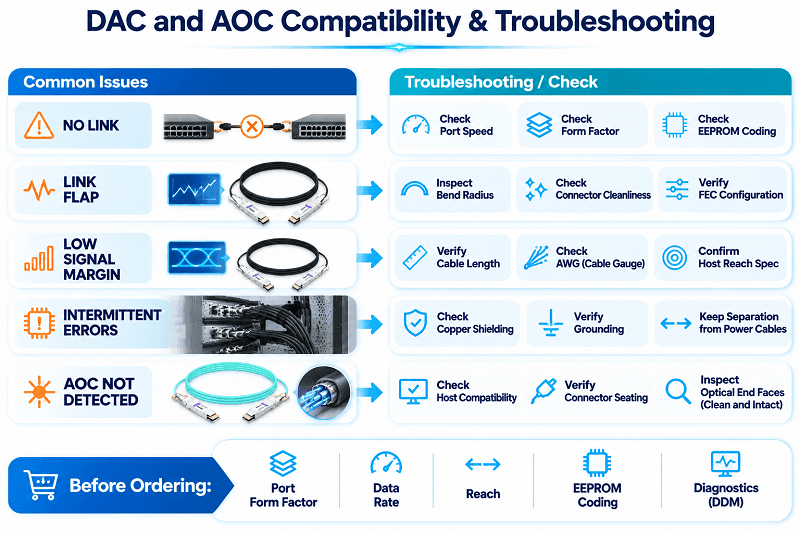
Most DAC and AOC field failures are not cable defects. They are compatibility, coding, or handling problems.
MSA compliance covers the mechanical and electrical interface, but vendors can still enforce EEPROM coding. A cable coded for one switch family may trigger an “unsupported transceiver” error in another, even when the hardware is electrically compatible. Specify the target platform when you order.
Common field issues to check:
- No link: confirm speed and form factor match, then check EEPROM coding.
- Link flap: inspect bend radius, connector cleanliness, and FEC settings.
- Low margin: verify cable length and AWG against the host’s reach specification.
- Intermittent errors: separate copper from power cabling and check shielding.
- AOC not detected: reseat the connector and inspect the fiber end face.
Before you order, confirm five things: port form factor, speed, reach, coding, and whether you need diagnostics. That checklist prevents most returns.
DAC vs AOC Cable FAQ
What is the difference between DAC and AOC cable?
DAC carries electrical signals over twinax copper. AOC converts electrical signals into optical signals inside the cable assemblies using embedded optical engines. DAC is generally cheaper and more power-efficient over short distances, while AOC supports longer reaches and provides immunity to EMI along the optical transmission path.
Is DAC better than AOC?
Neither is universally better. DAC is generally the best choice for in-rack connections under approximately 3 m. AOC is better suited to distances of 7–100 m, dense cable routing, and EMI-sensitive environments. AEC is a practical middle-ground option for many 3–7 m copper connections.
Which is faster, DAC or AOC?
Both can support the same Ethernet line rates when designed for the same data rate and supported by the host platform. The main difference is transmission medium and reach, not nominal line rate. A compatible 400G DAC and a 400G AOC can both deliver 400G, but the DAC typically reaches only about 2–3 m, while some AOCs can reach up to 100 m.
What is the maximum distance for DAC and AOC?
Passive DAC typically reaches about 5–7 m at 10G–40G, 3–5 m at 100G, 2–3 m at 400G, and 1–2 m at 800G. Actual reach depends on cable construction and host specifications.
AOC typically reaches 1–100 m in many data center applications, although some lower-speed variants can support longer distances. Beyond the maximum supported AOC reach, use optical transceivers and structured fiber cabling.
Can I use AOC instead of DAC?
Yes, provided the port form factor, data rate, EEPROM coding, and host platform compatibility match. AOC can work at short distances, but it generally costs more and consumes more power than passive DAC. Use it when longer reach, EMI immunity, or improved cable management justifies the additional cost.
Which should I use for 100G, 400G, or 800G?
For 100G, use passive DAC for in-rack connections up to approximately 3 m. Consider ACC or AEC for longer copper connections and AOC for distances beyond approximately 7 m.
For 400G, passive DAC is generally suitable for short connections of about 2–3 m. AEC can extend copper reach, while AOC is suitable for longer connections.
For 800G, passive DAC is typically limited to approximately 1–2 m. Use AEC for supported short-reach copper connections and AOC for longer links. At 800G and 1.6T, always verify the exact reach, power consumption, and compatibility against the cable manufacturer’s datasheet and the switch specifications.
Related Products:
-
 QDD-200G-PC50CM 0.5m (1.6ft) 200G QSFP-DD to QSFP-DD Passive Direct Attach Copper Twinax Cable
$45.00
-
QSFP56-200G-PC50CM 0.5m (1.6ft) 200G QSFP56 to QSFP56 PAM4 Passive Direct Attach Copper Twinax Cable
$45.00
-
QSFPDD-400G-PC50CM 0.5m (1.6ft) 400G QSFP-DD to QSFP-DD PAM4 Passive Direct Attach Copper Twinax Cable
$70.00
-
QSFP-DD-400G-AC3M 3m (10ft) 400G QSFP-DD to QSFP-DD PAM4 Active Direct Attach Copper Twinax Cable
$350.00
-
QDD-OSFP-FLT-PC50CM 0.5m (1.6ft) 400G QSFP-DD to OSFP Flat Top PAM4 Passive Direct Attached Cable
$154.00
-
OSFP-FLT-400G-PC50CM 0.5m (1.6ft) 400G NDR OSFP to OSFP PAM4 Passive Direct Attached Cable, Flat top on one end and Flat top on other
$110.00
-
QDD-OSFP-FLT-AEC50CM 0.5m (1.6ft) 400G QSFP-DD to OSFP Flat Top PAM4 Active Electrical Copper Cable
$1200.00
-
OSFP-FLT-800G-AC3M 3m (10ft) 800G Twin-port 2x400G OSFP to 2x400G OSFP InfiniBand NDR Active Copper Cable, Flat top on one end and Flat top on the other
$600.00
-
OSFP-FLT-800G-PC2M 2m (7ft) 2x400G OSFP to 2x400G OSFP PAM4 InfiniBand NDR Passive Direct Attached Cable, Flat top on one end and Flat top on the other
$300.00
-
OSFP-800G-PC50CM 0.5m (1.6ft) 800G Twin-port 2x400G OSFP to 2x400G OSFP InfiniBand NDR Passive Direct Attach Copper Cable
$105.00
-
QSFP-DD-200G-AOC-1M 1m (3ft) 200G QSFP-DD to QSFP-DD Active Optical Cable
$560.00
-
QSFP-DD-200G-AOC-2M 2m (7ft) 200G QSFP-DD to QSFP-DD Active Optical Cable
$563.00
-
QSFP-DD-400G-AOC-3M 3m (10ft) 400G QSFP-DD to QSFP-DD Active Optical Cable
$466.00
-
QSFP-DD-400G-AOC-5M 5m (16ft) 400G QSFP-DD to QSFP-DD Active Optical Cable
$472.00
-
QSFP-DD-800G-AOC-25M 25m (82ft) 800G QSFP-DD to QSFP-DD Active Optical Cable
$2805.00
-
QSFP-DD-800G-AOC-20M 20m (66ft) 800G QSFP-DD to QSFP-DD Active Optical Cable
$2790.00