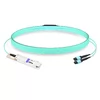
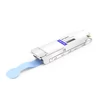
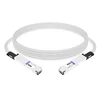
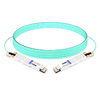
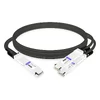
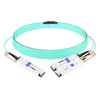
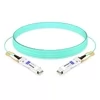
Ordering the wrong 10G SFP+ DAC cable does not show up as a big line item. It shows up as intermittent link flaps, CRC errors, and a troubleshooting ticket that burns a whole afternoon. The cable looked right, but the EEPROM was coded for a different switch family, the gauge was too thin for the length, or the passive design was asked to carry a signal farther than it could reliably.
What a 10G SFP+ DAC Cable Actually Delivers
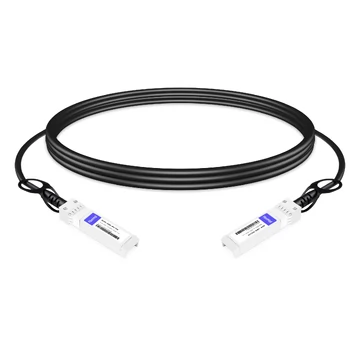
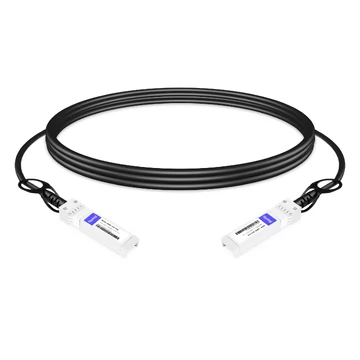
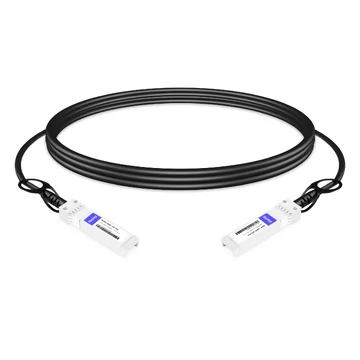
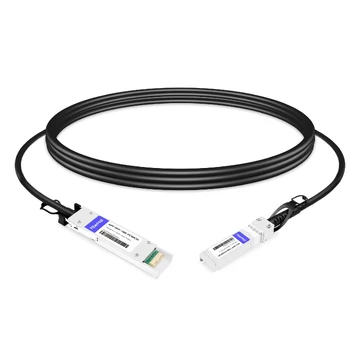
A 10G SFP+ DAC (Direct Attach Copper) cable is a fixed twinax copper assembly with SFP+ connectors on both ends. It carries one 10 Gbps lane directly between two SFP+ ports without separate transceivers or fiber patch cords. For short-reach links, it is the lowest-cost, lowest-latency, and lowest-power option in the data center.
FiberMall's 10G SFP+ cable portfolio covers the two deployment types you actually need:
SFP+ to SFP+ passive DAC — same-rack or adjacent-rack links, typically 0.5M to 7M
SFP+ to SFP+ active DAC — longer copper runs where passive signal integrity would fail, typically 3M to 10M
Every design complies with SFP+ MSA, SFF-8431, SFF-8432, and IEEE 802.3 industry standards for 10GbE. We also support 1G/10G multi-rate operation, where your switch allows it.
Passive DAC vs Active DAC: Which One Do You Need?
This is the decision that separates a clean deployment from a support call. Passive cables are simpler and cheaper, but they cannot carry a signal as far. Active cables add signal conditioning, extending reach at the cost of slightly higher power and price.
Here is a breakdown of their key differences:
Signal conditioning: Passive DACs have none. Active DACs feature a built-in equalizer and retimer.
Typical reach: Passive DACs are best for 0.5M to 7M. Active DACs cover 3M to 10M.
Power draw: Passive DACs are extremely efficient at < 0.15W. Active DACs typically draw ~0.5W to 1W.
Latency: Passive DACs add virtually no delay (< 1 ns). Active DACs introduce a slight delay (~5 ns to 15 ns).
Best use case: Use passive for in-rack or adjacent-rack links, and active for longer inter-rack copper runs.
Relative cost: Passive DACs are the lowest cost option, while active DACs are moderately higher.
Cable gauge: Passive DACs range from 30 AWG to 24 AWG. Active DACs typically use 26 AWG to 24 AWG.
Rule of thumb for 10G:
0.5M – 3M in the same rack → passive DAC, usually 30 AWG
3M – 5M across adjacent racks → passive DAC with 28 AWG or 26 AWG
5M – 7M → passive DAC with 26 AWG or 24 AWG, or active DAC for extra margin
7M – 10M → active DAC only
Beyond 10M → use AOC or fiber transceivers
Length, AWG, and Signal Integrity: A Practical Guide
American Wire Gauge (AWG) controls copper thickness. Thicker wire has lower insertion loss and supports longer reach, but it is less flexible and takes up more space in cable managers.
For 10G SFP+ DAC cables, use this mapping:
0.5M – 1M: Use 30 AWG (Passive DAC) for top-of-rack switch to server connections.
1M – 3M: Use 30 AWG or 28 AWG (Passive DAC) for same-rack or adjacent-rack links.
3M – 5M: Use 28 AWG or 26 AWG (Passive DAC) for end-of-row or cross-rack connections.
5M – 7M: Use 26 AWG or 24 AWG (Passive / Active DAC) for longer copper runs.
7M – 10M: Use 26 AWG or 24 AWG (Active DAC) for row-to-row or extended copper reach.
At 10G, 30 AWG copper works well for short runs, but signal integrity becomes marginal past 3M. If your deployment uses 5M or longer passive cables, choose 26 AWG or 24 AWG to keep insertion loss within IEEE specifications.
OEM Compatibility Without the OEM Price
Third-party 10G SFP+ DAC cables work with Cisco, HPE/Aruba, Juniper, Dell, Arista, Mellanox/NVIDIA, Fortinet, Ubiquiti, and other major platforms when they are correctly coded. FiberMall programs the EEPROM on each cable to match the OEM part number your switch expects.
Supported compatibility targets include:
Cisco: SFP-H10GB-CU1M, SFP-H10GB-CU1.5M, SFP-H10GB-CU2M, SFP-H10GB-CU3M, SFP-H10GB-CU5M, SFP-H10GB-CU7M
HPE / Aruba: J9281B/D (1M), J9283B/D (3M), J9285B/D (5M), J9286B (10M active)
Juniper: EX-SFP-10GE-DAC-1M, EX-SFP-10GE-DAC-3M, QFX-SFP-DAC-1M
Dell: 470-ABDR, 470-ABJB, 470-AAVH series
Arista: CAB-SFP-SFP-1M, CAB-SFP-SFP-3M, CAB-SFP-SFP-5M
Mellanox/NVIDIA: MCP21J3-X001A, MCP21J3-X003A
Fortinet: FS-TRAN-SFP+ series equivalents
Ubiquiti / MikroTik / Intel / Supermicro: multi-vendor MSA options available
Certifications and Testing That Matter
Data center buyers should not have to take compatibility on faith. FiberMall validates every 10G SFP+ DAC cable through:
Interoperability testing on live switches from Cisco, HPE/Aruba, Juniper, Dell, Arista, and Mellanox
Bit-error-rate (BER) validation to confirm signal integrity at rated distance
EEPROM coding verification to ensure the switch recognizes the cable correctly
Visual and mechanical inspection for connector finish, pull-tab integrity, and jacket uniformity
When to Consider 10G AOC or Fiber Instead
DAC cables are the right choice for short-reach copper connections. For longer distances or environments with high electromagnetic interference, fiber becomes the better option. FiberMall also supplies 10G SFP+ AOC and 10G SFP+ transceivers for those scenarios.
Use this decision framework:
0.5M – 3M, clean cable route → Passive DAC
3M – 7M, copper preferred → Passive DAC with thicker gauge, or Active DAC
7M – 10M → Active DAC
10M – 100M → AOC
Beyond 100M or outdoor plant → Fiber transceivers with structured cabling
FAQ
What is a 10G SFP+ DAC cable?
A 10G SFP+ DAC cable is a pre-assembled twinax copper cable with SFP+ connectors on both ends. It connects two 10GbE ports directly without separate transceivers, making it a low-cost, low-latency option for short-reach links.
What is the maximum length for a passive 10G SFP+ DAC cable?
Most passive 10G SFP+ DAC cables reach up to 5M reliably. With thicker 26 AWG or 24 AWG copper, some designs extend to 7M. Beyond that, use active DAC, AOC, or fiber transceivers.
What is the difference between passive and active 10G SFP+ DAC cables?
A passive DAC has no active electronics and relies solely on copper quality. It is the lowest-cost, lowest-power option for short distances. An active DAC includes signal conditioning chips that clean and equalize the signal, enabling longer copper runs up to 10M.
Are FiberMall 10G SFP+ DAC cables compatible with Cisco switches?
Yes. We pre-code the EEPROM on each cable to match Cisco part numbers such as SFP-H10GB-CU1M, SFP-H10GB-CU3M, and SFP-H10GB-CU7M. The cable is recognized as a supported module and operates at full specification.
Can a 10G SFP+ DAC cable work in a 1G SFP port?
Often yes, but it depends on the switch or NIC port and the cable EEPROM coding. Many 10G SFP+ DACs support multi-rate operation from 1.25 Gbps to 10.31 Gbps. Confirm with your platform documentation or ask our engineers to verify.
What AWG should I choose for my 10G SFP+ DAC cable?
Use 30 AWG for 0.5M–3M, 28 AWG for 3M–5M, and 26 AWG or 24 AWG for 5M–7M. Thicker wire reduces insertion loss and improves reliability at longer distances.
When should I choose an AOC instead of a DAC cable?
Choose AOC for links longer than 10M, for environments with high EMI, or when you need a lighter, more flexible cable. For shorter distances, DAC is usually the lower-cost and lower-power choice.