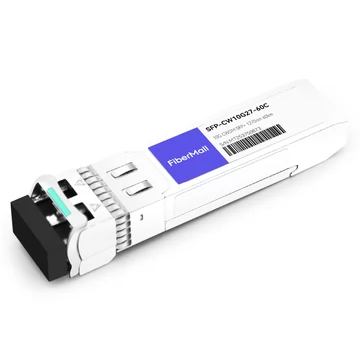
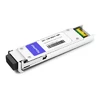
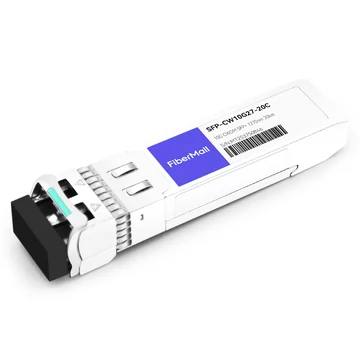
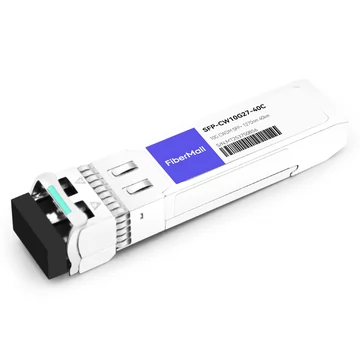
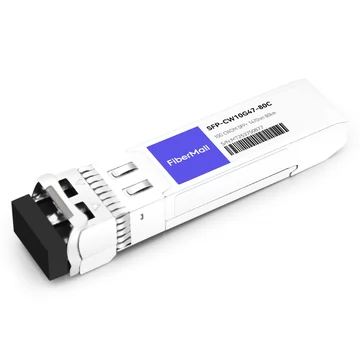
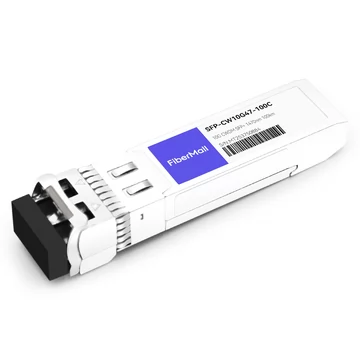
10G CWDM SFP+: Key Features and Benefits
The demand for faster, more efficient, and reliable network performance has never been stronger-the 10G CWDM SFP+ modules are very much at the forefront of providing high-speed connectivity in modern data networks. This small, high-performance device provides a strong solution to cater to the growing enterprise, cloud provider, and data center needs by delivering the required bandwidth with an improved infrastructure cost.
Introduction to 10G CWDM SFP+ Technology
What is 10G CWDM SFP+?
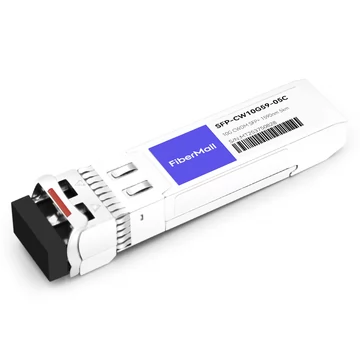
An overview of 10G CWDM SFP+ (10-Gigabit Coarse Wavelength Division Multiplexing Small Form - Factor Plus): it is a mini module plug, hot swappable for high data rate transmission in the optical fiber networks. It has shown that module spearheads the potent consistent views of CWDM technology with SFP+ modules by offering the groundwork to rigs the most dynamic networking systems. The root principle of CWDM is that a number of optical signals at different wavelengths can be introduced in the same fiber bundle, hence logically broadening the bandwidth to meet increasing demands without any additional physical infrastructure.
10G CWDM SFP+ modules constitute a limited wavelength between 1270nm and 1610nm with gap spacing being 20nm. Being naturally spectacular, these versatile wavelengths can be easily tapped into any wavelength-centric multiplexer system to optimize such virtues of Metro Ethernet or any other metropolitan network, data centers, and long-haul telecommunications long distances.
The Importance of CWDM in Modern Networks
albeit CWDM can settle for upstream injection of optical fiber data in the finest manner, cost-effective, and pretty basic with the lack of any slightest report for any sophisticated lowly distributed system, all the way up in connection with implementing needed cables, which would be expensive and time-consuming.
CWDM is a fantastic answer to harshen the repeatability of networks because it allows for a maximum of 18 channels or wavelengths within the 1270 nm-1610 nm band. This system is most commonly employed in metro networks, data centers, and telecoms to connect two fiber compounds in reality up to 80 km distances. A significant disparity between CWDM and dense wave division multiplexing (DWDM) is channel spacing interval; therefore, the CAPEX of over 80% of equipment costs and power is significantly lower.
Technical Specifications and Compatibility
Understanding the 10G CWDM SFP+ Transceiver
The 10G SFP+ CWDM Wavelength original is one of the most perfect components in modern optical communication systems meant to support high-speed data transfer over long distances; it utilizes the Coarse Wavelength Division Multiplexing (CWDM) technology in which various data channels of different wavelengths move similarly over a single optical fiber. The 10G CWDM SFP+ works by spacing down from 1270 nm to 1610 nm by 20 nm, making the most of the fiber resources for good scalability.
Thus, this device remains suitable enough for different switch and router brands, adhering to SFP+ MSA conformities. Still, it has some merits to go along with; it reaches as far as 80 km, depending upon its model. With a transfer rate of 10 Gigabit, the device can run on Digital Diagnostic Monitoring (DDM), which provides scientific real-time tracking of important networking parameters such as temperature, voltage, transmitted power, and received power, and this keeps one of the crucial elements in network operation.
Understanding Distances and Wavelengths
The main source of the performance of 10G CWDM SFP+ transceivers is the range and wavelength to which signals are transmitted and received. Always fixed in ITU-T CWDM center wavelengths 1270, 1290, 1310, 1330, 1350, 1370, 1390, 1410, 1430, 1450, 1470, 1490, 1510, 1530, 1550, 1570, 1590, and 1610 nm on ITU G. 694.2 over a 20-nm separation, CWDM-based wavelengths award an array of wavelengths for multiple data rates on a fiber-optic network infrastructure simultaneously.
The maximum reach of 10G CWDM SFP+ modules heavily depends on many factors like fiber type, signal attenuation, and power levels. For example, on single-mode fiber cable (SMF), it will reach 40 km, 80 km, and beyond with the aid of amplifiers or/or dispersion compensation technologies. The Cisco CWDM-SFP10G-80 modules, for example, expect to hit 80 km under favorable conditions.
Key Benefits of Using 10G CWDM SFP+
Cost-Effectiveness of CWDM Technology
In most networks, CWDM (Coarse Wavelength Division Multiplexing) technology is viewed as a very cost-effective technology. In contrast to DWDM, which has replaced 4 or more wavelengths over a single fiber, CWDM means one wavelength per fiber- henceforth no need for costly fiber expansion to accommodate the DWDM setup, thus saving a lot in the capital expenditure. This is the sort of statement that suggests cost savings that are claimed to accompany CWDM enhancements-in terms of network costs, cost savings may be as high as 30% with an easy-to-achieve wave-length division multiplexing in small bandwidth situations.
Additionally, these CWDM elements/QMFs come in a much discounted price at equivalents to DWDM. They would require no electricity signaling where the passive equipment, which includes both multiplexers and demultiplexers, clearly indicates the usefulness of reduced operational expenses.
Single-mode fiber optimization for bandwidth
Single-mode fiber has become a powerful means for telecommunication, especially when combined with present-day technologies such as coarse wavelength division multiplexing (CWDM). Data transmission can take place over very long distances without any attenuation, which makes the single-mode fiber all the more popular and relatively conducive toward network performance enhancement. Bandwidth potential of the single-mode fiber can then be greatly improved, say by factor 20 times without major infrastructural upgrades; thanks to CWDM.
Recent studies have reported that one single-mode fiber with the superset of CWDM can potentially support eighteen channels per fiber, each channel capable of supporting ten Gbps (again, maximum speed). Thus, one fiber strand would accommodate the full aggregated bandwidth of 180 Gpbs such as might be required for heavy-duty applications, for which endurance is a must. Very important is the immensely wide range of wavelength starting from 1270 nm to 1610 nm over which CWDM is characterized and provides the smallest interference.
Common Use Cases and Installation Scenarios
Applications in Data Centers
CWDM technology has emerged as a prime solution in the modern networking domain in data center setups in response to their ever-growing need for expanding their network owing to the easy option for capacity and infrastructure expansion. It is only the increasing nature of data centers, as driven by cloud technology, server virtualization, and artificial intelligence applications, that could deliver high data traffic flows, streamlining workflows across labored zettabytes.
CWDM permits data centers with single-mode fiber to increase their ability in those wavelengths by permitting more optical channels in single pairs of fiber. For instance, a single CWDM system could offer up to 18 channels merely with a single fiber pair, thereby offering mostly for more bandwidth expansion without doing any cabling installations. As such scalability translates into the operative costs, the initial costs arise into significant savings in installation.
Corporate Network Service
What has seen rapid advancement recently is enterprise networking, which has called for pioneering mechanisms for scaling, flexibility, and performance. Companies are metamorphosing more into the hybrid and multi-cloud paradigm, thereby creating an even more pressing need for a guarded, robust connectivity. It is estimated that the global enterprise networking market will grow from US$56.83 billion in 2023 to US$96.33 billion in 2028 at a 11.15% compound annual growth rate (CAGR) over the forecast period.
The present-day exigencies call for the integration of Software Defined Network (SDN) and Network Function Virtualization (NFV) in the enterprise. SDN and the like get down to making network management easy if not largely automatic. These systems are for real-time configuration management capable of handling tasks with unceremoniously high workloads whose activities need to frequently change resource configurations. The whole lot of light-based means that target solutions for ramping up capacity and ensuring less latency are the CWDM and DWDM solutions likely to considerably grow for data centers that substantially lean into the cloud.
Factors to Consider When Selecting a 10G CWDM SFP+ Module
Evaluating Distance and Performance Requirements
When picking a 10G CWDM SFP+ module, all together range and performance requirements have to be weighed to obtain the best outcome. A single fiber optic is able to handle many bewares of light, which it is that allow the CWDM (Coarse Wavelength Division Multiplexing) technology to increase bandwidth while conserving cost. The modules are designed to support transmission distances from 10 km to 80 km or even more based on the network configuration and fiber quality.
As another example, standard 10G CWDM SFP+ modules consider about 40 km links over SMF within 1470 nm to 1610 nm wavelength range and Power Budget abought 14 dB. Modules targeted for extended-range job applications must maintain at the minimum the higher power available practically and have very sensitive receivers else thy can potentially operate anywhere from 80 km and higher in a link budget accounting for all losses from splicing, connectors, and aged lying around with forgotten infrastructure.
Choosing the Right Wavelength
The performance of your 10G CWDM SFP+ module, should operate with caution due to various issues such as compatibility and scalability in the entire network. Some basic facts are: the CWDM technology uses the wavelength range 1270nm to 1610nm in 20nm intervals, with each wavelength dedicated to some channel (the idea behind this approach is to transmit one or more signals through one optical fiber line). This technique optimizes for frequency efficiency while reducing overlapping of signal frequencies.
The wavelength for any optical link in one application depends on the optimum distance waveform over which data signals can be transmitted and the quality of fiber optic infrastructure. For example, working wavelengths of 1470 to 1610nm are quite immune to attenuation and are therefore very well suitable for links maintaining some longer distance, particularly over single-mode short distances while longer wavelengths are such which maintain well signals at or around 1270 nm for short or high-density distributed applications based on their suitable signal and compatibility with standard networking hardware.
Frequently Asked Questions (FAQs)
Is this 10G CWDMSFP+ compatible with a Cisco product?
Yes. In the event a module has a compatibility listing to a platform or has been marked as (CWDM-SFP10G-1470 compatible) compatible, most existing 10G-CWDM-SFP+ modules would infact operate on the Cisco product, Arista, Juniper and even other platforms. In the event you don't have a switched pair of fiber, check the transceiver capability matrix of your platform and switch, make sure the module operates with an LC-duplex singlemode fiber (LC SMF), and check the exact firmware or vendor locking, to make sure you have plug-and-play role of the SFP.
How do I install and test a 10 Gigabit CWDM SFP+ on a Cisco switch?
For installation, power down only if not locked to your platform, install the 10g SFP+ into its designated 10g SFP+ cage, connect duplex LC cables to LC SMF, bring down the port at the switch (if the port does not come up), apply link diagnostics, use show interface or show transceiver commands to verify certain optical parameters (such as wavelength, for example 1270nm or 1470nm, power, and DOM/80km DOM if this is supported).
Can a 10g CWDM SFP+ be used to extend the optical infrastructure without adding new fibers?
Yes. CWDM SFP+s allow multiple wavelengths on the same fiber pair and thus provide the capability to expand capacity without adding new fibers and without reworking existing optical infrastructure. They are ideal in scenarios like campus, DCI, ring, and enterprise deployments where minimizing fiber changes is of paramount importance.
What warranty and service is made available for a 10g CWDM SFP+?
In this regard, we need to check on vendors like Microway and OSD Computers in which, as part of service offerings, systems integration, training, migration of operating systems, and security consulting are available. Other local partners provide project-based or on-site support. Liaison with the program sponsor is necessary when the contract states that support fees and project work will be paid by an affected department.