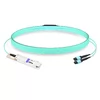
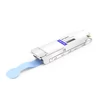
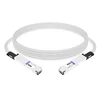
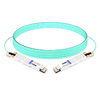
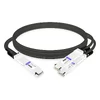
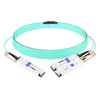
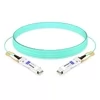
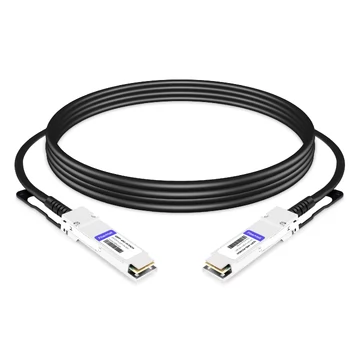
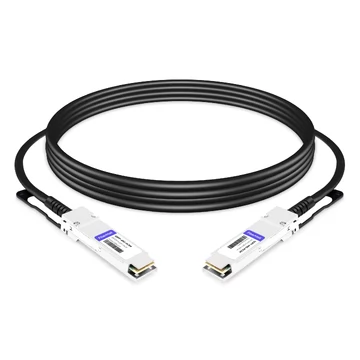
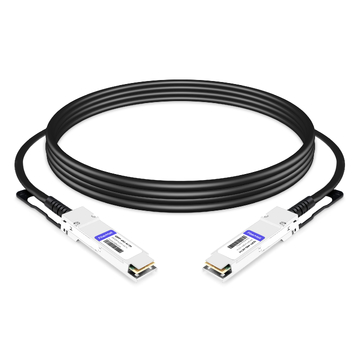
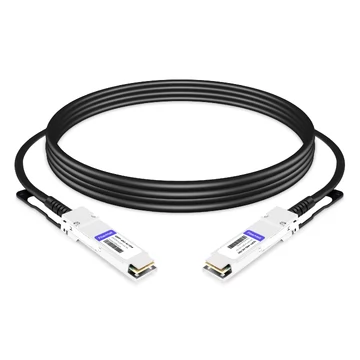
The cost of choosing the wrong 40G copper cable far outweighs the savings of buying a cheaper one. Order a Passive DAC for a 6-meter run, and you get signal errors, retransmissions, and unstable links. Order an Active Copper Cable (ACC) when a Passive DAC would work, and you burn budget on hardware and power you did not need.
FiberMall stocks both 40G QSFP+ Passive DAC and 40G QSFP+ Active Copper Cable (ACC) configurations from 0.5M to 7M.
What 40G QSFP+ DAC & ACC Cables Deliver
A 40G QSFP+ direct attach copper cable is a fixed assembly with QSFP+ connectors on one or both ends. It carries four 10 Gbps lanes over copper twinax for a total 40 Gbps payload. No separate transceivers. No fiber patch panels. No cleaning kits.
FiberMall's 40G cable portfolio covers three deployment patterns:
QSFP+ to QSFP+ Passive DAC: Switch-to-switch or switch-to-server links up to 7M.
QSFP+ to QSFP+ Active Copper Cable (ACC): Longer or higher-loss copper runs where passive signal integrity would fail.
QSFP+ to 4x SFP+ Breakout DAC: Splitting one 40G port into four 10G connections.
Every configuration complies with QSFP+ MSA, SFF-8436, and IEEE 802.3ba 40GBASE-CR4. We also support InfiniBand QDR/DDR and Fibre Channel over Ethernet environments.
Passive DAC vs Active Copper Cable (ACC): Which Do You Need?
This is the decision most product pages skip. It is also the decision that determines whether your link runs cleanly or generates CRC errors. Here is how the two compare across key factors:
Signal Conditioning & Power: Passive DACs have no active electronics and operate at the lowest power, drawing less than 0.15W. ACCs feature a built-in Redriver chip for signal conditioning, which draws approximately 0.8W to 1.5W per end.
Typical Reach & Wire Gauge: Passive DACs typically cover 0.5M to 5M using 30 AWG to 24 AWG wire (stretching up to 7M only with thicker gauges). ACCs are designed for longer 3M to 7M+ distances, usually utilizing 26 AWG to 24 AWG wire.
Best Use Case & Relative Cost: For same-rack or adjacent-rack setups, Passive DACs are the ideal, lowest-cost solution. For longer copper runs or higher-loss paths, ACCs are moderately more expensive but ensure reliable signal integrity.
Rule of thumb for 40G:
0.5M – 3M in the same rack → Passive DAC, usually 30 AWG
4M – 5M across adjacent racks → Passive DAC with 26 AWG, or ACC if your environment is noisy
6M – 7M or mixed cable routes → ACC for guaranteed signal integrity
Length, AWG, and Signal Integrity: A Practical Guide
American Wire Gauge (AWG) determines copper thickness. Thicker wire has lower attenuation and supports longer reach, but it is less flexible and consumes more space in cable managers.
For 40G QSFP+ DAC cables, use this practical mapping based on length:
0.5M – 1M: Use a 30 AWG Passive DAC for top-of-rack switch to server connections.
2M – 3M: Use a 30 AWG or 28 AWG Passive DAC for same-rack or adjacent-rack stacking.
4M: Use a 28 AWG or 26 AWG Passive DAC for end-of-row connections.
5M – 7M: Use a 26 AWG or 24 AWG Passive DAC or ACC for longer copper runs and mixed pathways.
At 40G, signal integrity degrades noticeably after 3M on thin 30 AWG copper. If your deployment uses 5M or 7M passive cables, choose 26 AWG or 24 AWG to keep insertion loss within IEEE 802.3ba limits.
QSFP+ to QSFP+ vs QSFP+ to 4x SFP+ Breakout
Not every 40G port connects to another 40G port. Many data centers use a 40G QSFP+ uplink and break it out to four 10G SFP+ server ports.
QSFP+ to QSFP+:
40G switch port to 40G switch port
40G switch port to 40G NIC or storage controller
Single 40GbE lane, no splitting
QSFP+ to 4x SFP+ Breakout DAC:
40G switch port to four 10G server NICs
40G aggregation to 10G access layer
Migrating 10G equipment into a 40G fabric without new transceivers
Both formats are hot-swappable, plug-and-play, and MSA-compliant. We code each end independently, so you can mix vendors — for example, a Cisco-coded QSFP+ end on the switch side and generic SFP+ ends on the server side.
When to Consider 40G AOC Instead
DAC and ACC cables work for short-reach copper connections. For longer distances, fiber is the better choice. FiberMall also supplies 40G QSFP+ AOC for runs beyond 7 meters.
Use this decision framework:
0.5M – 3M, clean cable route → Passive DAC
3M – 7M, copper preferred → Passive DAC with thicker gauge, or ACC
7M – 100M → AOC
Beyond 100M or outdoor plant → Fiber transceivers with structured cabling
FAQ
What is the maximum length for a 40G QSFP+ Passive DAC?
Most 40G passive DAC cables reach up to 5M. With thicker 26 AWG or 24 AWG copper, some designs extend to 7M. Beyond that, signal integrity becomes unreliable, and you should use ACC or AOC.
What is the difference between DAC and ACC cables?
A Passive DAC has no active electronics. It is the lowest-cost, lowest-power option for short distances. An Active Copper Cable (ACC) includes signal conditioning chips (Redrivers) that clean and retime the signal, enabling longer or noisier copper runs up to 7M or more.
Are FiberMall 40G cables compatible with Cisco, Arista, and Juniper switches?
Yes. We pre-code the EEPROM on each cable to match the OEM part number your switch expects. The cable is recognized as a supported module and operates at full specification.
When should I choose ACC over Passive DAC?
Choose ACC when your link exceeds 5M, runs through cable managers with tight bends, passes near high-interference equipment, or when you need extra margin for signal integrity. For same-rack connections under 3M, a Passive DAC is usually the better value.
What AWG should I choose for my 40G DAC cable?
Use 30 AWG for 0.5M–3M, 28 AWG for 4M, and 26 AWG or 24 AWG for 5M–7M. Thicker wire reduces insertion loss and improves reliability at longer distances.
Can I use a 40G QSFP+ DAC in a 100G QSFP28 port?
Not directly. 40G and 100G cables have different electrical signaling. However, some QSFP28 ports support rate selection to 40G mode. When configured for 40G, you can use a 40G QSFP+ DAC.
Do passive 40G DAC cables support DDM/DOM?
Most passive DACs do not provide Digital Diagnostic Monitoring. If your operations team requires real-time monitoring, consider ACC or AOC alternatives.