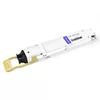
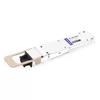
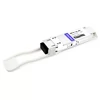
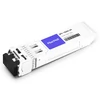
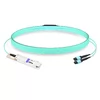
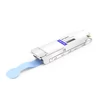
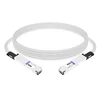
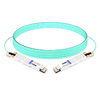
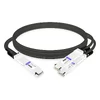
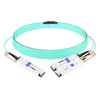
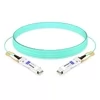
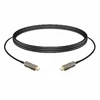
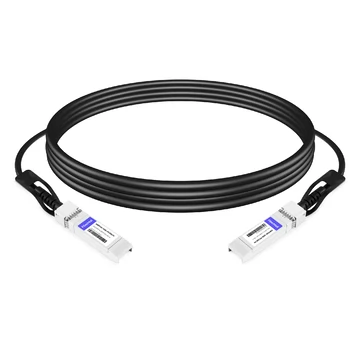
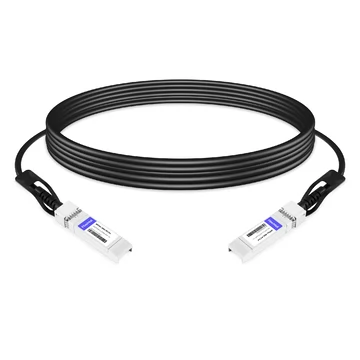
Direct attach copper (DAC) cables remain the most cost-effective interconnect for short-reach data center links. A single passive 50G SFP56 DAC cable typically consumes less than 0.5 W and eliminates the need for separate optical transceivers, reducing both capital expenditure and operational power draw.
FiberMall supplies MSA-compliant DAC cables from 50 Gbps to 112 Gbps in QSFP28, SFP-DD, SFP112, SFP56, and DSFP form factors. Each cable undergoes signal-integrity testing and switch-platform verification before shipment.
What Are 50G-112G DAC Cables?
Direct attach copper cables integrate copper twinax conductors with fixed pluggable connectors on each end. Unlike optical transceivers that require separate fiber patch cords, DAC cables provide a complete point-to-point electrical link in a single assembly.
At 50 Gbps and above, DAC cables use high-density form factors to carry high-speed electrical signals through compact connectors:
QSFP28 supports four 25 Gbps NRZ lanes for an aggregate data rate of 100 Gbps.
SFP-DD doubles lane density within the SFP envelope and supports 100 Gbps over two 50 Gbps PAM4 lanes.
SFP112 advances to single-lane 100G/112G-class PAM4 signaling for next-generation 100G and beyond.
SFP56 delivers 50 Gbps over a single PAM4 lane in a standard SFP footprint.
DSFP is a dual-lane SFP-like form factor that supports high-density 100G operation over two 50 Gbps PAM4 lanes.
These cables operate over short distances—typically 0.5 m to 3 m for passive variants and up to approximately 7 m for active copper cables. For intra-rack switch-to-server or switch-to-switch connections, this distance range covers the majority of data center cabling scenarios.
DAC cables eliminate the optical-electrical-optical (O-E-O) conversion stages found in transceiver-based links. The result is very low latency, minimal power consumption, and reduced component count. In a 100 Gbps link, a passive DAC assembly typically draws less than 0.5 W, compared to several watts for a pair of optical transceivers plus fiber.
The trade-off is distance and flexibility. Copper signal attenuation increases with frequency, so 50G-112G passive DACs are practical mainly within a rack or between adjacent racks. For longer runs, active copper cables (ACC) or active optical cables (AOC) extend reach at a higher cost and power level.
50G/100G/112G DAC Cable Types and Form Factors
Selecting the correct form factor depends on port availability, lane configuration, and future upgrade path. The following cable types are commonly used in the 50G-112G range.
SFP56 DAC cables support 50 Gbps using one 50G PAM4 electrical lane. They are commonly used for server NICs, storage controllers, and top-of-rack switch ports that operate at 50 Gbps. The single-lane design simplifies cabling compared to QSFP28 breakout solutions, while the SFP footprint fits standard 25G/50G switch ports.
DSFP DAC cables provide a dual-lane SFP-like interface for high-density 100G deployments. A typical DSFP 100G DAC uses two 50G PAM4 lanes. While DSFP is less common than QSFP28 or SFP-DD, it remains relevant in certain high-density switch platforms where two-lane 100G connectivity is required in a compact form factor.
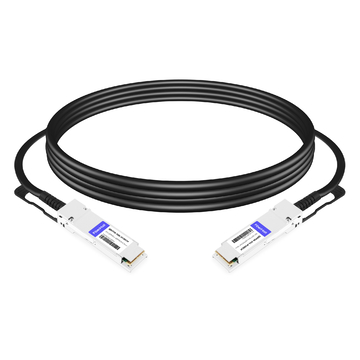
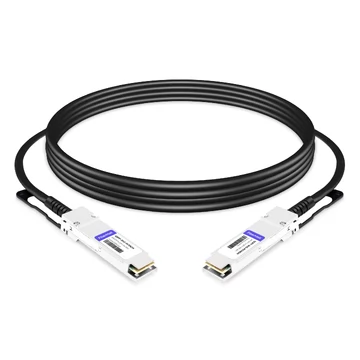
QSFP28 DAC cables dominate 100 Gbps data center interconnects. A native QSFP28-to-QSFP28 DAC uses four 25G NRZ lanes to deliver 100 Gbps. These cables are widely used for spine-leaf uplinks, switch-to-switch connections, and short-reach data center aggregation links.
QSFP28 breakout DAC cables split a 100G QSFP28 port into multiple lower-speed links. A 100G QSFP28-to-4xSFP28 breakout DAC connects one 100G switch port to four 25G endpoints. In some platforms, a 100G QSFP28 port can also be configured for 2x50G breakout, typically connecting to two 50G SFP56 endpoints. Switch support for breakout mode must be verified before ordering, because not all ports or port groups support every breakout configuration.
SFP-DD DAC cables fit 100 Gbps into an SFP-sized envelope by using two 50G PAM4 lanes. This improves front-panel density compared with QSFP28 and allows data center architects to deploy more 100G ports in the same switch faceplate area.
SFP112 DAC cables represent the next evolution of single-lane high-speed copper connectivity. By using 100G/112G-class PAM4 signaling on one electrical lane, SFP112 enables 100G and beyond in the SFP physical size. This form factor is especially attractive for AI clusters, GPU fabrics, and high-density server access designs where port density directly affects cluster scale.
How to Choose the Right DAC Cable for Your Network
Network engineers typically select DAC cables based on four factors: endpoint speed, port expansion needs, architecture layer, and physical constraints.
Match endpoint speeds first. Both ends of a DAC link must support the same speed, lane configuration, encoding, and FEC mode. A 100G QSFP28 DAC connects two 100G QSFP28 ports using four 25G lanes. If the downstream device runs at 50 Gbps, use a supported 100G-to-2x50G breakout DAC or a native 50G SFP56 DAC from a 50G-capable SFP56 port.
Consider port expansion. Breakout DAC cables split a higher-speed port into multiple lower-speed links. A 100G QSFP28-to-4xSFP28 breakout connects four 25G servers to one 100G switch port. A 100G-to-2x50G breakout can connect one 100G-capable port to two 50G devices when the switch supports this mode. Always verify breakout support in the switch hardware guide, because not all 100G ports implement lane splitting, and some platforms support 4x25G breakout but not 2x50G breakout.
Align with the architecture layer. Spine-leaf backbones typically use native 100G QSFP28 DACs for short, uniform, high-capacity uplinks. Top-of-rack to server connections may use 50G SFP56 or 25G SFP28 DACs, depending on the server NIC generation. AI and HPC clusters increasingly adopt SFP112 for single-lane 100G-class server and accelerator connectivity where density and power efficiency are critical.
Account for physical constraints. Passive DAC cables are limited by copper insertion loss. At 100G QSFP28, 26 AWG twinax typically reaches up to approximately 3 m, while thinner 30 AWG cables are usually limited to shorter lengths such as 1 m. Higher-speed single-lane PAM4 solutions such as SFP112 are generally more distance-sensitive. Active copper cables extend reach to approximately 7 m with signal conditioning. Exceeding the specified length can cause elevated bit-error rates, CRC errors, and link flaps.
Passive vs Active DAC: Which Do You Need?
The choice between passive and active DAC centers on distance, power budget, and cost.
Passive DAC cables are usually the best choice for 1 m to 3 m short-reach links. They contain no active signal-conditioning chips and rely on high-quality copper twinax, controlled impedance, and proper host-side equalization to carry high-speed signals. Their main advantages are the lowest cost, the lowest power consumption, and very low latency. They are ideal for intra-rack server-to-switch connections and adjacent-rack links where the cable length is within the passive reach limit.
Active copper cables (ACC) are used when passive copper reach is not enough. ACC cables include active equalization or redriver circuitry inside the connector housing to improve signal quality and extend reach. They typically support longer distances, often up to around 7 m depending on the speed, host platform, and cable design. ACC cables consume more power than passive DACs and cost more, but they are still simpler and often more cost-effective than optical links for short intra-row connections.
For most standard intra-rack server-to-switch connections, data centers choose passive DACs because the power and cost savings compound across thousands of links. ACC cables fill the gap between short passive DACs and AOC or optical transceiver solutions.
Compatibility with Major Network Equipment
Compatibility anxiety is the primary barrier to third-party DAC adoption. Network engineers need assurance that a non-OEM cable will negotiate link-up, maintain stability, and avoid triggering switch error logs.
FiberMall DAC cables are engineered to MSA and IEEE specifications, including IEEE 802.3bj for 100GBASE-CR4, IEEE 802.3cd for 50GBASE-CR and 100GBASE-CR2, IEEE 802.3ck for 100G/lane electrical interfaces such as 100GBASE-CR1, the QSFP28 MSA, SFF-8662 and SFF-8665 for QSFP28 mechanical and management interfaces, SFF-8402 and SFF-8432 for SFP-based mechanical specifications, the SFP-DD MSA, and the SFP112 MSA.
DAC Cable Specifications and Technical Parameters
FiberMall passive DAC cables in the 50G-112G range are available in several common configurations.
A 50G SFP56 DAC supports 50 Gbps using one 50G PAM4 lane. It is typically used for 50GBASE-CR links, supports common AWG options such as 26 AWG to 30 AWG, operates from a +3.3 V supply, and is designed for standard commercial operating temperatures from 0°C to 70°C. Passive lengths commonly reach up to approximately 3 m depending on AWG and platform capability.
A 100G QSFP28 DAC supports 100 Gbps using four 25G NRZ lanes. It is used for 100GBASE-CR4 links and remains one of the most mature copper solutions for short-reach 100G data center interconnects. Typical passive reach is up to approximately 3 m with thicker-gauge twinax cable, with shorter lengths offering better flexibility.
A 100G SFP-DD DAC supports 100 Gbps using two 50G PAM4 lanes. It is used for 100GBASE-CR2 applications where high front-panel density is important. Passive reach is typically shorter than QSFP28 because the per-lane signaling rate is higher, with common lengths around 1 m to 2 m depending on AWG and system margin.
A 100G SFP112 DAC supports 100G/112G-class PAM4 signaling over a single lane. It is used for 100GBASE-CR1 and next-generation single-lane 100G connectivity. Because it carries the full 100G-class data rate on one electrical lane, passive reach is generally limited and must be matched carefully to the host platform’s signal-integrity budget.
All cables include an integrated EEPROM accessible via the I²C two-wire serial interface. The EEPROM stores vendor information, cable length, compliance flags, and other identification data that host switches read during link initialization.
Common DAC Cable Issues and How to Avoid Them
Even high-quality DAC cables can exhibit issues when deployed incorrectly. The following troubleshooting guidance addresses the most common field problems.
No link, or the port LED is off. Verify that both connectors are fully seated until the latch clicks. Inspect connector pins for damage or debris. Confirm that the switch port is enabled and configured for the correct speed. Some platforms require manual speed, FEC, or breakout configuration before the link can come up.
CRC errors or Rx/Tx errors. CRC errors typically indicate signal degradation. Check that the cable length does not exceed the passive limit for the AWG and speed. Ensure that the cable is not pinched, kinked, or routed near high-EMI sources. Verify that FEC settings match on both ends. Depending on the platform and link type, Firecode FEC, RS-FEC, or Auto mode may be required.
Intermittent disconnections. Thermal stress and marginal signal integrity can cause intermittent link flaps. Confirm that the data center ambient temperature stays within the cable’s operating range, typically 0°C to 70°C for commercial-grade DACs. Avoid bundling DAC cables so tightly that airflow to switch ports is restricted. Check that the cable bend radius does not fall below the manufacturer’s minimum recommendation.
Speed negotiation failures. Configure both ports according to the switch vendor’s recommended speed, FEC, and auto-negotiation settings. At 50G and above, encoding, lane mapping, link training, and FEC mismatches are common causes of failed negotiation. Do not disable auto-negotiation or link training unless the switch vendor specifically recommends doing so for that cable type and port mode.
Breakout port not splitting. Breakout cables require explicit switch configuration. A 100G-to-4x25G breakout DAC will not function until the switch port is configured in breakout mode. Not all switch SKUs or port groups support breakout, and some ports support only specific breakout ratios. Verify the hardware datasheet and operating system configuration guide before purchase.
Frequently Asked Questions
What is the difference between 50G SFP56, 100G QSFP28, and DSFP DAC cables?
A 50G SFP56 DAC uses one 50G PAM4 lane in an SFP form factor and is commonly used for 50G server-to-switch links. A 100G QSFP28 DAC uses four 25G NRZ lanes to deliver 100G and is widely used for switch-to-switch and spine-leaf connections. DSFP is a compact dual-lane SFP-like form factor that can support 100G over two 50G PAM4 lanes. In practice, the right choice depends on the switch port type, lane configuration, and target endpoint speed.
Can I use a 100G QSFP28 breakout DAC for two 50G connections?
Yes, but only if the switch supports 2x50G breakout mode on that specific port. A supported 100G-to-2x50G breakout DAC can split one 100G-capable port into two independent 50G links. Some switches support only 4x25G breakout and do not support 2x50G breakout. FiberMall pre-sales verification can confirm the correct breakout ratio for your switch model, port group, and operating system version.
How long can a passive 50G/100G DAC cable be?
Passive 50G SFP56 and 100G QSFP28 DAC cables typically reach up to approximately 3 m with thicker-gauge twinax such as 26 AWG. Shorter 1 m cables may use thinner gauges such as 30 AWG for improved flexibility. SFP-DD and SFP112 passive cables are generally more distance-sensitive because they use higher-speed PAM4 signaling per lane, so practical passive lengths are often around 1 m to 2 m depending on the platform and cable design. For distances beyond passive copper limits, active copper cables can extend reach to approximately 7 m.
Are FiberMall DAC cables compatible with Cisco, Juniper, and Arista switches?
Yes. FiberMall DAC cables are designed to comply with relevant MSA and IEEE specifications to support interoperability across major switch vendors. Pre-sales compatibility verification checks the specific cable coding, form factor, speed, FEC behavior, and switch model before shipment. This helps eliminate the guesswork that can lead to link failures with uncertified third-party cables.
What is SFP112, and should I choose it over QSFP28?
SFP112 is a next-generation SFP-sized form factor designed for 100G/112G-class PAM4 signaling over a single electrical lane. It offers higher port density than QSFP28 for single-lane 100G applications and provides a forward-looking path for high-density AI, GPU, and data center access networks. Choose SFP112 for new platforms that support single-lane 100G connectivity and require maximum faceplate density. QSFP28 remains the mature, cost-optimized choice for standard 100G spine-leaf and switch-to-switch links.