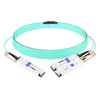
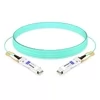
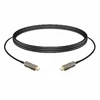
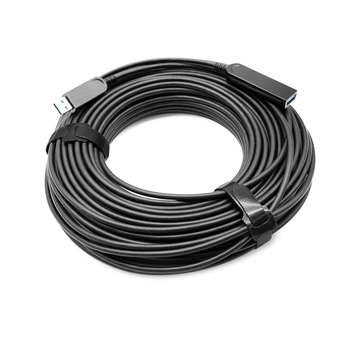
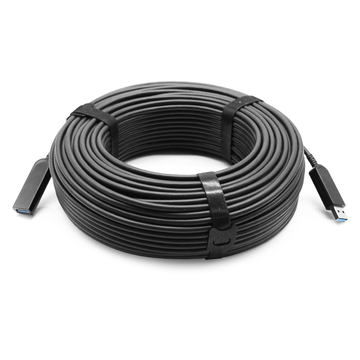
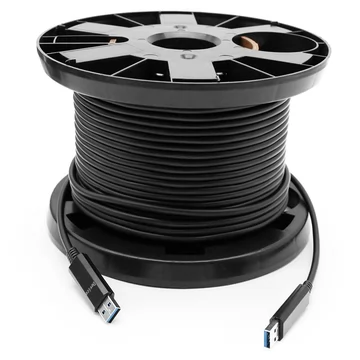
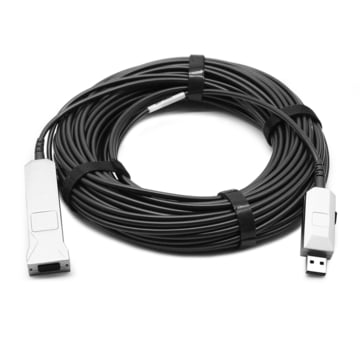
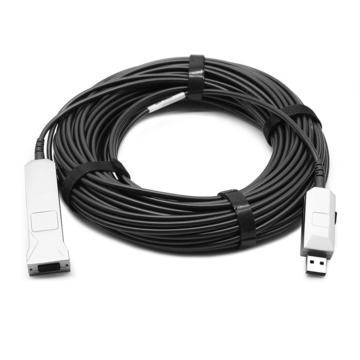
USB AOC Cable for Reliable Long-Distance USB 3.0 Transmission
Standard copper USB cables typically reach their practical distance limit at around 2–3 meters when operating at USB 5Gbps speeds. Beyond that distance, signal attenuation, connection drops, and inconsistent data throughput can turn a simple USB extension into a difficult integration problem.
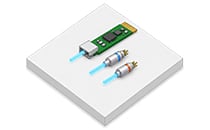
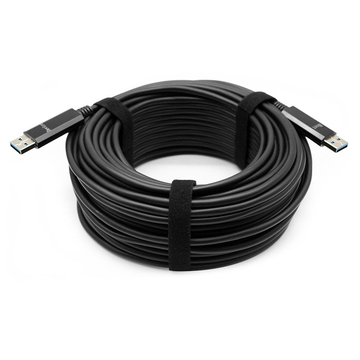
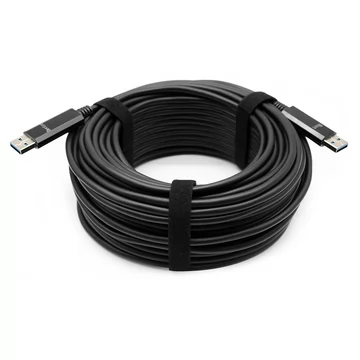
A USB AOC cable solves this limitation by using active optical technology. The cable converts the electrical USB signal into optical signals inside the Source connector, transmits high-speed data over optical fiber, and converts the signal back into electrical form at the Device connector.
FiberMall USB AOC cable solutions support stable USB 5Gbps transmission over long distances while providing significantly greater resistance to electromagnetic interference than conventional copper USB cables. The cable’s internal electronics are powered through the USB interface, so no separate power adapter is normally required for the cable itself.
Available power for the connected peripheral depends on the selected USB AOC cable model, cable length, host-port capability, and device power requirements.
Why Copper USB Cables Fail on Long or Noisy Runs
Data center engineers, machine vision integrators, Pro AV installers, and industrial automation teams all face the same limitation: copper USB cables have a restricted transmission distance.
At the 5Gbps signaling rate used by USB 3.2 Gen 1, formerly known as USB 3.0, passive copper USB cables can become unreliable beyond approximately 2–3 meters. Actual performance depends on cable construction, conductor size, connector quality, host-controller performance, peripheral sensitivity, and the surrounding electromagnetic environment.
Active copper USB cables and repeater cables can extend the transmission distance, but they are generally thicker, less flexible, and still susceptible to electromagnetic interference. Some active copper solutions may also require additional power, particularly over longer distances or when connected to higher-power peripherals.
These limitations can cause unstable device connectivity:
• Industrial cameras may drop image frames.
• High-speed storage devices may disconnect.
• Remote workstations may lose access to USB peripherals.
• Imaging and inspection systems may experience interrupted data transfer.
• Pro AV equipment may fail to maintain a reliable USB connection.
In machine vision, data center, broadcast, healthcare, and industrial environments, unstable USB connectivity can directly affect productivity, reliability, and system uptime.
The solution is not simply a longer copper cable. It is a USB AOC cable engineered for long-distance transmission, stable signal integrity, and electrically noisy environments.
The FiberMall USB AOC Cable Solution
A FiberMall USB AOC cable uses optical fiber to carry USB 5Gbps SuperSpeed data over long distances.
Active chipsets inside the cable connectors convert the electrical USB signal into optical signals at the Source end. The optical data travels through the fiber inside the cable and is converted back into an electrical USB signal at the Device end.
Copper conductors may also be incorporated to power the cable’s internal electronics and, depending on the cable model and length, provide limited power to the connected peripheral.
This hybrid design allows the USB AOC cable to provide a stable USB 5Gbps connection across distances where conventional passive copper cables cannot deliver consistent performance.
Key Benefits of a USB AOC Cable
• Long-distance USB 5Gbps transmission: A USB AOC cable supports stable USB 5Gbps connections over tens of meters, with selected models supporting distances of up to 100 meters.
• Improved resistance to EMI and RFI: The high-speed data path travels over optical fiber, greatly reducing susceptibility to electromagnetic and radio-frequency interference from motors, power cables, variable-frequency drives, wireless systems, and other electrical equipment.
• Thin and flexible construction: A USB active optical cable is generally easier to route through conduits, cable trays, equipment racks, walls, ceilings, and tight enclosures than long copper USB cables.
• Plug-and-play installation: The cable’s active optical conversion electronics are powered through the USB interface, so the USB AOC cable itself normally does not require an external power supply.
• Clear directional installation: Source and Device connectors are clearly labeled to help installers connect the USB AOC cable correctly.
• Factory-direct customization: FiberMall offers custom lengths, connector options, private labeling, custom packaging, and project-specific configurations.
USB AOC Cable Specifications for Industrial and Commercial Applications
Data and Performance
• USB Protocol: USB 3.2 Gen 1, formerly known as USB 3.0
• Maximum Signaling Rate: Up to 5Gbps SuperSpeed USB
• Standard Connector Configuration: Directional USB Type-A male to USB Type-A male on selected SuperSpeed-only models
• Optional Connector Configurations: USB Type-B, Type-C, Micro-B, and other device-side connectors may be available for OEM and project orders
• Directionality: Source to Device, with both USB AOC cable connectors clearly labeled
• USB 2.0 and USB 1.1 Support: Not supported on SuperSpeed-only models unless specifically stated in the product datasheet
• Cable Power: The active optical electronics are powered through the USB connection
• Peripheral Power: Available power for the connected device depends on the USB host, cable length, product design, and peripheral power requirements
• External Power: No external power supply is normally required for the USB AOC cable electronics. Higher-power peripherals may require a separate local power source
Physical and Environmental Characteristics
• Cable Type: Hybrid USB active optical cable using optical fiber for high-speed data and copper conductors for powering the active components
• Available Lengths: 10m, 25m, 30m, 50m, and 100m, with custom lengths available for qualified projects
• Maximum Distance: Up to 100 meters on selected USB AOC cable models
• Cable Diameter: Slim cable profile designed for easier installation in conduits, cable trays, and confined spaces
• Bend Radius: Flexible construction suitable for structured cabling routes when the specified minimum bend radius is observed
• Standard Operating Temperature: Typically 0°C to 50°C
• Industrial Options: Wider-temperature USB AOC cable versions may be available subject to project requirements and engineering confirmation
Compliance and Quality
• Environmental Compliance: RoHS compliant
• Regulatory Compliance: CE marking and FCC compliance may be available where applicable to the specific model and target market
• Quality Management: Manufactured under an ISO 9001-certified quality management system
• Product Testing: 100% pre-shipment functional, continuity, and USB link testing
• Warranty: Covered by the applicable FiberMall product warranty and sales terms
Important USB AOC Cable Compatibility Information
The USB AOC cable configuration described in this article is designed for USB 5Gbps SuperSpeed host-to-device connections.
A SuperSpeed-only USB AOC cable does not carry the USB 2.0 D+ and D− data channels. It therefore does not support USB 2.0 or USB 1.1 devices and cannot fall back to a lower USB speed.
The cable should only be used with compatible USB 3.x hosts and peripherals that establish communication through the SuperSpeed interface.
Compatibility should be confirmed before installation, especially when the connected equipment includes:
• Keyboards and mice
• KVM systems
• Touchscreens
• Control panels
• Barcode scanners
• Conference-room peripherals
• Server-management interfaces
• USB devices that may operate only over USB 2.0
FiberMall may offer other USB active optical cable configurations that support additional USB protocols. Confirm the required USB version, connector type, cable length, and device power consumption before ordering.
How Does a USB AOC Cable Work?
1. The Source Connector Receives the USB Signal
The connector labeled Source is connected to the USB host, such as a PC, server, hub, industrial controller, or machine vision computer.
The active chipset inside the Source connector receives the USB 5Gbps SuperSpeed electrical signal from the host interface.
2. The Electrical Signal Is Converted into Light
The Source-side chipset converts the high-speed electrical USB signal into optical pulses.
These optical signals travel through the fiber inside the USB AOC cable. Because the high-speed data path is optical rather than electrical, it is much less susceptible to electromagnetic interference from motors, power lines, wireless equipment, and industrial machinery.
3. The Device Connector Restores the USB Signal
At the far end of the USB AOC cable, the Device-side chipset converts the optical signal back into a USB 5Gbps electrical signal.
The restored signal is then delivered to the connected industrial camera, storage device, imaging system, inspection equipment, or other compatible USB 3.x peripheral.
The USB AOC cable’s internal conversion electronics draw power from the USB interface, so a separate power adapter is normally not required for the cable itself.
However, the ability to power the connected peripheral depends on the cable model, cable length, available host-port current, and the peripheral’s power consumption. High-power devices may require a separate local power supply.
USB AOC Cable vs. Copper USB Cable vs. USB Extender
A passive copper USB cable is best suited to short host-to-device connections. At USB 5Gbps speeds, the practical reliable transmission distance is generally around 2–3 meters. Passive copper cables are simple to install and do not require active electronics, but longer cables can become thick, stiff, and more vulnerable to electromagnetic interference.
A USB AOC cable is designed for longer USB 5Gbps connections. Selected models can support distances of up to 100 meters. The optical data path provides significantly better resistance to electromagnetic interference, while the cable is generally thinner and more flexible than an equivalent long-distance copper solution.
USB AOC cables are directional. The Source connector must be connected to the host, and the Device connector must be connected to the peripheral. The cable electronics are normally powered through the USB interface, although the power available to the connected device depends on the specific cable model.
A USB extender kit can also support distances of 100 meters or more. These systems usually use separate transmitter and receiver units connected by optical fiber, Ethernet cable, or another transmission medium.
USB extender kits may support remote USB hubs, multiple devices, or additional USB protocols. However, they usually require more components, more installation space, and, in many cases, external power at the remote end.
For applications that require a simple, lightweight, single-cable connection, a USB AOC cable is often the more convenient option.
When Should You Choose a USB AOC Cable?
Choose a FiberMall USB AOC cable when:
• Your USB connection is 5 meters or longer.
• You need reliable USB 5Gbps SuperSpeed performance.
• Your cable route passes near motors, power cables, drives, or electrical equipment.
• You need to route the cable through conduits, cable trays, walls, or ceilings.
• You require a thinner and more flexible alternative to long copper USB cables.
• You want a single-cable solution without separate transmitter and receiver boxes.
• Your USB host and peripheral both support the required SuperSpeed interface.
• The connected device’s power requirements are compatible with the selected cable.
USB AOC Cable Applications
Machine Vision and Industrial Automation
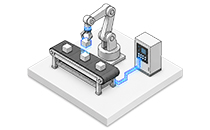
A USB AOC cable provides long-distance, high-bandwidth connectivity for compatible industrial cameras, image-acquisition devices, automated inspection systems, and machine vision equipment.
The optical data path helps maintain stable image transmission in environments containing motors, drives, robotic systems, welding equipment, and other sources of electromagnetic interference.
Before deployment, confirm that the camera uses a USB 5Gbps interface and that its power requirements are compatible with the selected USB AOC cable.
Medical Imaging and Laboratory Systems
USB AOC cable solutions can provide stable long-distance USB connectivity for compatible diagnostic equipment, medical imaging systems, laboratory instruments, and remote control interfaces.
Any USB AOC cable used in medical equipment must be evaluated as part of the complete medical system. A hybrid optical cable should not automatically be considered medically isolated or suitable for patient-connected applications unless the complete product and system have been specifically designed, tested, and certified for that purpose.
KVM Extension and Remote Workstations
A USB AOC cable may be used with validated USB 3.x KVM systems, remote workstations, high-speed storage devices, and compatible SuperSpeed peripherals in server rooms, broadcast facilities, and secure operations centers.
A SuperSpeed-only USB AOC cable is not suitable for directly extending conventional USB 2.0 keyboards, mice, or other low-speed USB devices.
For these applications, select a USB AOC cable or KVM extender that specifically supports USB 2.0 data channels.
Pro AV and Digital Signage
USB AOC cable products can support compatible USB 5Gbps conference cameras, interactive display systems, video-processing equipment, and digital signage devices installed away from the host computer.
Compatibility should be confirmed before installation because many touchscreens, control interfaces, and conference-room peripherals operate over USB 2.0 rather than USB 5Gbps.
Data Centers and Server Rooms
A USB AOC cable can connect compatible high-speed USB storage devices, diagnostic equipment, imaging devices, and management peripherals across racks and rows without the signal-loss limitations of long passive copper cables.
Because many server-management and console interfaces use USB 2.0, the protocol used by each device must be verified before selecting a SuperSpeed-only USB AOC cable.
Security and Surveillance
USB AOC cable solutions can extend compatible USB 5Gbps cameras, recording equipment, and high-speed control interfaces over long distances where copper cables may suffer from excessive signal attenuation or electromagnetic interference.
The USB protocol and device power consumption should be confirmed before installation.
USB AOC Cable Directionality Explained
Every FiberMall USB AOC cable is directional.
The connector labeled Source must be connected to the USB host, such as a PC, server, hub, workstation, or industrial controller.
The connector labeled Device must be connected to the compatible USB peripheral, such as an industrial camera, storage device, imaging system, or inspection device.
Reversing the Source and Device ends will prevent the USB link from being established.
Each connector is clearly labeled to help technicians identify the correct installation direction. For permanent installations, both ends of the cable route should also be labeled during the initial installation.
This is especially important when the USB AOC cable is routed through:
• Walls
• Ceilings
• Raised floors
• Underground conduits
• Equipment racks
• Cable trays
• Industrial machinery
USB 2.0 Compatibility Note
The SuperSpeed-only USB AOC cable described in this article is optimized for USB 5Gbps communication and does not carry the USB 2.0 or USB 1.1 D+ and D− channels.
As a result, it does not support USB 2.0 or USB 1.1 devices and will not automatically fall back to USB 2.0 operation.
USB 2.0 compatibility is product-specific. Customers requiring USB 2.0 support should select a USB AOC cable that specifically includes USB 2.0 functionality.
USB AOC Cable FAQ
What is a USB AOC cable?
A USB AOC cable, or USB Active Optical Cable, is a USB cable that uses optical fiber to transmit high-speed USB data over longer distances than conventional passive copper cables.
Active chipsets inside the connectors convert the electrical USB signal into optical signals and then convert those signals back into electrical form at the receiving end.
Copper conductors may also be included to power the cable’s active electronics and, depending on the model, provide limited power to the connected peripheral.
How does a USB AOC cable work?
The Source-side connector receives an electrical USB signal from the host and converts the high-speed data into optical pulses.
The optical signals travel through the fiber inside the USB AOC cable. At the Device end, another active chipset converts the optical signals back into electrical USB signals for the connected peripheral.
This active conversion preserves signal integrity over longer distances and reduces susceptibility to electromagnetic interference.
What is the difference between a USB AOC cable and a copper USB cable?
A copper USB cable transmits high-speed data as electrical signals. At USB 5Gbps speeds, signal quality can deteriorate after a few meters because of attenuation, insertion loss, crosstalk, and electromagnetic interference.
A USB AOC cable transmits high-speed data as optical signals over fiber. This supports much longer transmission distances, improved EMI resistance, and a thinner, lighter cable design.
How far can a USB AOC cable transmit?
Selected FiberMall USB AOC cable models support USB 5Gbps transmission over distances of up to 100 meters.
The maximum distance depends on the product model, connector configuration, host controller, connected peripheral, device power requirements, and installation environment.
Is a USB AOC cable directional?
Yes. A USB AOC cable is directional.
The Source connector must be connected to the USB host, and the Device connector must be connected to the peripheral.
The cable will not work if the two ends are reversed.
Does a USB AOC cable require external power?
The active optical conversion electronics inside a USB AOC cable are normally powered through the USB interface, so the cable itself does not usually require a separate power adapter.
However, the amount of power available to the connected peripheral depends on the host port, cable length, cable design, and peripheral power consumption.
Higher-power devices may require a separate local power supply.
Is a USB AOC cable backward compatible with USB 2.0?
Not all USB AOC cable models support USB 2.0.
The SuperSpeed-only model described in this article supports USB 5Gbps signaling but does not carry the USB 2.0 or USB 1.1 D+ and D− channels.
Customers who require USB 2.0 compatibility should select a USB AOC cable that specifically supports USB 2.0 data transmission.
Can a USB AOC cable support power delivery?
A standard USB AOC cable may include copper conductors to power its internal electronics and may provide limited 5V bus power to a connected peripheral.
This should not be confused with USB Power Delivery, also known as USB PD, which requires compatible USB Type-C hardware and dedicated power negotiation.
For high-power devices or USB-C Power Delivery applications, confirm the supported voltage, current, and USB-C AOC configuration before ordering.
What USB AOC cable lengths are available?
Standard FiberMall USB AOC cable lengths may include:
• 10 meters
• 25 meters
• 30 meters
• 50 meters
• 100 meters
Custom cable lengths may also be available for OEM, system integration, and volume projects.
What connector options are available for a USB AOC cable?
Selected models use directional USB Type-A male connectors.
Other connector options may include:
• USB Type-B
• USB Type-C
• USB Micro-B
Project-specific connector combinations
Connector availability, maximum distance, USB protocol support, and power capability vary by model.
Can FiberMall provide a custom USB AOC cable?
Yes. FiberMall can provide custom USB AOC cable solutions for qualified OEM and project orders.
Customization options may include:
Custom cable lengths
• Alternative USB connector combinations
• Private labeling
• Custom packaging
• Serialized product identification
• Project-specific compatibility testing
• Test reports and inspection documentation
To select the correct USB AOC cable, provide the required USB protocol, connector types, cable length, host platform, peripheral model, device power consumption, operating environment, and expected order quantity.