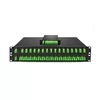
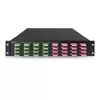
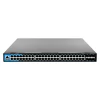
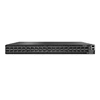
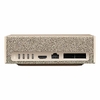
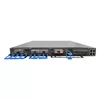
10G Media Converter: Extend 10 Gigabit Copper and Fiber Networks Without Rebuilding Infrastructure
A 10G media converter bridges the gap between 10 Gigabit copper and fiber networks — a common challenge when upgrading network links from 1G to 10G. It converts a 10GBASE-T copper Ethernet signal to fiber, extends 10GbE connections across campuses or between buildings, and connects different types of fiber segments through compatible optical interfaces.
Most 10G media converters provide transparent signal conversion without requiring changes to the existing network configuration. By using the appropriate SFP+ transceiver, they allow network teams to extend link distance, reuse existing infrastructure, and avoid replacing switches or endpoints that are still operational.
The Problem: 10G Copper Has a Distance Limit — and 10G Optics Require Careful Selection
Standard 10GBASE-T copper Ethernet supports up to 100 meters over Cat6A cabling. Beyond this distance, signal attenuation and crosstalk affect link reliability. When a security camera is located 400 meters from a switch, a remote building needs to connect to a campus backbone, or two data-center racks require a longer 10GbE connection, copper cabling alone is no longer sufficient.
Installing new fiber-based equipment everywhere can be expensive and disruptive. A 10G media converter provides a practical alternative by allowing existing copper devices to connect to fiber infrastructure.
The upgrade from 1G to 10G also introduces more optical considerations. A 10G link requires the correct selection of:
· Fiber type (multimode or single-mode)
· Optical reach
· Wavelength
· Connector type
· SFP+ transceiver compatibility
A mismatch between the switch port, optical module, and fiber infrastructure can result in issues such as an unsupported module, link failure, unstable connectivity, or an optical module that cannot achieve the expected transmission distance.
A properly matched 10G media converter and SFP+ transceiver combination eliminates much of this compatibility uncertainty while providing a straightforward path from copper to fiber.
10G Media Converters: Bridge and Extend 10 Gigabit Links Without Rebuilding
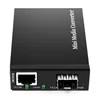
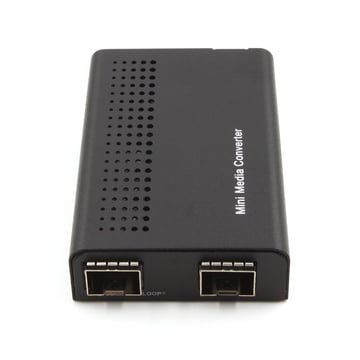
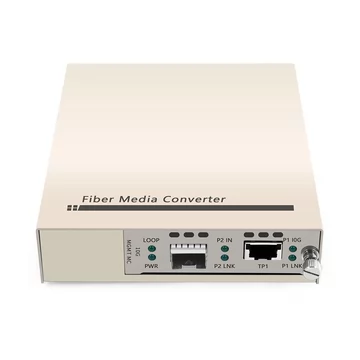
A 10G media converter is a compact networking device that converts a 10 Gigabit Ethernet signal between different physical interfaces, such as copper and fiber. Depending on the design, it can support copper-to-fiber conversion, fiber interface conversion, or multi-rate Ethernet connectivity.
Because the conversion is transparent to the network layer, most 10G media converters can work with switches and routers from different vendors without requiring software changes or network reconfiguration.
A 10G media converter helps solve three common challenges during network upgrades:
Extend Beyond the 100-Meter Copper Limit
By converting a 10GBASE-T copper connection to fiber, a media converter allows 10GbE links to extend much farther than copper cabling. The maximum distance depends on the installed SFP+ optics:
· 10GBASE-SR multimode optics can typically reach up to 300–400 meters.
· 10GBASE-LR single-mode optics can reach up to 10 km.
· 10GBASE-ER single-mode optics can reach up to 40 km.
Reduce Compatibility Issues During Deployment
A matched converter and optical module combination reduces the risk of selecting incompatible transceivers, incorrect fiber types, or unsupported optical specifications.
Reduce Infrastructure Replacement Costs
Instead of replacing existing copper switches, servers, or network equipment with fiber-native devices, organizations can upgrade only the links that require longer distance or fiber connectivity.
Copper-to-Fiber or Fiber-to-Fiber: Which 10G Conversion Do You Need?
The first step is not choosing the converter model — it is identifying the type of physical mismatch that needs to be solved.
10G Copper-to-Fiber Conversion
A copper-to-fiber 10G media converter is used when a device provides a 10GBASE-T RJ45 interface, but the network requires fiber connectivity.
Typical applications include:
· Extending a 10G connection beyond the 100-meter copper limit
· Connecting remote buildings through fiber
· Avoiding copper interference in industrial environments
The transmission distance depends on the selected SFP+ optical module, ranging from several hundred meters to 40 km.
10G Fiber-to-Fiber Conversion
A fiber-to-fiber converter connects different optical network segments when their physical characteristics do not match.
Common applications include:
· Multimode fiber connections to single-mode fiber backbones
· Different fiber interface requirements
· Optical link extensions using different SFP+ modules
The supported distance depends on the optical modules installed on both sides.
Multi-Rate Ethernet Conversion
Some 10G media converters support multiple Ethernet speeds, such as:
· 100M
· 1G
· 2.5G
· 5G
· 10G
These multi-rate converters are useful when newer 10G backbone infrastructure needs to support existing lower-speed endpoints.
10GBASE-SR, LR, or ER: Choosing the Right Fiber Type and Optical Reach
The optical transceiver is the component that determines the transmission distance of a 10G fiber link. When selecting a 10G media converter with an SFP+ slot, the converter itself does not define the maximum reach — the installed SFP+ module, fiber type, and optical budget determine how far the signal can travel.
The three most common 10GbE optical standards are 10GBASE-SR, 10GBASE-LR, and 10GBASE-ER.
10GBASE-SR: Short-Reach Multimode Fiber
10GBASE-SR uses multimode fiber with an 850 nm wavelength and is designed for short-distance applications such as:
· Data center racks
· Server rooms
· Building-level networks
With compatible multimode fiber:
· OM3 fiber supports up to approximately 300 meters
· OM4 fiber supports up to approximately 400 meters
Multimode fiber is typically the most cost-effective choice for short 10GbE connections where existing OM3 or OM4 cabling is available.
10GBASE-LR: Long-Reach Single-Mode Fiber
10GBASE-LR uses single-mode fiber at a 1310 nm wavelength and supports transmission distances up to approximately 10 km.
Typical applications include:
· Building-to-building connections
· Campus networks
· Longer enterprise backbone links
· 10GBASE-ER: Extended-Reach Single-Mode Fiber
10GBASE-ER uses single-mode fiber at a 1550 nm wavelength and supports distances up to approximately 40 km.
It is commonly used for:
· Metropolitan area links
· Long campus connections
· Extended enterprise networks
The general selection rule is:
· For links within approximately 300–400 meters, 10GBASE-SR with OM3/OM4 multimode fiber is usually the preferred option.
· For links beyond multimode distance limits, 10GBASE-LR or ER with single-mode fiber should be selected.
Because an SFP+ slot-based media converter allows the optical module to be replaced, the same converter chassis can support different transmission distances by changing only the SFP+ transceiver instead of replacing the entire device.
The 10GBASE-T SFP+ Trap — and How to Avoid It
One of the most common mistakes when deploying 10GbE links is selecting a 10GBASE-T SFP+ module as a replacement for a native copper Ethernet port.
A 10GBASE-T SFP+ module is a copper transceiver that fits into an SFP+ cage and provides an RJ45 interface. Although it appears to be a simple way to continue using copper cabling, it has several limitations.
Compared with a native 10GBASE-T RJ45 port, 10GBASE-T SFP+ modules typically:
· Consume more power
· Generate more heat
· May have compatibility limitations depending on the host device
· Often support shorter distances because SFP+ cages have stricter power and thermal limitations
Many 10GBASE-T SFP+ modules are limited to around 30 meters, while a native 10GBASE-T switch port can support up to 100 meters over Cat6A cabling.
For this reason, the recommended approach is:
· Use a native 10GBASE-T RJ45 port for short copper connections.
· Use 10GBASE-SR, LR, or ER optical modules when fiber distance or interference protection is required.
A 10G media converter is typically used to solve a copper-to-fiber requirement, rather than extending copper through an SFP+ copper module.
SFP+ Slot or Fixed Port?
10G media converters are generally available in two designs:
Fixed-Port 10G Media Converter
A fixed-port converter includes a built-in optical interface with a predefined:
· Fiber type
· Wavelength
· Transmission distance
· Connector type
It is suitable when the network requirements are known and unlikely to change.
For example, a fixed 10GBASE-LR converter can be deployed for a permanent 10 km single-mode fiber connection.
SFP+ Slot 10G Media Converter
An SFP+ slot converter allows users to select the optical module separately. The installed SFP+ transceiver determines:
· Fiber type
· Wavelength
· Transmission distance
· Optical characteristics
This design provides greater flexibility because the same converter platform can support different link distances by changing the SFP+ module.
For example:
· 10GBASE-SR SFP+ for a 300–400 m multimode connection
· 10GBASE-LR SFP+ for a 10 km single-mode connection
· 10GBASE-ER SFP+ for a 40 km single-mode connection
SFP+ slot converters are usually the better choice for networks with mixed environments, future expansion plans, or multiple link-distance requirements.
Multi-Gigabit and Managed 10G Converters
Multi-Gigabit (100M/1G/2.5G/5G/10G)
Some 10G media converters support multiple Ethernet speeds, including:
· 100 Mbps
· 1 Gigabit Ethernet
· 2.5 Gigabit Ethernet
· 5 Gigabit Ethernet
· 10 Gigabit Ethernet
These multi-rate converters are useful when a network is gradually migrating to 10GbE but still contains lower-speed devices.
For example, a 10G fiber backbone can support existing 1G or 2.5G endpoints without requiring immediate replacement of all connected equipment.
Managed vs. Unmanaged 10G Media Converters
Unmanaged 10G converters provide simple plug-and-play operation and are suitable for:
· Point-to-point fiber links
· Small deployments
· Networks where remote monitoring is not required
Managed 10G converters provide additional features such as:
· Remote status monitoring
· Link fault pass-through (LFP)
· SNMP monitoring
· Web-based configuration
Managed converters are valuable when:
· Many converter links are deployed
· Equipment is installed in remote locations
· Network administrators need visibility into link status and failures
Industrial and Hardened 10G Media Converters
For outdoor, industrial, roadside, or harsh-environment deployments, standard commercial media converters may not provide sufficient protection.
Industrial-grade 10G media converters are designed with features such as:
· Wide operating temperature ranges, commonly from -40°C to +75°C
· Rugged metal enclosures
· DIN-rail or wall mounting options
· Enhanced ESD protection
These hardened designs help maintain reliable 10GbE connectivity in environments where temperature variation, vibration, dust, or electrical interference may affect standard networking equipment.
Industrial 10G media converters typically maintain the same SFP+ flexibility as commercial models, allowing users to select the appropriate optical module based on distance and fiber requirements.
Frequently Asked Questions
What is a 10G media converter used for?
A 10G media converter converts a 10 Gigabit Ethernet signal between different physical interfaces, such as copper and fiber.
The most common applications include:
· Copper-to-fiber conversion — extending 10GBASE-T connections beyond the 100-meter copper distance limitation by using fiber optics.
· Fiber-to-fiber conversion — connecting different fiber types, such as multimode and single-mode fiber segments, or adapting different optical interfaces.
· Multi-rate Ethernet support — allowing networks with different Ethernet speeds, such as 1G, 2.5G, 5G, and 10G, to connect through compatible converter models.
By using the appropriate optical module, a 10G media converter allows organizations to extend network distance while keeping existing switches and endpoints.
How do I convert 10GBASE-T copper to fiber?
To convert a 10GBASE-T copper connection to fiber, use a 10G media converter with:
· One 10GBASE-T RJ45 copper interface
· One fiber interface, either fixed optical port or SFP+ slot
For an SFP+ slot converter, select the optical module based on the required distance:
· 10GBASE-SR SFP+ for short-distance multimode fiber links
· 10GBASE-LR SFP+ for single-mode fiber links up to approximately 10 km
· 10GBASE-ER SFP+ for single-mode fiber links up to approximately 40 km
The converter transparently converts the electrical Ethernet signal to an optical signal, allowing the copper device to communicate across a fiber infrastructure.
What is the difference between 10GBASE-SR, 10GBASE-LR, and 10GBASE-ER?
The main difference is the optical transmission distance and fiber type.
10GBASE-SR uses multimode fiber at an 850 nm wavelength. It is designed for short-distance connections and supports approximately:
· 300 meters over OM3 fiber
· 400 meters over OM4 fiber
It is commonly used in data centers, server rooms, and short building connections.
10GBASE-LR uses single-mode fiber at a 1310 nm wavelength and supports distances up to approximately 10 km.
It is commonly used for:
· Campus networks
· Building-to-building connections
· Enterprise backbone links
10GBASE-ER uses single-mode fiber at a 1550 nm wavelength and supports distances up to approximately 40 km.
It is designed for longer-distance applications, including:
· Metropolitan links
· Extended campus networks
· Long enterprise fiber connections
Can I use a 10GBASE-T SFP+ module in a 10G media converter?
Technically, yes. A 10GBASE-T SFP+ module can be installed in an SFP+ slot because it provides an RJ45 copper interface.
However, it is usually not the preferred solution for extending 10GbE connections.
Compared with native 10GBASE-T switch ports, 10GBASE-T SFP+ modules typically:
· Require more power
· Produce more heat
· Have stricter host-device compatibility requirements
· Often support shorter distances, commonly around 30 meters depending on the module design
For short copper connections, a native 10GBASE-T port is usually the better option.
For longer-distance connections, use fiber-based SFP+ optics such as:
· 10GBASE-SR
· 10GBASE-LR
· 10GBASE-ER
with a compatible 10G media converter.
Should I choose an SFP+ slot or a fixed fiber port?
The choice depends on whether the network requirements are fixed or may change in the future.
A fixed-port 10G media converter is suitable when:
· The fiber type is already known
· The transmission distance is permanent
· The network design will not change frequently
For example, a fixed 10GBASE-LR converter can be used for a dedicated 10 km single-mode fiber link.
An SFP+ slot 10G media converter provides more flexibility because the optical module can be changed.
It allows the same converter platform to support:
· Multimode fiber with 10GBASE-SR
· Single-mode fiber with 10GBASE-LR
· Extended-distance links with 10GBASE-ER
An SFP+ design is generally more suitable for environments with different link distances or future expansion requirements.
How far can a 10G media converter transmit?
The transmission distance depends on the installed SFP+ module, fiber type, and optical budget.
Typical distances include:
· 10GBASE-SR multimode fiber: approximately 300–400 meters
· 10GBASE-LR single-mode fiber: up to approximately 10 km
· 10GBASE-ER single-mode fiber: up to approximately 40 km
A media converter with an SFP+ slot allows users to change the optical module to match different distance requirements without replacing the converter hardware.
Do I need a managed or unmanaged 10G media converter?
The choice depends on network management requirements.
Unmanaged 10G media converters are suitable for:
· Simple point-to-point connections
· Small networks
· Applications where remote monitoring is not required
They provide plug-and-play operation without additional configuration.
Managed 10G media converters provide additional monitoring and control functions, including:
· Remote status monitoring
· Link fault pass-through (LFP)
· SNMP management
· Web-based configuration
Managed converters are useful when:
· Many converter links are deployed
· Devices are installed in remote locations
· Network administrators need visibility into link status and failures
Can a 10G media converter connect different fiber types?
Yes, some 10G media converters can connect different fiber environments when compatible optical modules are used.
Common examples include:
· Multimode fiber to single-mode fiber conversion
· Different optical interface types
· Fiber links requiring different transmission distances
The actual capability depends on the converter design and the supported SFP+ modules.
Does a 10G media converter require network configuration?
In most cases, no.
A standard unmanaged 10G media converter operates transparently and does not require IP configuration, software installation, or routing changes.
However, managed 10G media converters may provide additional configuration options for monitoring, diagnostics, and network management.
Conclusion
A 10G media converter provides a practical way to extend 10GbE networks without replacing existing infrastructure. By converting between copper and fiber interfaces, supporting different optical reaches, and allowing flexible SFP+ selection, it helps organizations upgrade network connectivity while reducing deployment complexity and cost.
For short connections, 10GBASE-SR multimode optics provide an economical solution. For longer links, 10GBASE-LR and 10GBASE-ER single-mode optics provide extended reach. Selecting the correct converter type and optical module ensures reliable 10GbE connectivity across enterprise, campus, industrial, and data center environments.