Chromatic dispersion is the quiet ceiling on every long-haul DWDM link. Beyond a few kilometers, the pulses of a 100G or 400G direct-detect signal spread until the receiver can no longer read them. Adding amplifiers alone doesn't fix it, because an EDFA boosts the distortion right along with the signal.
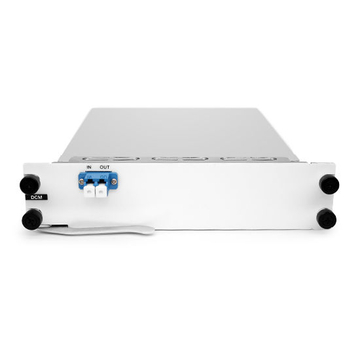
A dispersion compensation module (DCM) removes that ceiling. Built on dispersion-compensating fiber (DCF) with a negative dispersion value across the C-band, a DCM recompresses optical pulses so your signal stays clean and error-free over 100 km and beyond.
The Problem: Why Chromatic Dispersion Caps Your DWDM Reach
In a DWDM system, different wavelengths travel at slightly different speeds through standard single-mode fiber (G.652). Over distance, this speed difference smears each optical pulse outward—a phenomenon known as chromatic dispersion. The longer the span, the worse the smear.
Two factors make this a difficult problem for long-haul engineers:
· Amplifiers don't help: An EDFA restores power but amplifies the already-dispersed signal. You get a louder, yet still unreadable, pulse.
· The limit arrives sooner at higher rates: Dispersion tolerance drops as bit rates rise. A direct-detect 100G QSFP28 DWDM channel (such as PAM4) needs dispersion compensation after roughly 5 to 6 km; at 400G and above, the tolerance window is even tighter.
The result: without dispersion management, your 100 km, 200 km, or 400 km trunk simply won't close. Regeneration (OEO) works, but it is expensive, power-hungry, and adds latency at every site.
A dispersion compensation module provides a cost-effective fix. It is a passive device that reverses the dispersion at the receiving end before the signal hits the transceiver.
The Solution: DCF-Based Dispersion Compensation Modules
FiberMall DCMs are passive, protocol-transparent modules built on dispersion-compensating fiber. DCF carries a negative chromatic dispersion value across the 1525–1565 nm C-band. When placed inline with your G.652 span, it cancels the accumulated positive dispersion and restores a clean eye diagram.
Key Benefits:
· Extend reach without regeneration: Push 100G/400G direct-detect DWDM channels past 100 km using passive compensation instead of costly OEO.
· Low, flat insertion loss: Ranging from ≤ 2.6 dB at 10 km to ≤ 11.5 dB at 120 km, ensuring your link budget survives the compensation stage.
· Low PMD (1.0 ps) and low PDL (0.5 dB): Critical for the narrow optical tolerances of high-speed direct-detect channels.
· 100% slope compensation in the C-band: Perfectly matched to G.652 fiber, with G.655 support available.
· Protocol transparent: Works seamlessly with SDH/SONET, OTN, DWDM, and CATV without altering the data rate.
FiberMall DCM Specifications & Models
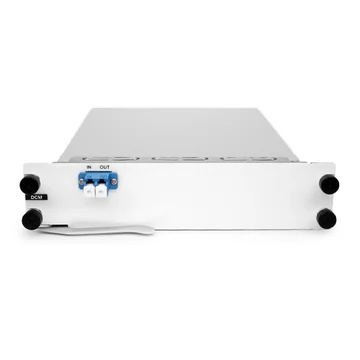
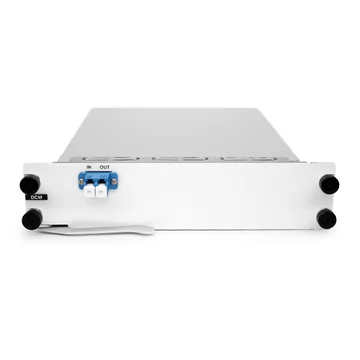
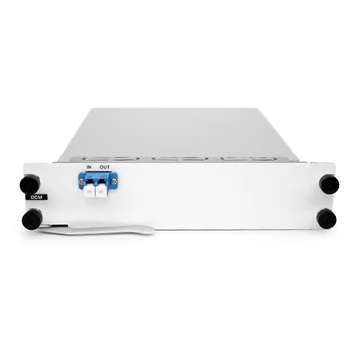
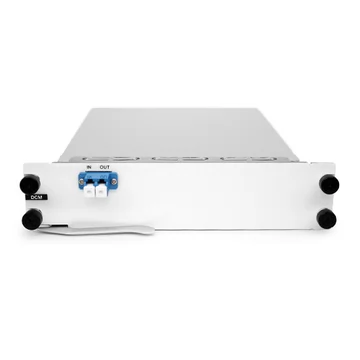
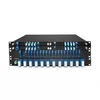
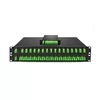
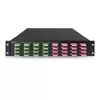
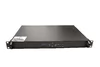
Every FiberMall dispersion compensation module is Telcordia GR-2854-CORE qualified and RoHS compliant, delivered in either an LGX box module or a 2-slot 1U rack chassis that accepts two DCM modules.
Compensation Distance and Specifications:
· 10 km: Dispersion of −165 to −175 ps/nm at 1545 nm, with an insertion loss of ≤ 2.6 dB.
· 20 km: Dispersion of −330 to −350 ps/nm at 1545 nm, with an insertion loss of ≤ 4.0 dB.
· 30 km: Dispersion of −495 to −525 ps/nm at 1545 nm, with an insertion loss of ≤ 5.0 dB.
· 40 km: Dispersion of −660 to −700 ps/nm at 1545 nm, with an insertion loss of ≤ 6.0 dB.
· 60 km: Dispersion of −990 to −1020 ps/nm at 1545 nm, with an insertion loss of ≤ 8.0 dB.
· 80 km: Dispersion of −1320 to −1360 ps/nm at 1545 nm, with an insertion loss of ≤ 9.5 dB.
· 100 km: Dispersion of −1650 to −1750 ps/nm at 1545 nm, with an insertion loss of ≤ 10.5 dB.
· 120 km: Dispersion of −1990 to −2090 ps/nm at 1545 nm, with an insertion loss of ≤ 11.5 dB.
Additional Specifications:
· Wavelength range: 1525–1565 nm (C-band)
· Center wavelength: 1550.12 nm
· PMD: ≤ 1.0 ps
· PDL: ≤ 0.5 dB
· Connector options: LC/UPC, LC/APC, SC/UPC, SC/APC, FC/UPC, FC/APC
· Form factor: LGX box module or 2-slot 1U rack chassis
· Operating temperature: −5°C to 70°C
How to Choose the Right Compensation Distance
The most common question engineers ask is not whether they need a DCM, but how much compensation to specify. The answer comes from a simple dispersion budget.
Step 1 — Find the accumulated dispersion of your span: Multiply your fiber distance by the fiber's dispersion coefficient. Standard G.652 fiber has a coefficient of roughly 17 ps/(nm·km) at 1545 nm.
Step 2 — Match the DCM to that value: For a 40 km span, the accumulated dispersion is about 40 × 17 ≈ 680 ps/nm. Therefore, you would select the 40 km module (which provides −660 to −700 ps/nm).
Step 3 — Leave headroom for slope: Choose the module whose dispersion range brackets your calculated value, and be sure to account for connector and splice losses in your optical power budget.
A quick reference for common spans:
· 40 km span → 40 km DCM (−660 to −700 ps/nm)
· 80 km span → 80 km DCM (−1320 to −1360 ps/nm)
· 120 km span → 120 km DCM (−1990 to −2090 ps/nm)
If your span length is likely to change over time—or if you are compensating across mixed fiber types—a tunable dispersion compensation module may be a better fit.
A Complete Long-Haul Solution: DCM + EDFA + DWDM MUX
Most suppliers sell a DCM in isolation, but FiberMall delivers the entire long-haul chain.
Our dispersion compensation modules are engineered to work alongside FiberMall EDFA optical amplifiers and passive DWDM multiplexers—including 1×, 4×, 24×, and 48× 100G QSFP28 DWDM configurations. The result is a validated, point-to-point solution that pushes 100G DWDM channels beyond 100 km without regeneration, all sourced from a single vendor.
This matters for three key reasons:
· One tested stack, not three vendors: The DCM, amplifier, and MUX are designed to interoperate, avoiding the finger-pointing that often comes with mixing suppliers.
· Simpler procurement: One quote, one lead time, and one support contact for the entire optical transport chain.
· Lower total cost: Passive compensation combined with amplification replaces the costly regeneration sites that would otherwise be required every 80 to 120 km.
Fixed DCF vs. Tunable Dispersion Compensation
DCMs come in two families, and the right choice depends on the stability of your spans.
Fixed DCF modules (like the FiberMall DCM series) are the workhorses of the industry. They offer the lowest insertion loss, the best cost per ps/nm, and a fully passive design with no power requirements or control-plane overhead. For most point-to-point DWDM trunks with a known span length, fixed DCF is the clear winner in both cost and reliability.
Tunable dispersion compensators (TDCM, typically FBG-based) allow you to adjust compensation electronically. They earn their price premium in two scenarios: networks where span lengths change frequently, and links that require per-channel or per-span fine-tuning. However, they introduce additional insertion loss and complexity in exchange for that flexibility.
What Our Customers Ask (FAQ)
What is a dispersion compensation module used for?
A DCM corrects chromatic dispersion in long fiber spans, restoring clean optical pulses so DWDM and OTN links can transmit reliably beyond roughly 40 km—and well past 100 km when paired with an EDFA amplifier.
How much dispersion compensation do I need for my fiber span?
Multiply your span distance by your fiber's dispersion coefficient (about 17 ps/(nm·km) for G.652 at 1545 nm), then select the DCM whose dispersion range brackets that value. For example, a 40 km span generates roughly 680 ps/nm of dispersion, which is perfectly offset by a 40 km module.
What is the difference between a fixed DCM and a tunable DCM?
A fixed DCM uses dispersion-compensating fiber to provide a static compensation value, offering the lowest loss and lowest cost. A tunable DCM adjusts compensation electronically, making it suitable for networks where span lengths change, though it comes at a higher price and with slightly higher insertion loss.
Do 100G DWDM links require dispersion compensation?
Yes, specifically direct-detect formats. A direct-detect 100G QSFP28 DWDM channel (like PAM4) typically requires dispersion compensation beyond about 5 to 6 km of G.652 fiber. FiberMall DCMs, when paired with an EDFA and DWDM MUX, can support these point-to-point 100G links beyond 100 km.
What is DCF (dispersion-compensating fiber)?
DCF is a specialty optical fiber engineered to have a negative chromatic dispersion value in the C-band. When placed inline with standard G.652 single-mode fiber, it cancels out the accumulated positive dispersion and restores the integrity of the signal.
Which connector and form factor options are available?
FiberMall DCMs are available as LGX box modules or in a 2-slot 1U rack chassis. Connector options include LC, SC, and FC formats in both UPC and APC polishes.