A single cut fiber span is enough to take a metro ring, an ISP backbone, or a DWDM trunk offline—and every minute of downtime carries revenue and SLA costs your team has to answer for.
Optical line protection (OLP) removes that single point of failure. An OLP monitors your working and standby fibers in real time and switches traffic automatically the moment the working path degrades, often in under 15 ms—fast enough that most services never notice the failover.
The Problem: One Cut Fiber, One Network Outage
Most fiber links are provisioned as a single path. That works until a backhoe, a failed splice, or a degraded connector takes it down. When it happens:
· Traffic stops. Customers lose service, and every minute compounds the outage cost.
· Recovery is manual. Rerouting by hand means a human has to detect the fault, make a decision, and reconfigure the network—adding minutes to hours of exposure.
· SLAs are at risk. Carrier and enterprise SLAs often tolerate only milliseconds of disruption. Exceeding that threshold triggers strict financial penalties.
Diversity helps—such as running a second fiber path—but diversity alone doesn't switch traffic. A system must monitor both fibers and execute the cutover the instant one fails. That system is an optical line protection platform.
The Solution: Automatic Protection Switching With FiberMall OLP
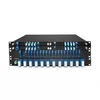
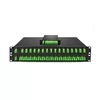
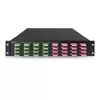
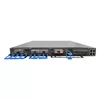
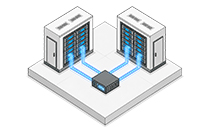
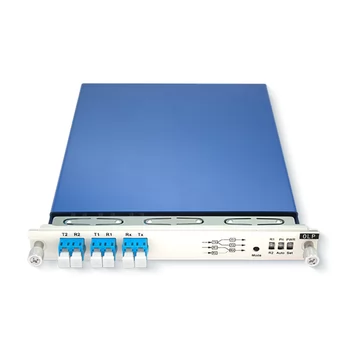
A FiberMall optical line protection platform is a protocol-transparent device deployed in pairs—one at each end of the link. It continuously monitors optical power on the working and standby fibers and automatically switches to the standby path when the primary path fails.
Key Benefits:
· Failover in under 15 ms (1+1): This operates far faster than the ~50 ms threshold that disrupts most services, keeping you well within SLA requirements.
· No manual intervention required: Automatic, forced-manual, and remote-control switching modes cover both unattended and operator-driven operations.
· Real-time power monitoring: Operators can view live optical power on every path with adjustable alarm and switching thresholds.
· Three protection modes in one platform: Supports 1+1, 1:1, and 1-1 configurations, meaning a single device can adapt to most network designs.
· Protocol-transparent: Works seamlessly with DWDM, CWDM, SDH/SONET, PDH, and PON traffic without altering or restricting the data rate.
Which Mode Do You Need: 1+1 vs. 1:1 vs. 1-1?
Choosing the right protection mode is a critical decision for network engineers. Here is how the three primary modes compare:
· 1+1 Mode: The signal is split and transmitted over both paths simultaneously, while the receiver selects the better signal. It delivers the simplest, lowest-latency failover with a switching time of under 15 ms. It is the default standard for mission-critical links where failover speed matters most.
· 1:1 Mode: The working path carries primary traffic, while the standby path carries extra, lower-priority traffic until a switch occurs. It offers a cost-efficient use of standby fiber with a switching time of under 35 ms. This is the smart choice when you want to extract value from an otherwise idle standby fiber.
· 1-1 Mode: This mode features fully separate working and protection paths with no shared components, providing strict redundancy. It operates with an automatic switching time of 20 ms or less and is ideal when the primary and protection paths must remain completely isolated.
FiberMall OLP Specifications
Every FiberMall optical line protection platform is built for carrier-grade operation, featuring dual hot-swappable power supplies and comprehensive remote management. The key technical specifications include:
· Protection Modes: Supports 1+1, 1:1, and 1-1 configurations.
· Switching Time: Less than 15 ms for 1+1; less than 35 ms for 1:1; and 20 ms or less for 1-1 automatic switching.
· Wavelength Range: Operates robustly within 1310±50 nm and 1550±50 nm windows.
· Insertion Loss: For 1+1 setups, the transmit (TX) loss is ≤4.0 dB (accounting for the 50/50 signal split), and the receive (RX) loss is ≤1.5 dB. For 1:1 setups, the total insertion loss is ≤1.5 dB.
· Signal Integrity: Delivers a return loss of ≥45 dB, crosstalk isolation of ≥55 dB, and a polarization-dependent loss (PDL) of ≤0.1 dB.
· Optical Power Monitoring: Spans a highly sensitive range from −50 to +23 dBm with user-adjustable thresholds.
· Power Supply: Equipped with dual hot-swappable AC 220V and DC 48V inputs for hardware redundancy.
· Management: Fully accessible via SNMP, RJ45 web GUI, LCD front panel, and CLI.
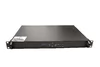
· Form Factor: Housed in a standard 1RU rack chassis (typically deployed in pairs at opposite link ends).
Run Extra Traffic on Your Standby Fiber
A standby fiber that sits dark is money left on the table. In 1:1 mode, a FiberMall OLP keeps the standby path productive: lower-priority traffic travels on the protection fiber during normal operation. The moment the working path fails, that extra traffic is automatically dropped, and the primary service seamlessly switches over.
This turns your protection investment into a dual-purpose asset—providing both resilience and usable capacity. It is a capability few vendors highlight, and one that changes the ROI math on network protection.
A Complete Resilient-Transport Stack
Optical line protection is most valuable as part of a resilient long-haul chain. FiberMall provides every link of that chain:
· OLP: Automatic protection switching for the fiber span.
· EDFA Optical Amplifier: Extends signal reach without the need for OEO regeneration.
· Dispersion Compensation Module (DCM): Keeps high-speed 100G/400G signals clean over long distances.
· Passive DWDM MUX: Multiplexes up to 48×100G channels onto a single fiber pair.
Applications
· FiberMall optical line protection platforms support the full range of fiber networks:
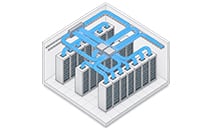
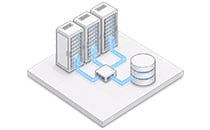
· DWDM / OTN Trunks: Protect long-haul and metro wavelength-multiplexed links.
· SDH / SONET Backbones: Provide automatic protection for existing transport infrastructure.
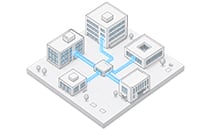
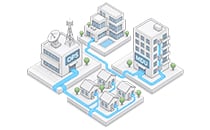
· ISP and Metro Networks: Keep customer circuits online when a span fails.
· PON / FTTx Aggregation: Protect feeder fibers carrying thousands of broadband subscribers.
What Our Customers Ask (FAQ)
What is optical line protection (OLP)?
Optical line protection is an automatic switching technology for fiber links. Deployed in pairs at each end of a link, an OLP monitors working and standby fibers and switches traffic to the standby path the moment the working path degrades, requiring no manual intervention.
What is the difference between OLP 1+1 and 1:1?
In 1+1 protection, the signal is split and sent down both paths simultaneously, and the receiver selects the better one, ensuring the fastest failover (<15 ms). In 1:1 protection, the standby path can carry lower-priority traffic until a switch is triggered, utilizing idle capacity more efficiently but at a slightly higher switching time (<35 ms).
How fast does an OLP switch?
A FiberMall 1+1 OLP platform switches in under 15 ms, while a 1:1 platform switches in under 35 ms. Both metrics sit comfortably below the standard 50 ms threshold that typically disrupts services and triggers SLA penalties.
What is 1-1 optical line protection?
1-1 protection maintains fully separate working and protection paths that share no internal components, ensuring the strictest hardware redundancy. It is used in architecture where working and protection traffic must remain completely isolated prior to a switch.
Can I run extra traffic on my standby fiber?
Yes. In 1:1 mode, the standby fiber carries lower-priority traffic during normal operation. That traffic is dropped automatically when a failover occurs, ensuring your protection fiber isn't sitting idle while waiting for an emergency.
Does OLP work in DWDM networks?
Yes. FiberMall OLP platforms are protocol-transparent and wavelength-agnostic. Operating primarily at 1310 nm and 1550 nm (with wider ranges available on select models), they protect DWDM, CWDM, SDH/SONET, and PON traffic alike without modifying the underlying optical signals.