CWDM OADM: Add and Drop Wavelengths Without Installing New Fiber
New fiber routes are expensive to deploy and often impossible to expand quickly. A CWDM OADM, or Coarse Wavelength Division Multiplexing Optical Add-Drop Multiplexer, allows specific wavelength channels to be added or dropped at intermediate sites while all remaining wavelengths continue along the express path.
The device requires no electrical power, introduces no protocol processing, and eliminates the need to install or lease additional fiber for every new service.
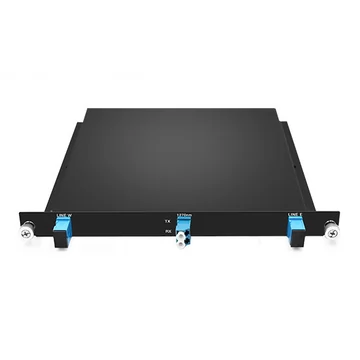
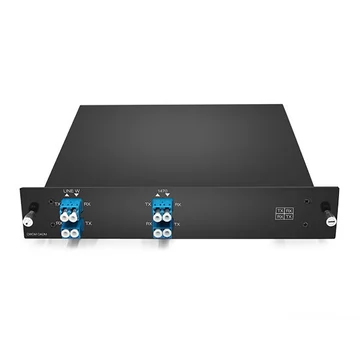
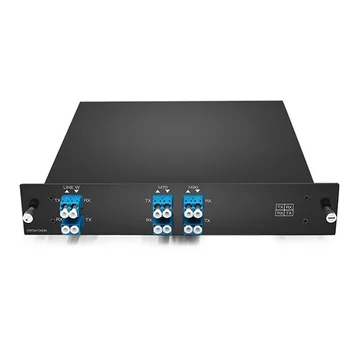
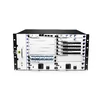
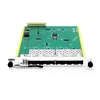
FiberMall supplies passive CWDM OADM modules in 1-channel, 2-channel, 4-channel, and 8-channel configurations. Options include single-fiber and dual-fiber designs, East-only, West-only, and East-and-West configurations, as well as LGX-compatible modules and other compact packaging formats. The modules are designed in accordance with the ITU-T G.694.2 CWDM wavelength grid and are available for industrial-temperature applications.
Running Out of Fiber Capacity? Add Nodes Without Adding Cable
Network engineers face the same constraint in metro rings, enterprise campuses, 5G fronthaul networks, and multi-site access networks: the fiber infrastructure is already in place, but new sites still require additional bandwidth.
Installing new fiber is costly, time-consuming, and sometimes physically impractical because of limited conduit space, leased ducts, right-of-way restrictions, or construction requirements.
A CWDM OADM addresses this challenge by allowing multiple independent optical wavelength channels to share one fiber or one fiber pair, depending on the selected configuration. At an intermediate node, selected wavelengths are dropped to local equipment while locally generated optical signals are added to the line. All other wavelength channels continue along the express path without being terminated.
In a dual-fiber network, separate fibers are normally used for transmission in each direction, and the same nominal wavelength can be used on both fibers. In a single-fiber bidirectional network, different wavelength sets are typically assigned to the two transmission directions.
Because the CWDM OADM is completely passive, it requires no electrical power, cooling, fans, software, or active management. Only normal fiber-connector inspection, cleaning, and optical-link maintenance are required.
FiberMall CWDM OADM Solution Overview
FiberMall CWDM OADM modules provide selective wavelength access in CWDM ring, bus, linear, and point-to-point topologies.
Each module is assembled using thin-film filter, or TFF, technology to achieve low insertion loss, high channel isolation, low polarization-dependent loss, and stable long-term optical performance.
Key Benefits
• Passive operation: No power supply, fans, software, or active monitoring system is required.
• Protocol-transparent transmission: The OADM does not inspect or process the transmitted protocol. It can carry Ethernet, Fibre Channel, SDH/SONET, video, RF-over-fiber, and other optical services, provided that the transceiver wavelength, channel passband, optical power, and link budget are compatible.
• ITU-T G.694.2 wavelength grid: Supports nominal CWDM center wavelengths from 1271 nm to 1611 nm with 20 nm channel spacing. Some products may still use legacy wavelength labels such as 1270 nm, 1290 nm, and 1310 nm in their model names.
• Flexible configurations: Available in single-fiber or dual-fiber designs and with East-only, West-only, or East-and-West line access.
• Industrial-grade reliability: Selected configurations support operating temperatures from -40°C to +85°C. The applicable temperature range should be confirmed for each housing, connector, and channel configuration.
• Matched transceiver options: FiberMall CWDM OADMs can be paired with compatible FiberMall CWDM SFP, SFP+, SFP28, and other wavelength-specific transceivers, subject to the required data rate, wavelength, reach, and optical power budget.
Features That Deliver Reliable Wavelength Add/Drop
Low Insertion Loss for Better Link Budgets
Insertion loss generally increases as the number of channels and optical filtering stages increases.
FiberMall CWDM OADMs are designed to keep add-port, drop-port, and express-path insertion loss within the specified limits, helping preserve the available optical power budget across multi-node CWDM rings and linear networks.
Actual insertion loss depends on the channel count, single-fiber or dual-fiber design, East/West configuration, connector type, packaging format, and optional monitor or upgrade ports. Configuration-specific maximum values should therefore be confirmed in the applicable product datasheet.
High Channel Isolation
High channel isolation helps prevent optical crosstalk between adjacent and non-adjacent CWDM wavelengths.
Depending on the configuration, adjacent-channel isolation can reach at least 30 dB, while non-adjacent-channel isolation can reach at least 40 dB. These values help maintain clean wavelength separation and stable signal transmission.
Guaranteed isolation values should be confirmed against the datasheet for the selected model.
Optional Monitor and Upgrade Ports
An optional monitor port can tap a small percentage of the optical signal for power measurement, performance monitoring, or troubleshooting without disconnecting the live line.
Because the monitor port uses an optical tap, it introduces a small amount of additional line loss. The monitor tap ratio and associated insertion loss depend on the selected design.
An optional upgrade port can route unused wavelength bands or remaining channels to an additional WDM device, allowing future capacity expansion without replacing the original OADM.
The terms “express port,” “pass-through port,” and “upgrade port” may describe different optical functions depending on the product design. The exact port definition should therefore be confirmed on the port diagram and product datasheet.
Multiple Connector and Polish Options
FiberMall CWDM OADMs are available with LC, SC, or FC connectors and with UPC or APC polish, depending on the housing and application.
APC connectors are commonly used in PON, FTTx, CATV, analog RF, and other reflection-sensitive applications because of their lower back reflection. UPC connectors are widely used in Ethernet, Fibre Channel, and general digital optical networks.
The connector type and polish must match the connected transceivers, patch panels, and fiber infrastructure. APC and UPC connectors must not be directly mated because their end-face geometries are different.
LGX-Compatible and Rack-Mount Packaging
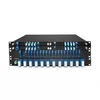
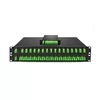
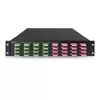
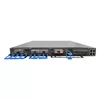
LGX-compatible modules simplify installation in 1U or multi-slot 19-inch rack-mount chassis. They provide organized front-panel access and make it easier to add, replace, or rearrange passive WDM modules.
Compact ABS-box, mini-module, steel-tube, cassette, and fiber-tray packages may also be available for wall-mounted cabinets, splice enclosures, outdoor cabinets, and space-constrained remote sites.
The correct package should be selected according to the available installation space, connector-access requirements, environmental conditions, and cable-management method.
CWDM OADM Specifications
FiberMall CWDM OADMs use passive thin-film filter technology and are designed around the ITU-T G.694.2 CWDM wavelength grid.
The nominal CWDM center-wavelength range is 1271 nm to 1611 nm, with 20 nm spacing between adjacent channels.
Standard channel-count options include 1 channel, 2 channels, 4 channels, and 8 channels. Custom wavelength combinations and channel counts may be available for project or OEM/ODM requirements.
Single-mode fiber is used internally and for pigtail connections. Depending on the package and configuration, the fiber may be G.652.D, G.657.A1, or another compatible single-mode fiber type.
Available connector options may include LC, SC, and FC connectors with UPC or APC polish.
Add-port and drop-port insertion loss depends on the number of channels and the internal filter structure. A 1-channel module may have an insertion loss of approximately 0.6 dB or lower, while some 8-channel configurations may have a maximum insertion loss of approximately 2.5 dB. These values must not be treated as universal limits for every design because East-and-West, single-fiber, monitor-port, upgrade-port, and connectorized versions may have different loss specifications.
Express-path or pass-through insertion loss also varies according to the number of filtering stages and the selected configuration. The applicable value should be taken from the model-specific datasheet.
Typical design targets may include adjacent-channel isolation of at least 30 dB and non-adjacent-channel isolation of at least 40 dB.
Polarization-dependent loss may be specified at 0.3 dB or lower, while polarization mode dispersion may be specified at 0.2 ps or lower, depending on the selected model.
Return loss may be specified at 45 dB or higher for UPC versions, while APC versions may provide higher return-loss performance. Directivity may be specified at 50 dB or higher.
Selected industrial-grade models can support operating temperatures from -40°C to +85°C. Storage-temperature limits may be wider and should be checked separately.
Product environmental compliance may include RoHS and CE compliance where applicable. Reliability qualification may be based on relevant Telcordia requirements when supported by test documentation.
ISO 9001 refers to the manufacturer’s or supplier’s quality management system and should not be described as an individual product-performance certification. FCC compliance should only be stated when it is applicable to the specific product and supported by valid documentation.
How to Choose Your CWDM OADM Configuration
Selecting the right CWDM OADM requires consideration of three separate factors: fiber configuration, line direction, and channel count.
Single-Fiber, East-Only or West-Only Configuration
A single-fiber, single-sided OADM is suitable for linear or point-to-point applications in which the intermediate node accesses wavelengths from one network direction.
Single-fiber bidirectional transmission normally uses different wavelengths for the two traffic directions. The wavelength plan must therefore be coordinated with the transceivers installed at both ends of the link.
This configuration may be referenced by an internal ordering code such as “SS,” but such codes are not universal industry abbreviations and should always be defined in the product documentation.
Single-Fiber, East-and-West Configuration
A single-fiber East-and-West OADM provides wavelength access from both sides of an intermediate node while using a single fiber for bidirectional transmission on each span.
Different wavelength sets are typically assigned to opposite transmission directions. Careful wavelength planning is required to avoid assigning the same wavelength to incompatible traffic directions.
An internal code such as “SD” may be used for ordering purposes, but the full configuration description should always be provided to avoid ambiguity.
Dual-Fiber, East-Only or West-Only Configuration
A dual-fiber, single-sided OADM uses a fiber pair, with one fiber carrying traffic in one direction and the second fiber carrying traffic in the opposite direction.
This design is commonly used in traditional CWDM ring, bus, and linear networks. It is generally easier to plan than a single-fiber system because the same nominal wavelength can be used for opposite traffic directions on separate fibers.
An ordering reference such as “DS” may be used internally, provided that it is clearly defined.
Dual-Fiber, East-and-West Configuration
A dual-fiber East-and-West OADM provides wavelength add/drop access toward both sides of a node and is suitable for dual-fiber ring or resilient network architectures.
The passive OADM itself does not detect failures, switch traffic, or perform protection routing. Network protection must be implemented by active transmission equipment, optical switches, Ethernet protection protocols, or another control mechanism.
An internal ordering code such as “DD” may be used, but it should not be presented as an industry-standard abbreviation.
Selecting the Channel Count
A 1-channel OADM is appropriate when only one local optical service must be added and dropped.
A 2-channel or 4-channel OADM is suitable for sites that require multiple Ethernet, storage, mobile-fronthaul, video, or other services.
An 8-channel OADM is commonly used at larger aggregation nodes or sites where additional wavelength capacity is expected.
Single-Fiber Versus Dual-Fiber
A single-fiber configuration saves fiber resources by transmitting the two traffic directions on different wavelength sets over one fiber.
A dual-fiber configuration uses a fiber pair, with separate fibers for the two transmission directions. It is generally simpler to design, troubleshoot, and expand in conventional ring and point-to-point networks.
East and West
“East” and “West” describe the two sides or transmission directions of the fiber span connected to an intermediate node.
A single-sided OADM provides wavelength access from only one side and can reduce cost and insertion loss in simple linear networks.
An East-and-West OADM provides wavelength access toward both network directions and can be incorporated into ring or protected network architectures. However, protection switching and traffic rerouting must be performed by active network equipment or network protocols rather than by the passive OADM itself.
Applications for FiberMall CWDM OADM
Metro Access and Carrier Rings
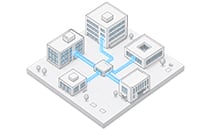
CWDM OADMs can add or drop selected wavelength channels at central offices, points of presence, street cabinets, aggregation sites, or customer handoff locations.
Only the wavelengths required at each node are terminated. All other wavelengths continue through the express path, avoiding the need to demultiplex and reconnect the entire CWDM wavelength set at every site.
5G Fronthaul and C-RAN
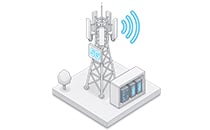
CWDM OADMs can add or drop wavelength channels between centralized baseband resources and remote radio or access sites.
Because the OADM is passive, it does not introduce packet-processing or protocol-conversion stages. This reduces remote-site power, cooling, space, and management requirements compared with active transport equipment.
The complete optical link must still be designed around the transceiver wavelength tolerance, optical power budget, fiber loss, connector loss, dispersion, and the cumulative insertion loss of all passive devices.
Enterprise Campus and Multi-Site Networks
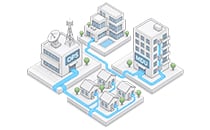
Organizations can use CWDM OADMs to increase the capacity of existing campus or metropolitan fiber infrastructure.
Separate wavelength channels can carry Ethernet, storage, voice, security-camera, building-management, or other services between offices, buildings, factories, hospitals, and education campuses.
Data Center Interconnect
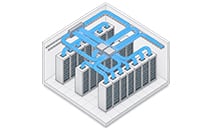
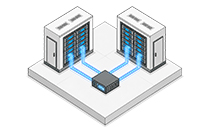
CWDM OADMs can increase inter-site capacity between nearby data centers over existing metro fiber infrastructure.
They are particularly suitable for cost-sensitive, lower-channel-count, and moderate-distance DCI applications using compatible CWDM transceivers.
For high-capacity, long-distance, or coherent optical DCI systems requiring many channels, amplification, dispersion management, or advanced optical monitoring, a DWDM or coherent transport platform may be more appropriate.
CATV, Broadcast, and RF Over Fiber
CWDM OADMs can allocate dedicated wavelength channels to analog video, broadcast, CATV, or RF-over-fiber services.
APC-polished connectors are commonly selected for these reflection-sensitive applications. Connector polish, return loss, optical power levels, and receiver requirements must be matched throughout the system.
CWDM OADM vs. Full Mux/Demux vs. DWDM OADM
Intermediate Node Requiring One to Four Wavelengths
A CWDM OADM is normally the preferred option when an intermediate site needs access to only a small number of wavelength channels.
It provides lower cost and often lower insertion loss than terminating every wavelength through a full Mux/Demux. Unselected channels remain on the express path.
Terminal Node Aggregating All CWDM Channels
A full CWDM Mux/Demux is appropriate at a terminal or endpoint where all wavelength channels must be combined onto, or separated from, the line fiber.
Unlike an OADM, a full Mux/Demux provides individual access to the complete configured wavelength set.
High-Density Long-Haul or Core Network
A DWDM OADM or DWDM Mux/Demux is more suitable for high-density networks that require tighter channel spacing, greater channel counts, C-band optimization, amplification, or long-distance transmission.
DWDM platforms can support 40, 80, 96, or more channels, depending on the selected grid, filter technology, and optical system design.
Space-Constrained Remote Site
A compact CWDM module can provide wavelength add/drop functionality in a smaller package for cabinets, enclosures, splice trays, or remote sites with limited rack space.
The optical performance may be similar to an LGX or rack-mounted version, but connector access, fiber handling, environmental protection, and installation method must be considered.
CWDM OADMs are the correct choice when selected wavelengths must be accessed at an intermediate point in the network.
Full CWDM Mux/Demux devices are normally installed at endpoints where all configured wavelengths must be combined or separated.
DWDM OADMs are better suited to core, long-haul, and high-capacity networks that require denser channel spacing and a larger number of wavelengths.
FAQ
What Is a CWDM OADM?
A CWDM OADM is a passive optical device that adds or drops one or more CWDM wavelength channels at an intermediate point in a fiber network while allowing all remaining wavelengths to continue along the express path.
It is commonly used in CWDM rings, bus networks, linear chains, campus networks, mobile-fronthaul systems, and metro-access networks.
How Does a CWDM OADM Work?
An incoming multi-wavelength optical signal enters the OADM through the line port.
Thin-film filters separate the selected drop wavelengths and route them to local drop ports. Local transmitters send optical signals into the add ports, and those signals are combined with the wavelengths continuing along the express path.
In an East-and-West configuration, separate filtering paths provide access toward both sides of the network node.
What Is the Difference Between a Single-Fiber and Dual-Fiber CWDM OADM?
A single-fiber OADM carries bidirectional traffic over one fiber by assigning different wavelength sets to the two transmission directions.
A dual-fiber OADM uses a fiber pair, with one fiber carrying traffic in each direction. The same nominal wavelength can normally be used on both fibers because the two directions are physically separated.
Dual-fiber networks are generally simpler to plan and troubleshoot, while single-fiber networks conserve fiber resources.
What Do East and West Mean for a CWDM OADM?
East and West describe the two sides or directions of the fiber span connected to an intermediate node.
An East-only or West-only OADM provides wavelength access from one network direction.
An East-and-West OADM provides wavelength access toward both sides of the node and can be used in ring or resilient network designs.
The OADM itself remains passive and does not perform protection switching or traffic rerouting. Those functions must be implemented by active equipment or network protocols.
How Many Channels Does a CWDM OADM Support?
FiberMall offers 1-channel, 2-channel, 4-channel, and 8-channel CWDM OADM configurations.
Custom wavelength combinations, channel counts, port arrangements, and package types may be available for OEM/ODM or project-based requirements.
Is a CWDM OADM Active or Passive?
A CWDM OADM is passive.
It requires no electrical power, fans, cooling, software, or configuration. This improves reliability and reduces the operating requirements of remote sites.
Normal connector cleaning, fiber inspection, and optical-link testing are still recommended.
What Is the Typical Insertion Loss of a CWDM OADM?
Insertion loss depends on the channel count, internal filter structure, single-fiber or dual-fiber design, East/West arrangement, connector type, and optional ports.
Some 1-channel configurations may have add/drop insertion loss of approximately 0.6 dB or lower, while some 8-channel configurations may have maximum insertion loss of approximately 2.5 dB.
These values are not universal. The guaranteed add, drop, and express-path insertion-loss limits must be confirmed using the datasheet for the exact configuration.
What Connectors Are Available?
Available connector types may include LC, SC, and FC with UPC or APC polish.
APC connectors are commonly used in PON, FTTx, CATV, analog RF, and other reflection-sensitive systems. UPC connectors are widely used in Ethernet, Fibre Channel, and general digital optical networks.
The connector type and polish must match the connected equipment. APC and UPC connectors must not be directly mated.
What Is a Monitor Port?
A monitor port taps a small percentage of the optical signal for power measurement, performance monitoring, or troubleshooting.
This allows technicians to check the optical signal without disconnecting the live line. Because the port uses a passive optical tap, it introduces a small amount of additional insertion loss.
The monitor ratio and associated loss depend on the selected product configuration.
What Is an Upgrade Port?
An upgrade port provides access to unused wavelength bands or remaining channels so that another WDM module can be added later.
This allows the network to be expanded without replacing the original CWDM OADM.
The exact wavelength range and optical function of the upgrade port must be confirmed in the product datasheet.
When Should I Use a CWDM OADM Instead of a Full Mux/Demux?
Use a CWDM OADM at an intermediate node where only selected wavelengths must be accessed and the remaining channels need to continue along the fiber.
Use a full CWDM Mux/Demux at a terminal node where all configured wavelengths must be combined or separated.
Can FiberMall Customize a CWDM OADM?
Yes. FiberMall supports custom CWDM wavelengths, channel combinations, fiber configurations, connectors, connector polish, pigtail lengths, housing types, port arrangements, labels, and packaging.
Custom monitor ports, upgrade ports, LGX-compatible modules, compact modules, and project-specific optical specifications may also be available.
Contact the FiberMall team with the required wavelength plan, fiber topology, connector type, channel count, transmission direction, link budget, and installation format for OEM/ODM evaluation.