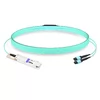
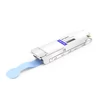
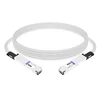
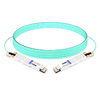
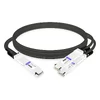
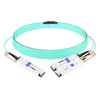
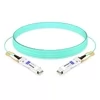
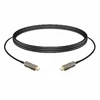
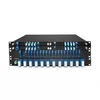
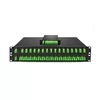
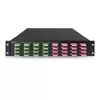
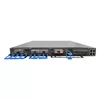
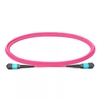
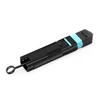
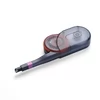
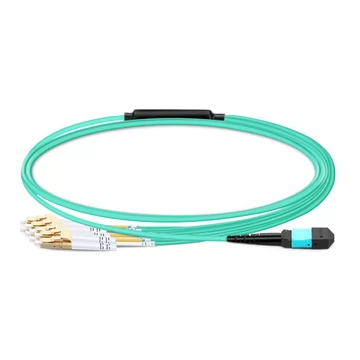
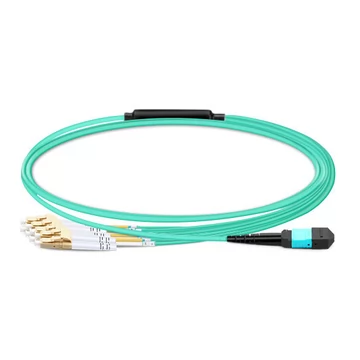
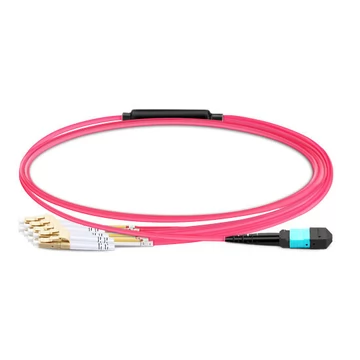
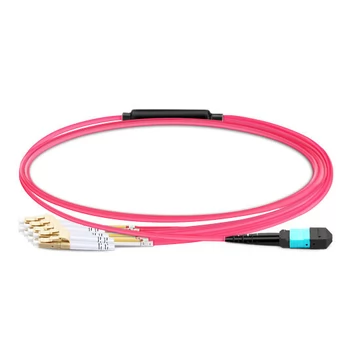
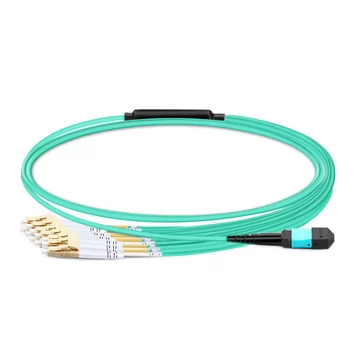
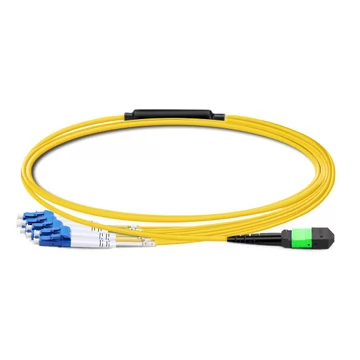
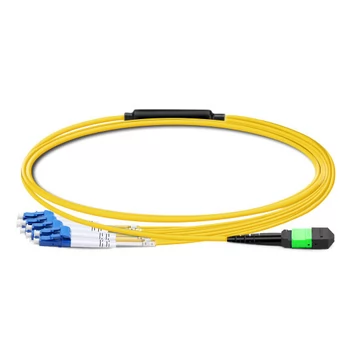
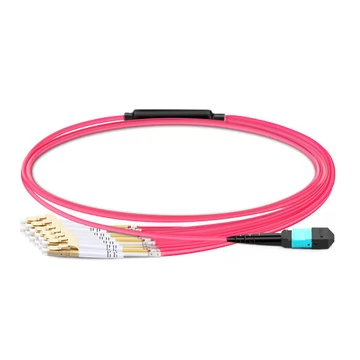
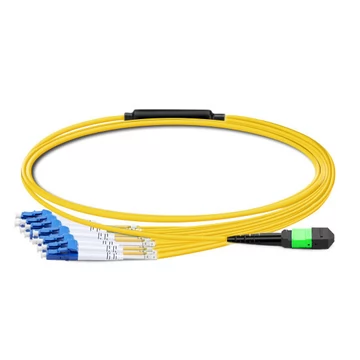
MTP-to-LC breakout fiber optic cables support 8 to 144 fibers and offer Polarity A, B, or C options. Designed for high-density data centers and high-speed 40G/100G/400G interconnect applications, this series features low insertion loss and high reliability. It is suitable for diverse cabling scenarios and supports customization as well as rapid delivery.
Why MTP Breakouts Fail — and How to Avoid It
MTP/MPO cabling is unforgiving when it comes to polarity mistakes. A reversed fiber map, the wrong connector gender, or an 8-fiber cable ordered where a 12-fiber was required will take an entire link down — and the failure often shows up only after the cable is installed.
Three decisions drive most failed deployments:
1. Polarity Type. Type A, B, or C determines how transmit and receive fibers map end-to-end. For 40G/100G parallel optics, Type B is the correct default — but most product pages list the options without telling you which to pick.
2. Connector Gender. QSFP+/QSFP28 transceivers use a pinned (male) MPO port, so the breakout cable must mate with an unpinned (female) MTP connector. Order the wrong end, and it simply will not plug in.
3. Fiber Count. An 8-fiber MTP breaks out to 4 LC duplex pairs, while a 12-fiber breaks out to 6. Ordering a 12-fiber cable when the parallel-optics port uses only 8 wastes fibers and can create polarity confusion.
FiberMall's MTP-to-LC breakout cables are built to remove all three risks.
Breaking Out 40G/100G QSFP Ports to LC Duplex
An MTP-to-LC breakout cable converts one multi-fiber MTP/MPO connector into individual LC duplex connectors, letting you fan out a high-speed parallel-optics port to multiple lower-speed links.
Application Breakout Configurations:
· 40G to 4×10G: Uses a QSFP+ SR4 transceiver with an 8-fiber MTP to 4× LC duplex (SFP+) breakout.
· 100G to 4×25G: Uses a QSFP28 SR4 transceiver with an 8-fiber MTP to 4× LC duplex (SFP28) breakout.
· 100G to 4×25G (Single-Mode): Uses a QSFP28 PSM4 transceiver with an 8-fiber single-mode MTP to 4× LC duplex breakout.
· Duplex Migration (40G/100G to LC patch panel): Uses a 12-fiber MTP to 6× LC duplex breakout.
This is the standard path for migrating a 10G access layer to 40G or 100G without re-cabling the entire spine. The MTP end connects to the 100G QSFP28 transceiver or 40G QSFP+ module, while the LC ends land on individual SFP/SFP+ ports.
MTP Polarity: A Quick-Pick Guide
Polarity defines how fiber positions map between the two ends of the link so that the transmit signal always meets the receive port. It is the single most important decision in MTP cabling — and the easiest to get wrong.
Polarity Options:
· Type A: Features straight fiber mapping (Position 1 to Position 1) with a key-up to key-down orientation. This is best for legacy duplex, patch-cord-managed networks.
· Type B: Features reversed fiber mapping (Position 1 to Position 12) with a key-up to key-up orientation. This is the default and best option for 40G/100G/400G parallel optics.
· Type C: Features pair-flipped fiber mapping (Position 1 swapped with Position 2) with a key-up to key-down orientation. This is suited for niche duplex designs.
If you are breaking out a QSFP+/QSFP28 port to LC, order Type B. It provides the required transmit-to-receive cross-connection and works with standard A-to-B patch cords, keeping both ends of the channel symmetric.
Rules to Prevent Failures:
· Pick one polarity method for the entire channel (trunk + cassette + patch cord). Mixing methods fails every time.
· Direct transceiver-to-transceiver and breakout links should use Type B polarity.
· On an inherited site, document the existing polarity method before adding cables — never assume.
Fiber Count, Mode, and Connector Options
· Fiber Counts: 8, 12, 24, 48, 72, 96, and 144 fibers.
· Fiber Modes: Multimode (OM2, OM3, OM4, OM5) and Single-mode (OS2: G.652.D / G.657.A1).
· MTP Connector: Unpinned (female) to mate with pinned QSFP transceiver ports; pinned (male) is available for trunk-to-trunk mating.
· LC Termination: UPC or APC polish; duplex (uniboot optional) for clean, high-density patching.
· Jacket Ratings: LSZH, Plenum (OFNP), and Riser (OFNR), with 3.0 mm trunk legs and 0.9 mm or 2.0 mm breakout legs.
Specifications
· MTP Insertion Loss (Elite): ≤ 0.35 dB
· MTP Insertion Loss (Standard): ≤ 0.70 dB for Single-Mode (SM) / ≤ 0.60 dB for Multimode (MM)
· MTP Return Loss (SM): ≥ 60 dB
· LC Insertion Loss: ≤ 0.30 dB
· LC Return Loss: SM UPC ≥ 55 dB, SM APC ≥ 60 dB, MM ≥ 25 dB
· MTP Durability: ≥ 500 mating cycles
· LC Durability: ≥ 1000 mating cycles
· Operating Temperature: -40°C to +80°C
· Compliance: IEC 61754-7, TIA-604-5 (FOCIS-5), TIA-568.3
Frequently Asked Questions
What is the difference between an MTP breakout cable and a harness cable?
They are effectively the same assembly, and the terms are used interchangeably. Both convert a multi-fiber MTP/MPO connector into individual LC (or SC/FC/ST) connectors on the other end. "Breakout" sometimes implies a simplex fanout, while "harness" implies duplex pairs, but in practice, most vendors treat them as synonyms.
Which MTP polarity do I need for a 40G/100G QSFP breakout?
Type B. It reverses the fiber map (Position 1 to Position 12) to provide the transmit-to-receive cross-connection required by QSFP+/QSFP28 parallel optics, and it keeps both ends of the channel symmetric with standard A-to-B patch cords.
Should I choose 8-fiber or 12-fiber MTP?
For pure 40G/100G SR4 or PSM4 parallel optics, an 8-fiber cable is the exact match (4 transmit + 4 receive). For duplex breakout applications and mixed legacy environments, a 12-fiber cable is more versatile and provides upgrade headroom at a minimal cost difference.
Is the MTP connector male (pinned) or female (unpinned)?
The breakout cable that plugs directly into a QSFP/QSFP28 transceiver must be female (unpinned) because active equipment ports are inherently pinned. Pinned (male) MTP ends are reserved for trunk-to-trunk mating.
What is MTP insertion loss, and why does it matter?
Insertion loss is the optical power lost at the connection point, measured in decibels (dB). Lower is better: Elite MTP connectors feature a loss of ≤ 0.35 dB, compared to ≤ 0.60–0.70 dB for standard connectors. Lower insertion loss preserves the link budget, which matters most on long or high-loss single-mode links.
Can you provide custom lengths and fiber counts?
Yes. FiberMall supplies 8 to 144 fibers, custom overall lengths, custom breakout leg lengths, and OEM/ODM branding — with factory-direct lead times measured in days, not weeks.