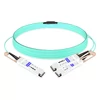
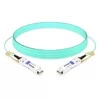
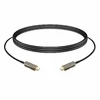
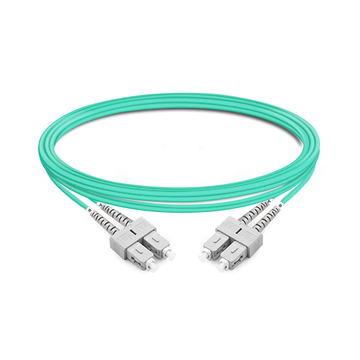
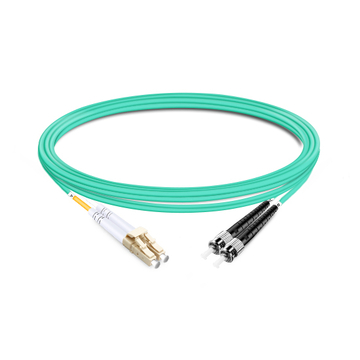
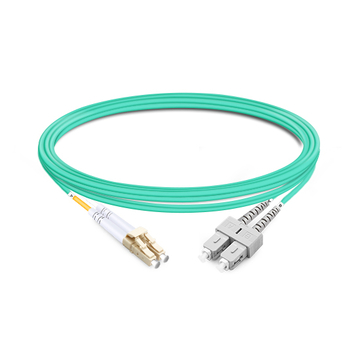
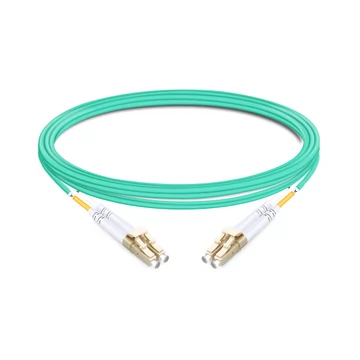
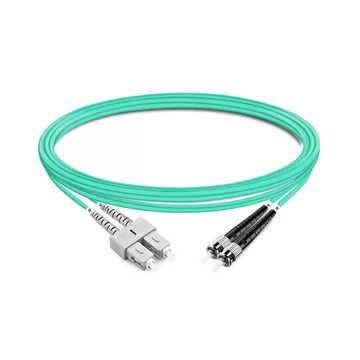
A 10 Gigabit link is only as good as the multimode fiber carrying it. Many "OM3" patch cables fail to meet the 2000 MHz·km laser-optimized specification, causing a 300-meter 10G run to fail prematurely. FiberMall publishes these specifications and rigorously tests every cable.
The Problem With Most OM3 Fiber Cables
OM3 is often sold as a commodity, but it shouldn't be treated as one. A cable labeled "OM3" must meet the laser-optimized multimode fiber (LOMMF) standard: a 50/125µm core and a 2000 MHz·km effective modal bandwidth (EMB) at 850 nm. That EMB rating—not simply the word "OM3" printed on the jacket—is what allows a VCSEL-driven 10GBASE-SR link to reach 300 meters. Many budget patch cords are labeled OM3 but are never verified against that figure, meaning a link budgeted for 300 meters might drop packets at 220 meters, long after the cable has been pulled and terminated.
Then there is the OM3 versus OM4 debate. Both are 50µm, laser-optimized, aqua-jacketed multimode fibers, and both work seamlessly with the same SFP+ and QSFP optics. The primary difference is their maximum reach. While OM3 tops out at 300 meters for 10G links, OM4 extends that reach to standard 400 meters (and up to 550 meters only with specific proprietary extended-reach transceivers). For most data center and enterprise runs under 300 meters, OM3 remains the correct, cost-effective choice. However, suppliers that simply list "multimode" without explaining these limits often push buyers to overpay for OM4 cables they do not actually need.
OM3 Fiber Cable Specifications
OM3 is a laser-optimized 50/125µm multimode fiber identified by its aqua jacket (compliant with TIA-598-C) and is specifically designed for VCSEL light sources (at 850 nm) in short-reach, high-speed links.
In terms of performance, OM3 features an effective modal bandwidth of ≥ 2000 MHz·km at 850 nm. Its maximum attenuation is ≤ 3.5 dB/km at 850 nm and ≤ 1.5 dB/km at 1300 nm. Standard connectors typically offer an insertion loss of ≤ 0.3 dB and a return loss of ≥ 30 dB. OM3 is fully compliant with IEC 60793-2-10, TIA-492AAAC, and IEEE 802.3ae standards.
Regarding supported reach, OM3 handles 1 Gbps (1000BASE-SX) links up to 550 meters, 10 Gbps (10GBASE-SR) up to 300 meters, and 40/100 Gbps (40GBASE-SR4 / 100GBASE-SR10) up to 100 meters. For transmission distances beyond these limits, OM4 multimode fiber is required, which extends 10G reach to 400 meters and 40G/100G reach to 150 meters.
Connector and Jacket Options
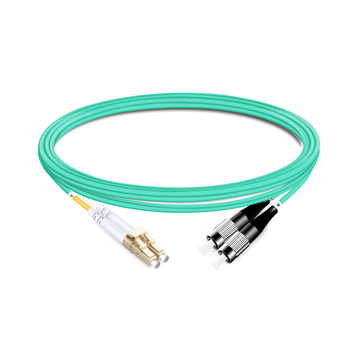
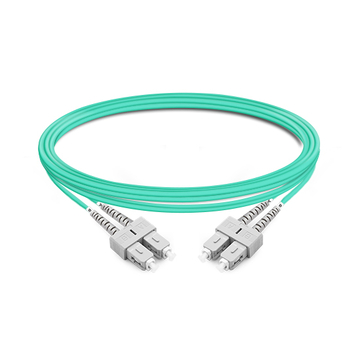
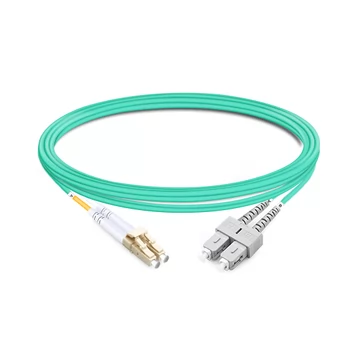
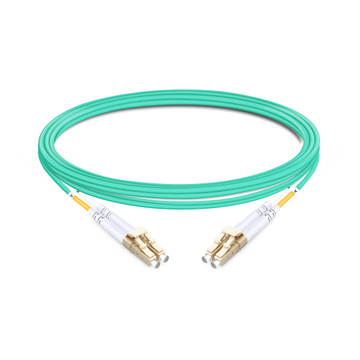
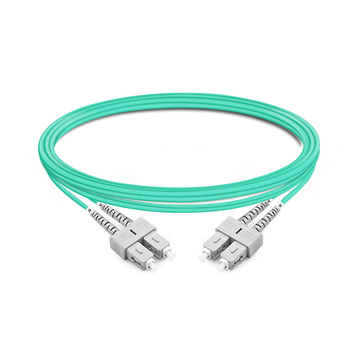
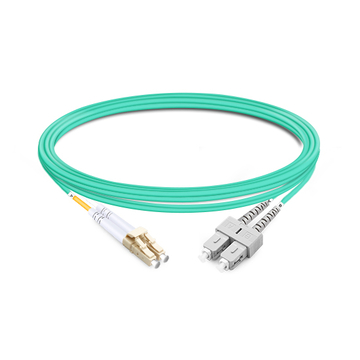
FiberMall carries OM3 duplex patch cords featuring the connector combinations that data centers and enterprises actively deploy, available in three distinct jacket ratings:
· Connectors: Options include LC-LC, LC-SC, LC-ST, LC-FC, SC-SC, and SC-ST. All utilize precision zirconia ceramic ferrules to ensure low, repeatable loss.
· PVC (OFNR): Riser-rated jackets for general indoor cable runs between floors.
· LSZH: Low-smoke zero-halogen jackets designed for environments with strict fire-safety code requirements.
· OFNP: Plenum-rated jackets for installation in environmental air-handling spaces.
Why the Ferrule Matters
Cheap connectors often use plastic or poor-quality ferrules that degrade after repeated mating. FiberMall OM3 patch cords utilize Grade A zirconia ceramic ferrules featuring a return loss of 30 dB or better and a repeatability of less than 0.2 dB over 1,000 mating cycles. This ensures the cable continues passing link tests long after the initial installation.
OM3 vs. OM4: When OM3 Is Still the Right Choice
The most useful service a supplier can provide is helping you select the correct grade—even when the correct answer is "not OM3." Here is how the 50µm multimode grades compare:
OM2 features an orange jacket and provides an overfilled-launch (OFL) bandwidth of 500 MHz·km. It is best suited for legacy 1G campus networks, supporting 10 GbE distances up to 82 meters, but does not support 40/100 GbE.
OM3 utilizes an aqua jacket and delivers an effective modal bandwidth of 2000 MHz·km. It is the standard for 10G data center installations, supporting 10 GbE up to 300 meters and 40/100 GbE up to 100 meters.
OM4 also utilizes an aqua jacket but offers a significantly higher bandwidth of 4700 MHz·km. It is designed for 40G/100G networks and longer 10G runs, supporting 10 GbE up to 400 meters and 40/100 GbE up to 150 meters.
Choose OM3 when your links are 10G at 300 meters or less, or 40G/100G at 100 meters or less. For the vast majority of enterprise and data center short-reach runs, OM3 delivers identical performance to OM4 at a considerably lower cost.
Choose OM4 when you need 10G reach beyond 300 meters, 40G/100G reach beyond 100 meters, or if you want extra bandwidth headroom for future speed upgrades. Since the price difference on patch cords is relatively modest, OM4 serves as a reasonable hedge for longer structured-cabling backbones.
Applications: Where OM3 Fiber Cables Are Used
OM3 fiber cable is the default choice for modern short-reach multimode connectivity:
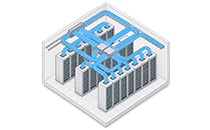
· Data center server-to-switch links — 10GBASE-SR and 25GBASE-SR patching between servers, top-of-rack (ToR) switches, and patch panels.
· 40G and 100G parallel optics — 40GBASE-SR4 and 100GBASE-SR10 links up to 100 meters using MPO-to-LC breakout trunks.
· Enterprise backbone risers — LSZH and OFNP-rated OM3 for code-compliant vertical distribution between building floors.
· Storage area networks (SAN) — Fibre Channel patching at 8G/16G within the data center.
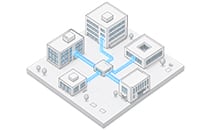
· Campus building interconnects — 10G links spanning up to 300 meters between adjacent buildings.
For each of these use cases, the value remains the same: a tested, spec-correct cable that successfully carries the link distance you actually paid for.
OM3 Fiber Cable FAQ
What is OM3 multimode fiber?
OM3 is a laser-optimized multimode fiber featuring a 50/125µm core-to-cladding diameter and an effective modal bandwidth of 2000 MHz·km at 850 nm. Identified by its aqua jacket, it is optimized for VCSEL light sources in short-reach 10G, 40G, and 100G links.
How far can OM3 fiber run at 10G?
OM3 comfortably carries 10 Gigabit Ethernet (10GBASE-SR) up to 300 meters. For 40G (40GBASE-SR4) and 100G (100GBASE-SR10) parallel optics, the limit is 100 meters. Beyond those distances, OM4 is required, which extends 10G reach up to 400 meters.
What is the difference between OM3 and OM4 fiber?
Both are 50µm laser-optimized multimode fibers with aqua jackets, but OM4 offers a higher effective modal bandwidth (4700 MHz·km vs. 2000 MHz·km). That extra bandwidth translates to a longer maximum reach—400 meters for standard 10G and 150 meters for 40G/100G. For links under 300 meters, OM3 performs identically to OM4 at a lower cost.
What color is OM3 fiber cable?
OM3 cable uses an aqua jacket by industry convention (TIA-598-C). In contrast, OM1 and OM2 use orange, OM4 uses aqua (and sometimes Erika Violet to easily distinguish it from OM3), and single-mode OS1/OS2 uses yellow.
Is OM3 fiber single-mode or multimode?
OM3 is a multimode fiber with a 50µm core. It is engineered for short-reach, high-speed links using VCSEL transceivers, contrasting with single-mode fiber, which utilizes a much smaller 9µm core for long-distance transmissions.
Which connectors are available on OM3 patch cables?
FiberMall offers OM3 duplex patch cords with LC-LC, LC-SC, LC-ST, LC-FC, SC-SC, and SC-ST connector combinations, all equipped with Grade A zirconia ceramic ferrules for optimal insertion loss.
Will OM3 work with my existing hardware?
Yes, provided your links use a 50/125µm multimode plant alongside 10GBASE-SR, 25GBASE-SR, or 40G/100G SR optics. OM3 is fully backward-compatible with OM2 and functions perfectly with standard VCSEL-based SFP+, SFP28, and QSFP transceivers.