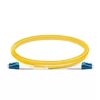
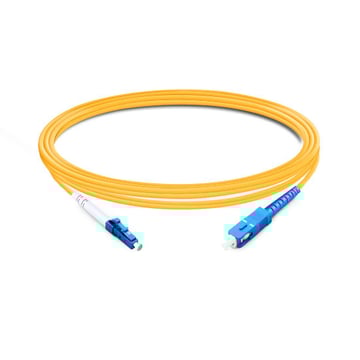
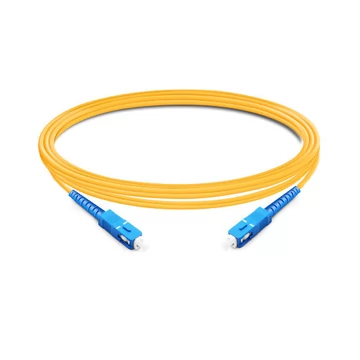
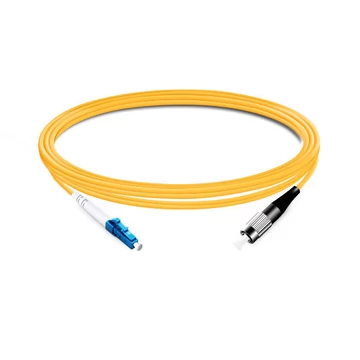
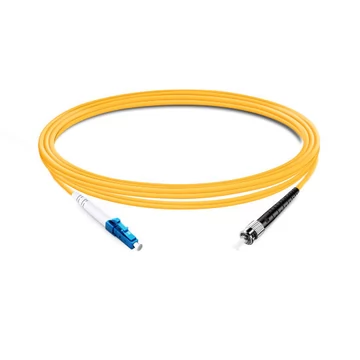
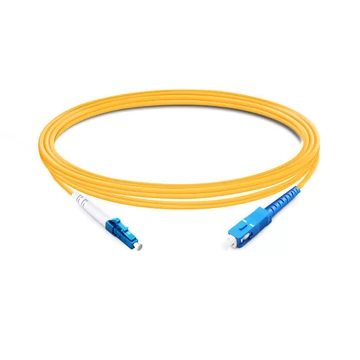
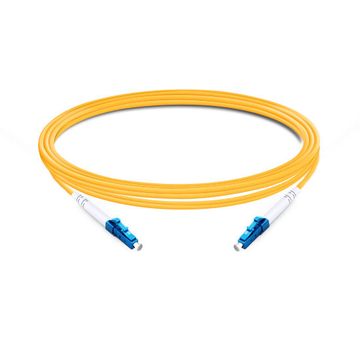
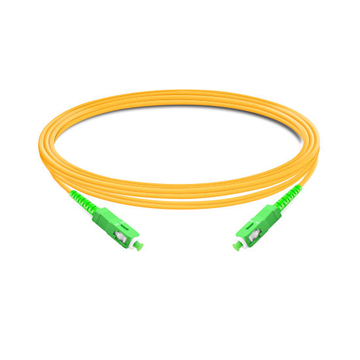
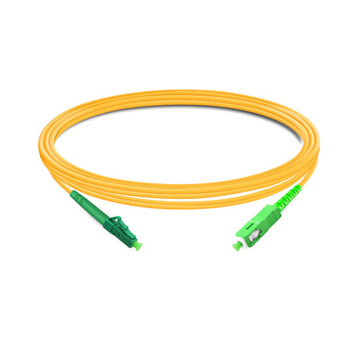
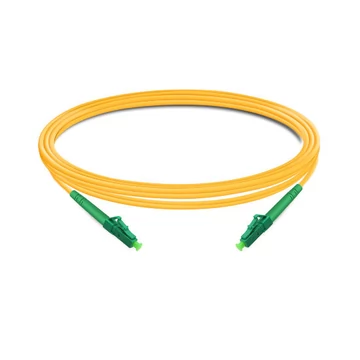
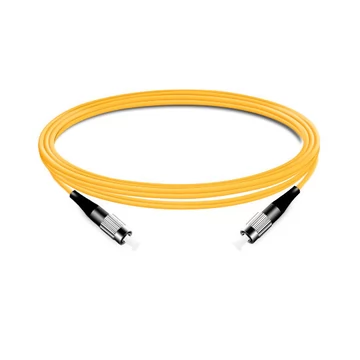
A single-fiber link only works when the patch cords at both ends match the transceivers in connector type, polish, and fiber grade. A simplex OS2 cable carries a single fiber strand. While it can be used for one-way transmission, it is most commonly utilized for bidirectional (BiDi) transmission, making it the correct cord for BiDi optics, FTTx drops, and single-fiber links. Get any specification wrong, and the link will fail at installation, rather than at the quoting stage.
Why OS2 Simplex Selection Goes Wrong
Most single-mode patch cord failures do not stem from fiber quality issues. Rather, they are ordering mistakes that surface only after the cord is plugged into a patch panel and the link fails to come up.
The three most common causes are:
· Wrong fiber count: A simplex cable has one fiber, whereas a standard transceiver link with separate transmit and receive ports needs two fibers (duplex). Ordering simplex where duplex is required leaves you one fiber short, and ordering duplex for a BiDi optic wastes a strand you cannot use.
· Mismatched polish: UPC and APC connectors do not mate. An APC (angled) connector plugged into a UPC adapter creates an air gap, causes high insertion loss, and can physically damage the connector faces, ultimately killing the link.
· Unaccounted loss budget: Using cables with no published insertion loss specifications can push a marginal single-mode link over its loss budget once patch panels and adapters are added to the channel.
FiberMall addresses all three: fiber count is explicitly stated on every SKU, polish is specified per connector, and insertion loss is published as a testable metric rather than an assumption.
Specification
· Fiber type: OS2 single-mode, 9/125µm (ITU-T G.652.D, with bend-insensitive G.657 options available)
· Insertion loss: ≤0.3 dB (typical ≤0.15 dB)
· Return loss: UPC ≥50 dB / APC ≥60 dB
· Wavelength: 1310 / 1550 nm (low-water-peak, supporting the full 1260–1625 nm spectrum)
· Connectors: LC, SC, ST, FC
· Polish: UPC, APC
· Jacket: PVC (OFNR), LSZH
· Lengths: 1 m to 30 m
· Testing: 100% insertion-loss, environmental, and tensile tested
Simplex vs. Duplex: One Fiber or Two
A simplex patch cord contains a single fiber with one connector at each end. It is built for single-fiber links—most commonly BiDi (bidirectional) transceivers that transmit and receive on two different wavelengths (e.g., 1310 nm and 1550 nm) over the same strand.
A duplex cord bonds two fibers side by side: one for transmitting and one for receiving. If your optic has separate TX and RX ports, you need a duplex cable. If it is a single-fiber BiDi optic or a simplex FTTx drop, you need a simplex cable.
Connector & Polish Options
Different connectors serve specific common applications:
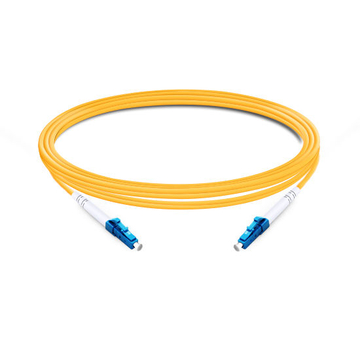
· LC connectors are standard for SFP, SFP+, and XFP transceivers, BiDi optics, and high-density patch panels.
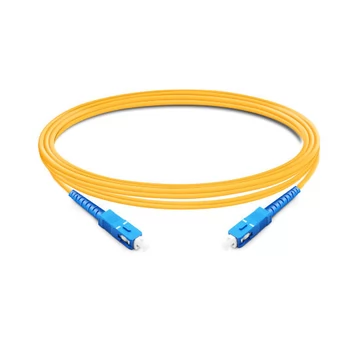
· SC connectors are frequently used for GBIC optics, CATV, FTTx/FTTH networks, and telecom ODF frames.
· ST connectors are typically found in campus and enterprise backbones, as well as legacy telecom environments.
· FC connectors feature a screw-on mechanism ideal for measurement equipment, lasers, and high-vibration environments.
Polish types:
· UPC (Blue connector): Features a slightly convex (domed) end face that provides standard low back-reflection for general data links (return loss ≥50 dB).
· APC (Green connector): Features an 8° angled end face for ultra-low back-reflection (return loss ≥60 dB). This is explicitly required for FTTx, CATV, and RF-over-fiber applications where reflections severely degrade the signal.
How to Choose the Right OS2 Simplex Cable
Three decisions determine whether your link will work:
1. Match the connector to the device: Use LC for SFP-family and standard BiDi transceivers, SC for FTTx and CATV, FC for measurement equipment, and ST for legacy campus runs.
2. Match the polish to the application: Use UPC for standard data links, and APC for any link where back-reflection is critical, such as FTTx, CATV, and long-haul RF.
3. Match the jacket to the environment: Choose PVC (OFNR) for general indoor riser use, or LSZH where low-smoke zero-halogen materials are required by building and safety codes.
FAQ
What is the difference between simplex and duplex fiber patch cable?
A simplex patch cord has one fiber with one connector at each end, designed for single-fiber links such as BiDi transceivers. A duplex cord bonds two fibers side by side—one for transmit and one for receive. Choose simplex for single-fiber optics and duplex for optics with separate TX and RX ports.
When should I choose OS2 simplex over OS2 duplex?
Choose simplex when your transceiver or drop uses a single fiber—such as BiDi SFP/SFP+ optics, FTTx ONT drops, or CATV RF links. Choose duplex when the equipment utilizes separate transmit and receive ports.
Which connector do I use for a BiDi SFP/SFP+ transceiver?
Most standard BiDi SFP-family transceivers use an LC connector and require a simplex single-mode cable. You should generally order an LC-UPC simplex OS2 cord unless your specific network or PON drop explicitly requires APC.
What is the difference between UPC and APC polish?
UPC connectors have a slightly convex (domed) end face resulting in a return loss of ≥50 dB. APC connectors use an 8° angled end face to achieve a ≥60 dB return loss, which heavily suppresses back-reflections that can degrade FTTx, CATV, and RF-over-fiber signals. The two connector types do not mate—you must match the polish on both ends.
What is the difference between OS1 and OS2 single-mode fiber?
OS1 is an older single-mode specification primarily designed for indoor, short-reach use (up to around 10 km) with standard attenuation. OS2 is a modern, low-water-peak single-mode fiber rated for longer reaches and optimized to use the full 1260–1625 nm spectrum, making it ideal for CWDM. FiberMall simplex patch cables exclusively use OS2 9/125µm fiber.