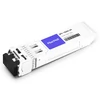
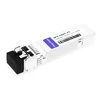
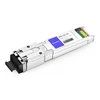
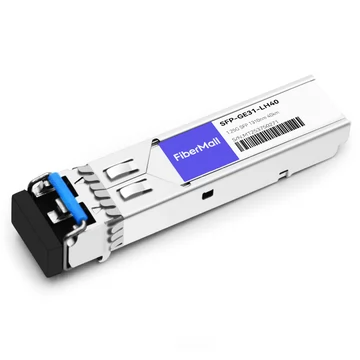
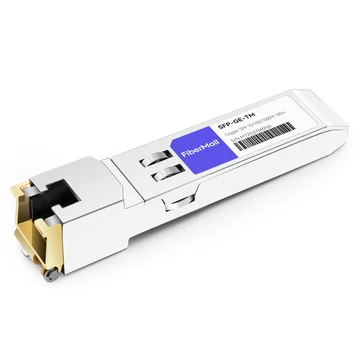
1000BASE SFP Transceiver Guide
1000BASE SFP transceivers are critical components in today's communications. This is because they enable short-distance data transmission over fiber optic cables. Their key features, application scenarios, and advantages highlight why high-speed network infrastructure needs them.
What is 1000BASE SFP? An Introduction to Gigabit Ethernet Technology
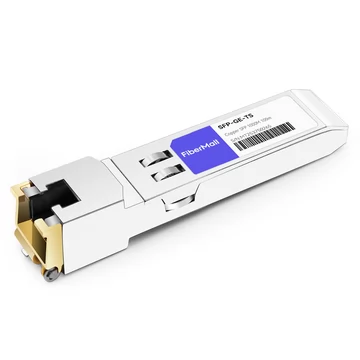
Communication through 1000BASE SFP or Gigabit Ethernet SFP is allowed by a transceiving device attaching to the network with a speed characteristically rated at 1 Gbps. This attachment is built to interface with the Small Form-factor Pluggable (SFP) ports to allow connectivity extension even through the use of fiber optic or copper cables. 1000BASE SFP modules are mostly found in data communication devices such as switches, routers, and many others that are useful in the transmission of information in organizations and data centers. They are compact, easy to replace without tools, and support various types of networks, which is essential for performance.
Overview of 1000BASE SFP
The 1000BASE SFP module is a compact, standardized transceiver that supports Gigabit Ethernet transmission over various physical media, such as multimode fiber (MMF), single-mode fiber (SMF), and copper RJ45 cable. These modules offer performance up to 1 Gbps, comply with the IEEE 802.3 standard, and are largely compatible with current network infrastructure. One of their key features is their hot-swappable capability, allowing for replacement and upgrades without taking the device offline. The data transmission distances of the 1000BASE SFP module also vary, up to 100 meters over copper cable and over 100 kilometers over single-mode fiber, depending on the specific design and size.
1000BASE SFP vs Other Ethernet Standards
1000BASE SFP is also known as Gigabit Ethernet SFP. It does have a lot of advantages over other versions of Ethernet. In contrast to the conventional standards such as 10BASE-T or 100BASE-TX, 1000BASE SFP allows for much faster data transmission with speeds of up to 1 Gbps. Unlike most technologies utilizing copper, it can use copper or fiber optics for connectivity through modular transceivers, making it adaptable to different networks. It is also more scalable and more robust over long distances than the copper options. In addition, while advanced standards such as 10GBASE or 40GBASE are being proposed, 1000BASE SFP continues to be a great alternative for unextended networks that do not need many bandwidths, especially in older or smaller installations. With these advantages, it is not surprising that this standard remains applicable in many different networks.
Advantages of 1000BASE SFP over older technologies
Improved Overall Performance and Capacity: In contrast to older technology, such as the 100Base-T, which contains 100 Mbit/s speeds, the 1000BASE SFP features considerably higher boundaries in data movement (1 Gbps). This helps in better utilization of bandwidth-hungry applications, resulting in higher efficiency of the network.
Improved Expandability: Due to the fact that the SFP transceivers come in a modular form, they can accommodate upgrades and changes in the networks much more easily compared to the traditional systems, which do not offer much in terms of expansion and upgrades, thereby tiring out and costing more whenever expansion is needed.
Availability of Longer Distance Communication: This is in contrast to copper-based technologies such as 100BASE-TX, which cover very short distances (commonly within 100 meters), where 1000BASE SFP can be used for both MMF and SMF fibers to reach distances of several kilometers, depending on the modules.
Lesser Interference and More Appropriately Working System: When it comes to interference that is electromagnetic, which is always an issue with copper solutions, fiber optics is immune to electromagnetic interference. This allows one, to an extent, consistent communication, noise-free, or even in areas with heavy industrial work.
Power efficiency: With its lower voltage, 1000BASE SFP transceivers are more efficient than any previous technology using copper, on the other hand, rendering it more economical and environmentally friendly in the design and usage of the network.
How Does 1000BASE SFP Work? A Technical Breakdown
1000BASE SFP technology is one of the technologies that utilizes an SFP transceiver, which is small in size and can easily be removed for very fast speeds on fiber or copper cables. These transceivers are made to allow Gigabit Ethernet (1 Gbps), which is achieved through the conversion of electric currents from devices such as network appliances into either electric current waves or light waves to be transmitted through the medium. In cases of fiber systems, pure light, which carries the transmitted waves longer distances with less attenuation, is created and guided inside the fiber. In the copper systems, simple electrical signals are propagated along twisted pair cables such as Cat5e, Cat6, that work effectively for distances that are in the range of a few meters.
For essential practicalities of the SFP, there is an axiom: structural design, which lets mount and dismount the module in several devices and hot-swap it upon demand during installation or substitution, hence lowering the amount of active network device intervention. Every module interacts with corresponding network switches using established protocols such as IEEE 802.3 as a means of ensuring compatibility between different vendors’ and users’ devices. 1000BASE SFP pertains to the solution that finely governs signal modulation and rebuilding, and this precisely enables the conflicting requirements of wideband communication, power usage restricted, and distance transmitted to be resolved in a way. This is one of the elements of network structures operable under the current mode.
Physical characteristics and components
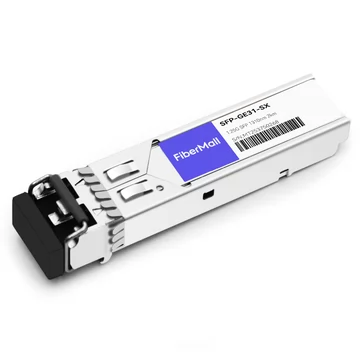
These tiny 1000BASE SFP modules are hot-swappable devices that are usually approximately 13.4 mm x 56.5 mm x 8.5 mm in size, and they follow the SFP MSA (Multi-Source Agreement) specifications. Every single one is encased within a die-cast metallic structure, which is necessary to keep the radiated emissions down and enable effective functioning in dense networks. On the inside, there is a laser driver, a photodetector, and digital diagnostic monitoring (DDM) allowing users to control such values as temperature, voltage, and optical power in real time. The host device is connected via a standard electrical connector, while the optical side allows for multimode or single-mode connections as needed. All these modules are designed to support data rates up to 1.25 Gbps and have excellent efficiency and precision in data transmission.
1000BASE SFP Transceivers Explained
The 1000BASE SFP – popularly known as small form factor pluggable transceivers – is a line of compact cableless devices that are used in support of Gigabit Ethernet. These SFP modules, however, are intermediary devices that convert electronic to converted light waves and light signals therein. This feature is most useful. These devices also have the advantage of compatibility with both types of fiber, hence adapting the usage to various stretches of the network. Such devices can operate at up to 1.25 Gbps and are known to offer high performance and robust connectivity. Therefore, they are heavily used in business and corporate environments, data centers, and in telecommunication network infrastructures. Such features ensure that such devices are able to provide real-time performance for networks and also make troubleshooting a more effective process.
Types of 1000BASE SFP modules (e.g., SX, LX, ZX)
Different variations of 1000BASE SFP are designed for diverse purposes, including distance of transmission, wavelength, and purpose of the unit. The key types are as follows:
1000BASE-SX: a module that supports a multimode fiber of an 850 nm wavelength used for short range application is called. It was primarily developed to connect buildings at various locations inside the buildings or between buildings based on the campuses’ networks.
1000BASE-LX: Functional in use with 1310 nm wavelengths, such as modules that carry either multimode or single-mode fiber cables. The present application has a medium range of operation with a single-mode fiber extending to a distance of over 10 km.
1000BASE-ZX: Designed for longer distances, the 1000BASE-ZX works with 1550 nm wavelength single-mode fiber optic cable. A distance as long as seventy to eighty kilometers can be bridged by this technology, and hence is suitable for metro areas as well as long-distance connections.
With these differences, organizations are able to use the correct module considering the corresponding distance and network conditions.
Benefits of 1000BASE SFP for Modern Networking
Capability: 1000BASE SFP transceivers offer a convenient way to expand networks with high-speed data capabilities over various ranges.
Versatility: They work well with both types of fiber (single-mode and multi-mode), enhancing existing networks seamlessly.
Economical: 1000BASE SFP offers expansion of network capacity through upgrading only selected links, thus avoiding massive infrastructural overhauls.
Robust: They can withstand extended operation without interruptions – providing stable connections that are essential for business continuity.
Eco Friendliness: They have been designed in a small size with very little consumption of energy, thereby resulting in low operational bills in the long run.
Performance improvements and scalability
Network functionality gets considerable improvement with the introduction of the 1000BASE SFP, which offers a rate of data communication up to 1 Gbps regardless of the distance that needs to be covered. The design of these devices, on the other hand, is modular, thus existing network systems can be upgraded based on necessity. Adding more machines to the network or enhancing existing connections in the network gives room for growth without incurring unnecessary costs that would have been incurred had the expansion been encompassed in the design at the beginning. In addition, these components integrate with all types of data centers, telecommunications, enterprise, and small network infrastructure environments so as to provide the same level of service irrespective of the size of the network. Multiple interfaces and fiber types can also be used and intercourse with various operational conditions without additional costs that might be incurred.
Frequently Asked Questions (FAQs)
What is the purpose of a 1000BASE SFP transceiver?
A 1000BASE SFP transceiver is a device that is designed to send and receive data over Ethernet networks at gigabit speeds. It also provides flexibility in the means of connection by supporting single or multi-stranded fiber types and copper wires, thereby making the device usable in settings such as data centers, enterprise networks, or telecommunications environments.
In which way does a 1000BASE SFP transceiver facilitate interoperability between the transceiver and the facility?
These transceivers rely on a set of standardized networking protocols, such as IEEE 802.3z, for harmonious application between different networking equipment. Furthermore, they provide the possibility of connecting different types of interfaces in order to fit in every kind of networking environment.
Can 1000BASE SFP transceivers be upgraded in preparation for network expansion?
Yes, 1000BASE SFP transceivers are intended for modularity and scalability. They are simple to replace or upgrade in case there is a need to increase bandwidth or change network types, thus supporting any growth strategies.
For the mass deployment of 1000BASE SFP transceivers, is the design economical?
Yes, because they are well structured and satisfy various needs. They help avert massive infrastructural modifications by offering modular and configurable systems.