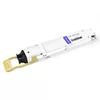
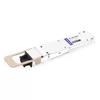
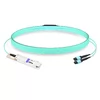
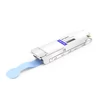
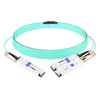
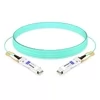
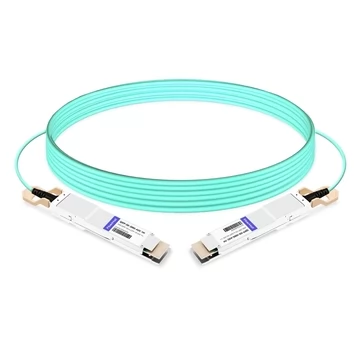
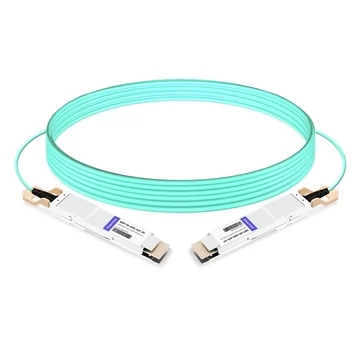
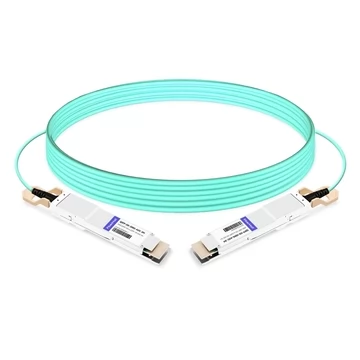
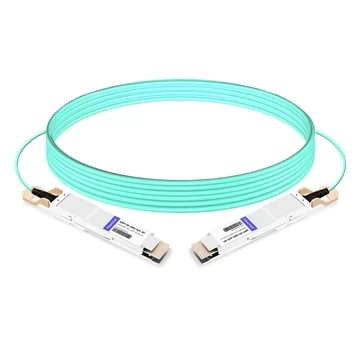
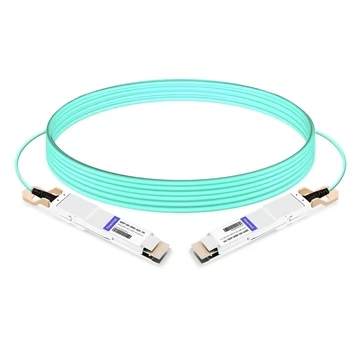
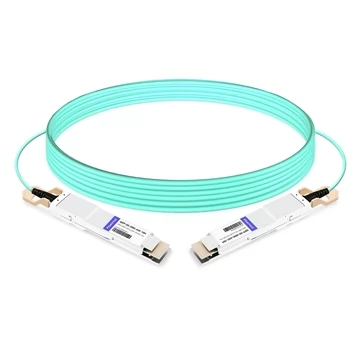
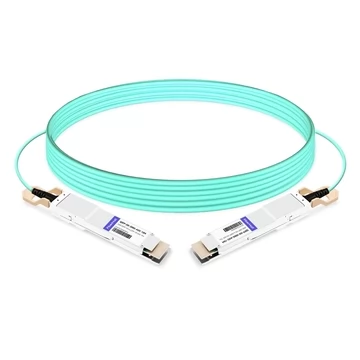
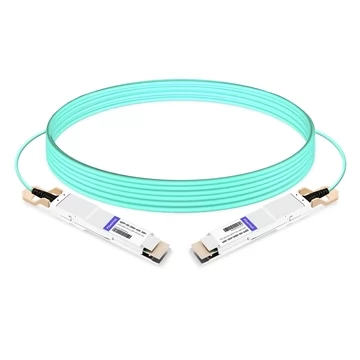
Upgrading to 200G introduces a cabling decision that directly affects signal integrity, rack airflow, and deployment cost. A 200G QSFP-DD active optical cable solves the distance and flexibility limits of copper while keeping installation simpler than discrete transceivers and fiber jumpers. Network engineers use these AOCs for leaf-spine links, AI cluster interconnects, and high-density data center rows where link distance exceeds what passive DACs can reliably deliver.
Why 200G Cabling Choices Matter More Than You Think
Moving from 100G to 200G changes more than port speed. The electrical lane mapping, power budget, and physical form factor all shift, and the wrong cable can create compatibility headaches before the first packet flows. Many engineers discover this when an 8×25G NRZ QSFP-DD link is paired with a 4×50G PAM4 QSFP56 cable or port mode, or when a passive DAC is too stiff and too short for a leaf-spine run.
The pain points are predictable but expensive:
Compatibility confusion: QSFP-DD and QSFP56 can both support 200G, but they usually use different lane configurations. A 200G QSFP-DD AOC based on 8×25G NRZ is not electrically interchangeable with a 200G QSFP56 AOC based on 4×50G PAM4.
Distance limitations: Passive DAC works well for short in-rack links, typically 0.5–3 m, but it becomes less practical as distance and routing complexity increase.
Cable management: Copper bundles can block airflow and strain connectors in dense racks.
OEM costs: Branded AOCs carry a premium that multiplies across hundreds of ports.
In high-density deployments, replacing copper breakout bundles with 200G QSFP-DD AOCs for row-to-row links can reduce installation complexity and remove many signal-integrity issues caused by long or tightly routed copper cables. The right cable choice does not just improve performance; it simplifies operations.
The FiberMall 200G QSFP-DD AOC Solution
FiberMall 200G QSFP-DD AOCs combine plug-and-play simplicity with optical performance. Each cable integrates 850 nm VCSEL transmitters, PIN photodetectors, and CDR/equalization circuitry into a single factory-terminated assembly, so you get a reliable 200G link without separate transceivers or patch cords.
Key benefits:
Multi-vendor compatibility — Pre-coded and tested for verified platforms from Arista, Cisco, Dell, H3C, Juniper, and NVIDIA, subject to port type, software support, and EEPROM coding.
Flexible reach — Standard lengths from 1 m to 100 m over OM3/OM4 multimode fiber.
Low power — Under 4 W per end, helping reduce heat load in dense switches.
Factory-direct value — Competitive pricing for single cables and volume deployments.
MSA compliance — QSFP-DD MSA Rev 3.0, CMIS, and applicable IEEE 802.3 Ethernet interface requirements.
200G QSFP-DD AOC Technical Specifications
Engineers need concrete numbers before they standardize on an interconnect. The standard FiberMall 200G QSFP-DD to QSFP-DD AOC is based on an 8-lane NRZ electrical interface and supports a nominal Ethernet rate of 200GbE. Its electrical lane rate is 8 × 25.78125 Gb/s NRZ, giving an aggregate serial line rate of 206.25 Gb/s.
The cable uses a QSFP-DD to QSFP-DD form factor with 8 transmit lanes and 8 receive lanes. It operates at an 850 nm wavelength over OM3 or OM4 multimode fiber. The optical engine uses an 850 nm VCSEL array on the transmitter side and a PIN photodetector array on the receiver side.
Power consumption is less than 4.0 W per end, with a 3.3 V supply voltage. The operating case temperature range is 0°C to 70°C. DDM/DOM functions are supported through a CMIS or host-compatible digital diagnostic interface.
The cable is designed around QSFP-DD MSA Rev 3.0, CMIS, and applicable IEEE 802.3 Ethernet interface requirements. The typical bend radius is 30 mm. Maximum reach is up to 70 m over OM3 multimode fiber and up to 100 m over OM4 multimode fiber.
Breakout configurations are also available, including 200G QSFP-DD to 2×100G QSFP28 and 200G QSFP-DD to 8×25G SFP28 for fan-out applications. Host port mode, lane mapping, and breakout support should be verified before deployment.
200G QSFP-DD vs QSFP56: Choose the Right Form Factor
Both form factors can deliver 200G, but the electrical interface is different. Selecting the wrong cable wastes budget and can block deployment.
A typical 200G QSFP-DD AOC uses an 8 × 25G NRZ electrical interface to deliver a total rate of 200 Gb/s. It is commonly used for switch-to-switch links and 400G-ready QSFP-DD platforms. QSFP-DD cages can support QSFP+/QSFP28 modules or cables in compatible hosts, but support depends on host design, port mode, and software configuration. QSFP-DD also provides a clearer forward path into the 400G QSFP-DD ecosystem.
A typical 200G QSFP56 AOC uses a 4 × 50G PAM4 electrical interface to deliver the same total rate of 200 Gb/s. It is commonly used for host/NIC connectivity and 200G switch ports based on 4×50G PAM4. QSFP28 support depends on the host platform. For future 400G upgrades, platforms usually move to QSFP-DD, QSFP112, or OSFP rather than staying with QSFP56.
These two form factors are not directly interchangeable. If your switch or NIC specifies a QSFP-DD port operating in 8×25G NRZ mode, you need a matching 200G QSFP-DD AOC. If the port is QSFP56, use a 200G QSFP56 AOC. The connectors may look similar, but the lane mapping, modulation format, FEC mode, and EEPROM coding must match. FiberMall stocks both form factors and can help confirm the right fit for your hardware.
When to Choose 200G AOC vs DAC
Not every 200G link needs fiber. The decision comes down to distance, power, cable routing, and cost.
A 200G passive DAC is the lowest-cost option for very short links, typically 0.5–3 m. It consumes near-zero power because it does not contain active optical components. However, passive copper cables are heavier and stiffer than AOCs, and they can be more difficult to route in dense racks. They are also more susceptible to electromagnetic interference. Passive DAC is best suited for ToR-to-server and same-rack connections where distance is short and cable routing is simple.
A 200G AOC is designed for longer and more flexible connections, typically from 1 m to 100 m. It consumes less than 4 W per end, but it provides major advantages in reach, bend flexibility, weight, airflow, and EMI immunity. AOC is best suited for inter-rack links, leaf-spine connections, AI clusters, HPC networks, and dense data center environments where passive copper becomes difficult to manage.
Choose passive DAC for the shortest in-rack links where cost and power are the top priorities. Choose AOC when reach, bend flexibility, airflow, and EMI immunity matter more.
Compatible Switches and Platforms
FiberMall 200G QSFP-DD AOCs are coded and verified for operation on leading networking platforms with compatible QSFP-DD ports and supported 200G operating modes, including:
Arista: 7060DX5 / 7060X5 QSFP-DD models and other compatible 200G-capable QSFP-DD platforms.
Cisco: Cisco Nexus and data center switching platforms with verified 200G QSFP-DD support. Exact switch model, software release, and transceiver matrix should be confirmed before deployment.
Dell: PowerSwitch platforms with compatible 200G QSFP-DD interfaces.
H3C: S12500R, S6800, and other 200G/400G platforms with supported QSFP-DD ports, depending on the exact SKU.
Juniper: QFX and MX platforms supporting QSFP-DD and the required 200G operating mode.
NVIDIA: Spectrum Ethernet switches with QSFP-DD ports. ConnectX adapter-side form factor should be verified separately, as many ConnectX adapters use QSFP56, QSFP112, or OSFP rather than QSFP-DD.
Each cable is tested in our compatibility lab before shipment. If your exact switch model is not listed, our engineering team can verify compatibility and provide the correct EEPROM coding.
Applications: Data Center, AI, and HPC Networks
200G QSFP-DD AOCs are deployed wherever high bandwidth and moderate distance meet. Common scenarios include:
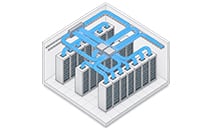
Leaf-spine interconnects — Rack-to-rack links that exceed DAC reach but do not require the flexibility of separate optical transceivers and fiber jumpers.
AI and HPC clusters — Low-latency, high-throughput connections between GPU servers, NICs/HCAs, and switches.
Enterprise data center upgrades — 100G to 200G transitions using QSFP-DD ports that can also support QSFP28 in compatible host platforms.
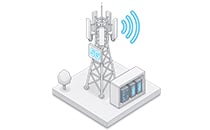
Telecom central offices — High-density interconnects between routers and aggregation switches.
Cloud and colocation facilities — Standardized cabling for repeatable, scalable deployments.
The QSFP-DD form factor provides a practical migration path toward 400G QSFP-DD platforms, helping protect infrastructure investment as bandwidth demands grow.
Frequently Asked Questions
What is the maximum reach of a 200G QSFP-DD AOC?
Standard FiberMall 200G QSFP-DD AOCs support up to 70 m over OM3 multimode fiber and 100 m over OM4. Custom lengths are available on request.
Is QSFP-DD backward compatible with QSFP28?
QSFP-DD cages are designed to support backward compatibility with QSFP+/QSFP28 form factors in compatible host platforms. However, the port mode, electrical interface, speed, and EEPROM coding must match. A QSFP-DD AOC will not operate in a QSFP56-only port unless the host explicitly supports the required mode and coding.
What is the difference between 200G QSFP-DD and 200G QSFP56?
A typical 200G QSFP-DD AOC uses eight 25G NRZ lanes, while a 200G QSFP56 AOC uses four 50G PAM4 lanes. Both can deliver 200G, but they use different electrical architectures and are not directly interchangeable.
How much power does a 200G QSFP-DD AOC consume?
Typical power consumption is under 4.0 W per end, making it suitable for high-density switches with strict thermal budgets.
When should I choose AOC over DAC for 200G?
Choose AOC for links longer than typical passive DAC reach, dense cabling environments, difficult cable routing, or locations with high electromagnetic interference. Choose DAC for the lowest-cost, shortest in-rack connections.
Are FiberMall 200G QSFP-DD AOCs compatible with Cisco, Arista, and Dell switches?
Yes. FiberMall cables are coded and tested for compatibility with major switch vendors. Exact platform support should be verified by switch model, port type, operating mode, software version, and EEPROM coding before shipment.
Do you offer breakout 200G QSFP-DD AOCs?
Yes. FiberMall supplies 200G QSFP-DD to 2×100G QSFP28 and 200G QSFP-DD to 8×25G SFP28 breakout AOCs for fan-out applications. Breakout support depends on host port configuration and should be confirmed before deployment.