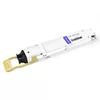
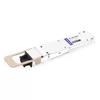
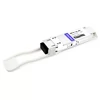
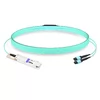
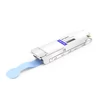
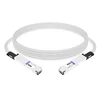
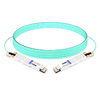
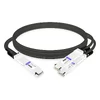
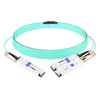
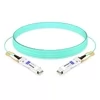
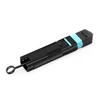
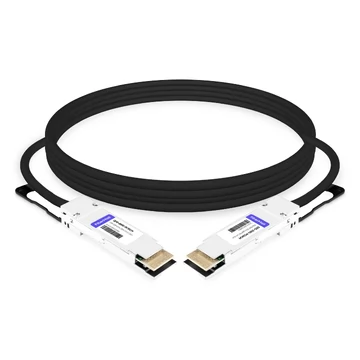
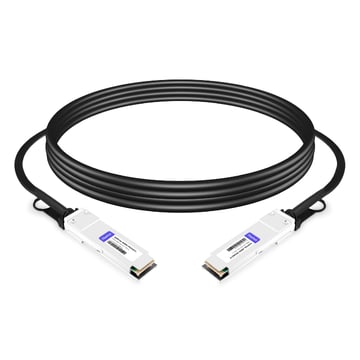
Deploying 200G Ethernet in your data center means choosing the right interconnect—and the wrong cable can stall your entire rollout. FiberMall supplies both 200G QSFP-DD and 200G QSFP56 passive DAC cables from stock, each pre-coded for compatibility with Cisco, Juniper, Arista, and NVIDIA switching platforms. Power consumption stays under 0.1 W per end, delivering up to 98% energy savings compared to optical transceivers for short-reach links.
The Risk of Mixing Form Factors in a 200G Deployment
Network engineers and procurement teams face a common problem when scaling to 200G: the same bandwidth target can be reached through two different physical standards. QSFP-DD uses eight 25G NRZ lanes in a double-density form factor. QSFP56 uses four 50G PAM4 lanes in the same mechanical envelope as QSFP28. The cables are not interchangeable, yet most vendors force you to navigate separate product pages—or worse, ship the wrong form factor entirely.
The result is project delays, failed compatibility tests, and excess inventory. A data center migration that should take days stretches into weeks when procurement discovers the DAC ordered for a QSFP-DD port does not fit a QSFP56 cage—or vice versa. FiberMall eliminates that risk by stocking both 200G DAC standards under one product family, with clear guidance on which form factor matches your switch hardware.
One Source for Both 200G DAC Standards
FiberMall manufactures and stocks 200G passive DAC cables in both QSFP-DD and QSFP56 variants from 0.5 m to 3 m, with active copper options up to 5 m and 7 m on request. Every cable is tested for insertion loss, near-end crosstalk, and EEPROM readability before shipment.
Key Benefits
Dual-form-factor availability: Order QSFP-DD and QSFP56 DACs from a single supplier without cross-referencing separate catalogs.
Pre-coded EEPROMs: Each cable is programmed for the target switch vendor, eliminating "unsupported transceiver" errors on Cisco NX-OS, Juniper Junos, Arista EOS, and NVIDIA Cumulus.
Factory-direct pricing: No distributor markup. Volume pricing starts at 10 pcs and scales to 500+ pc project rates.
Passive power draw under 0.1 W: Reduce data center energy and cooling loads versus 4W to 7W optical transceivers.
Same-day shipping on standard lengths: 0.5 m, 1 m, 1.5 m, 2 m, and 3 m SKUs ship within 24 hours from global inventory.
QSFP-DD vs. QSFP56: Which 200G DAC Do You Need?
Choosing between QSFP-DD and QSFP56 depends on your switch hardware, future upgrade path, and rack density requirements. The practical differences network engineers need to know include:
200G QSFP-DD DAC Specifications: Reaches 200G using an 8 x 25G NRZ lane configuration. It features double-density dimensions of 87 x 18 x 13 mm. A major advantage is backward compatibility, as a QSFP-DD port accepts legacy QSFP+, QSFP28, and QSFP56 modules. It allows maximum rack density with up to 64 ports in a 1RU switch. This standard is best for future 400G/800G migrations and maximum density architectures. Breakout options include 200G to 2x100G QSFP28 and 200G to 8x25G SFP28.
200G QSFP56 DAC Specifications: Reaches 200G using a 4 x 50G PAM4 lane configuration. It maintains standard QSFP dimensions of 70 x 18 x 13 mm. Backward compatibility is strictly host-dependent, as native QSFP56 architectures are built for 50G PAM4 signaling. It supports a port density of up to 36 ports per 1RU switch. This standard is best for cost-optimized, terminal 200G deployments where 200G is the final planned speed. Breakout options include 200G to 2x100G QSFP56 and 200G to 4x50G SFP56.
Shared Traits: Both standards support a typical passive reach of up to 3 m and feature ultra-low power consumption of less than 0.1 W.
Rule of thumb: If your switches have QSFP-DD cages or you plan to upgrade to 400G within two years, choose QSFP-DD. If your hardware is strictly QSFP56-native and 200G is your terminal speed, QSFP56 is the simpler, lower-cost choice.
Technical Specifications
FiberMall 200G DAC cables are built to MSA standards and tested across rigorous temperature, mechanical stress, and EMI profiles. The key parameters for our standard passive twinax copper assemblies include:
Data Rate & Connectors: Both standards deliver an aggregate data rate of 200 Gbps, utilizing straight-through QSFP-DD to QSFP-DD or QSFP56 to QSFP56 passive twinax copper connections.
Wire Gauge (AWG): Optimized by length to guarantee signal integrity and meet strict IEEE insertion loss budgets, using 30AWG, 28AWG, or 26AWG copper wires depending on the 0.5 m to 3 m reach.
Physical & Environmental: Built with flame-retardant PVC (OFNR) jacket materials. The minimum bend radius is 35 mm for QSFP-DD and 34.5 mm for QSFP56. Both operate reliably within a commercial temperature range of 0°C to 70°C.
Power Draw: Ultra-efficient operation consuming less than 0.1 W per end for both cable families.
Compliance Standards (QSFP-DD): Fully compliant with IEEE 802.3bj, IEEE 802.3cd, QSFP-DD MSA Rev 5.0, CMIS Rev 4.0, SFF-8665, and SFF-8636.
Compliance Standards (QSFP56): Fully compliant with IEEE 802.3cd, QSFP56 MSA, SFF-8665, SFF-8636, and RoHS.
Active copper cable (ACC) variants are available for reaches up to 5 m and 7 m. Contact engineering for insertion-loss budgets and signal-integrity reports on active assemblies.
Breakout Cable Options
Not every 200G port feeds a single 200G endpoint. FiberMall supplies factory-built breakout DACs that split one 200G interface into multiple lower-speed links, simplifying spine-leaf and top-of-rack wiring.
200G QSFP-DD to 2x100G QSFP28 DAC breakout: Split one 200G QSFP-DD port into two 100G NRZ links for gradual migration.
200G QSFP-DD to 8x25G SFP28 DAC breakout: Maximum fan-out for legacy 25G server connections.
200G QSFP56 to 2x100G QSFP56 DAC breakout: Divide a 200G PAM4 signal into two 100G PAM4 channels.
200G QSFP56 to 4x50G SFP56 DAC breakout: Direct fan-out to 50G server NICs.
All breakout cables use the same gauge and temperature ratings as straight-through assemblies. Custom breakout pinouts and EEPROM mapping are available for non-standard switch configurations.
Switch Compatibility Matrix
FiberMall 200G DAC cables are thoroughly tested and pre-coded for major network platforms. Below are the verified platform families and software requirements:
Cisco: Supports both 200G QSFP-DD and QSFP56 DACs on the Nexus 9300-GX2 and Nexus 3432D platforms. Note: NX-OS 9.3(4)+ is highly recommended to avoid generic DAC recognition errors.
Juniper: Supports both 200G QSFP-DD and QSFP56 DACs on QFX5120 and QFX5130 hardware families. Note: Junos 20.4R1-S3+ version verified.
Arista: Supports both 200G QSFP-DD and QSFP56 DACs on 7060X6 and DCS-7060DX4-32-F platforms. Note: Tested on EOS 4.28.x+; manual CLI configuration may be required when enabling breakout modes.
NVIDIA / Mellanox (Spectrum-4): Supports both 200G QSFP-DD and QSFP56 DACs on the Spectrum-4 SN5000 series. Note: Full RoCE (RDMA over Converged Ethernet) hardware validated.
NVIDIA / Mellanox (Quantum/Spectrum): Supports both 200G QSFP-DD and QSFP56 DACs on MSN4700, MSN4600, and MSN3700 switches. Note: ConnectX-6 and ConnectX-6 Lx NIC compatible.
Dell: Supports both 200G QSFP-DD and QSFP56 DACs on Z9264F and Z9332F platform families. Note: Please verify your specific Dell OS version before ordering.
HPE: Supports 200G QSFP-DD DACs fully on FlexFabric 5700 platforms. QSFP56 DACs have partial native support. Note: Please contact our engineering team to request the exact custom EEPROM variant for your HPE deployment.
Every cable ships with a compatibility guarantee. If a FiberMall 200G DAC fails to link on a validated platform, we replace the unit or refund the order.
Power and TCO Advantages Over Optical
For top-of-rack and intra-rack connections under 3 meters, passive DAC cables deliver the same 200G throughput as optical transceivers at a fraction of the operational cost.
Power: A passive DAC draws less than 0.1 W per end versus 4 W to 7 W for a 200G optical transceiver pair. In a 64-port 1RU switch, that equates to a 250 W to 440 W power reduction per rack unit.
Latency: Copper DAC adds negligible physical layer latency. There are no DSP (Digital Signal Processing) or laser warm-up delays.
Cost: Passive DAC cables typically cost 60% to 80% less than the combined cost of optical transceivers and fiber patch cords for short-reach links.
Reliability: No laser diodes or active silicon components to degrade over time. MTBF (Mean Time Between Failures) exceeds 10 million hours on standard passive assemblies.
Cooling: Lower thermal emission directly reduces HVAC facility loads, significantly improving PUE (Power Usage Effectiveness) in dense data centers.
When your link budget is under 3 meters, optical interconnects add unnecessary cost and complexity without delivering additional performance performance. Passive DAC remains the default standard for hyperscale and enterprise data center ToR wiring.
Customization and Factory-Direct Services
FiberMall operates its own cable assembly and testing facilities, which means customization requests move from quote to production faster than distributor-based competitors.
Custom lengths: Any length from 0.1 m to 7 m, including non-standard fractional increments.
EEPROM coding: Custom vendor ID strings for proprietary, legacy, or white-label switches.
Pull-tab colors: Color-code your cable plant by function, rack zone, or customer tier.
OEM labeling and packaging: White-label SKUs available for system integrators and resellers.
Active copper (ACC): Engineered for 3 m to 7 m reaches where passive signal attenuation is too high.
Sample program: Order a single unit for lab validation before committing to volume project purchases.
Standard custom lead time is 5 to 7 business days. Rush manufacturing options are available for time-sensitive deployments.
Frequently Asked Questions
What is the difference between a 200G QSFP-DD DAC and a 200G QSFP56 DAC?
QSFP-DD reaches 200G using eight 25G NRZ electrical lanes in a double-density form factor. QSFP56 reaches 200G using four 50G PAM4 lanes in the same mechanical size as QSFP28. QSFP-DD is physically deeper and supports higher port density, while QSFP56 offers a simpler upgrade path from existing QSFP28 infrastructure. The two cables are not interchangeable.
Are 200G QSFP-DD and QSFP56 DAC cables interchangeable?
No. A QSFP-DD module will not fit into a standard QSFP56 port because it is physically deeper and has a second row of electrical contacts. However, many QSFP-DD ports are backward-compatible and can accept QSFP56 modules depending on switch ASIC configuration. Always verify your switch port type before ordering.
What is the maximum cable length for a 200G passive DAC?
Standard passive 200G DAC cables support up to 3 meters. For 3 m to 7 m reaches, active copper cables (ACC) with integrated signal conditioning silicon are required. FiberMall stocks both passive and active variants.
Which switch models are compatible with FiberMall 200G DAC cables?
FiberMall 200G DAC cables are tested and coded for Cisco Nexus 9300-GX2 and 3432D, Juniper QFX5120 and QFX5130, Arista 7060X6, NVIDIA Spectrum-4 and MSN series, Dell Z9264F and Z9332F, and HPE FlexFabric 5700. If your platform is not listed, request a compatibility check, and we will validate EEPROM mapping at no charge for volume orders.
Can I order a custom length or breakout configuration?
Yes. FiberMall manufactures custom lengths from 0.1 m to 7 m and builds breakout cables to your exact pinout requirements. Standard custom lead time is 5 to 7 business days. Submit your requirements through our quote form, and engineering will confirm feasibility within 24 hours.
How much power does a 200G passive DAC consume compared to an optical transceiver?
A passive 200G DAC consumes less than 0.1 W per end. A 200G optical transceiver pair typically draws 4 W to 7 W. Over a 64-port switch, choosing passive DAC reduces power consumption by 250 W to 440 W per rack unit, with corresponding cooling savings.
What is the minimum order quantity?
Sample orders start at 1 piece. Volume pricing tiers begin at 10 pieces and scale to 500+ pieces for data center project deployments. There is no minimum order requirement for first-time sample evaluations.