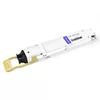
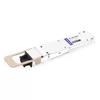
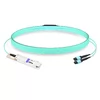
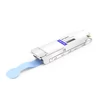
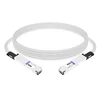
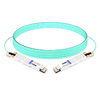
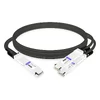
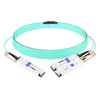
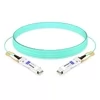
Connecting a 100G QSFP28 switch port to four 25G SFP28 server or storage ports shouldn't require guessing games about compatibility, signal integrity, or whether the cable will even link up. Engineers need a breakout DAC that works the first time, every time, across Cisco, Arista, Dell, Juniper, and the rest of their installed base.
The Real Risk With QSFP28 Breakout Cables
A breakout cable looks simple — one QSFP28 connector on one end, four SFP28 connectors on the other — but the field tells a different story. Network engineers consistently report four major problems:
• Compatibility failures: The switch rejects the cable because the EEPROM isn't coded for the right vendor signature.
• Signal integrity issues at longer lengths: A 30 AWG passive DAC that works perfectly at 1 m can produce CRC errors or fail to link at 3 m.
• FEC (Forward Error Correction) mismatches: Often overlooked in documentation, if the switch port demands RS-FEC but the server NIC is set differently or doesn't support it, the link will fail to establish.
• Unclear documentation: Product pages list specs but don't explain whether a passive DAC, active DAC, or AOC is the right choice for a given distance.
When a cable fails in production, the cost isn't just the replacement part. It's the troubleshooting time, the change-window delay, and the pressure from operations teams asking why the link is still down.
100G to 25G Breakout Cable Key Benefits
• Guaranteed compatibility: Pre-coded EEPROM options for Cisco, Arista, Dell, Juniper, Mellanox/NVIDIA, HPE, Intel, and other major switch vendors.
• Signal-integrity tested: Every cable is verified for insertion loss, return loss, and eye-mask performance before shipment.
• Flexible configurations: Standard lengths from 0.5 m to 5 m, with 30 AWG and 26 AWG options to match your distance and bend radius requirements.
• Factory-direct pricing: Competitive cost structure for volume procurement, samples, and OEM/ODM programs.
Specifications That Matter
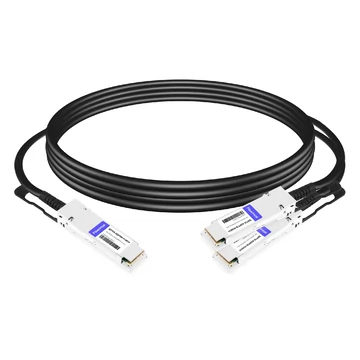
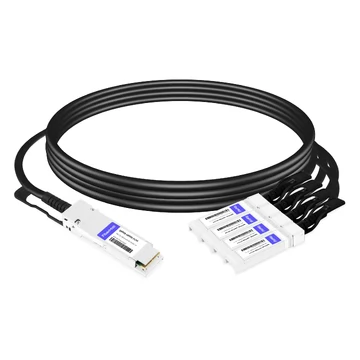
• Form Factor: QSFP28 (100G) to 4x SFP28 (25G)
• Data Rate: Up to 103.1 Gbps aggregate (4 × 25.78125 Gbps)
• Cable Type: Passive Direct Attach Copper (Twinax)
• Standards: IEEE 802.3bj (100GBASE-CR4), IEEE 802.3by (25GBASE-CR), SFF-8665, SFF-8402
• MSA Compliance: QSFP28 MSA, SFP28 MSA
• Standard Lengths: 0.5 m, 1 m, 2 m, 3 m, 5 m (custom lengths available)
• Wire Gauge: 30 AWG (≤ 3 m typical), 26 AWG (3–5 m)
• Power Consumption: < 0.5 W (passive)
• Operating Temperature: 0°C to 70°C (commercial); industrial temp options available
• Cable Jacket: LSZH or PVC, depending on configuration
Built-In Reliability Features
• Robust latching mechanisms: Ensures secure installation on both QSFP28 and SFP28 connectors in high-vibration racks.
• Bend radius management: Flexible jacketing protects signal integrity in dense cable bundles.
• OEM-specific EEPROM coding: Custom coded to match precise switch vendor compatibility requirements.
• RoHS/REACH compliant: Environmentally friendly materials for global deployment.
Switch Compatibility Matrix
FiberMall provides direct equivalent parts for major OEM vendors to ensure seamless integration:
• Cisco: Compatible with QSFP-4SFP25G-CU1M / CU2M / CU3M (FiberMall Equivalent: QSFP28-4SFP28-DAC-xM-CS)
• Dell: Compatible with DAC-Q28-4SFP28-25G-1M / 2M / 3M (FiberMall Equivalent: QSFP28-4SFP28-DAC-xM-DL)
• Arista: Compatible with CAB-Q-4S-100G-1M / 2M / 3M (FiberMall Equivalent: QSFP28-4SFP28-DAC-xM-AR)
• Juniper: Compatible with QFX-QSFP28-SFP28-DAC-1M / 3M (FiberMall Equivalent: QSFP28-4SFP28-DAC-xM-JN)
• HPE: Compatible with 850171-B21 / 850172-B21 (FiberMall Equivalent: QSFP28-4SFP28-DAC-xM-HP)
• Mellanox/NVIDIA: Compatible with MCP7Y00-G001 / MCP7Y00-G002 (FiberMall Equivalent: QSFP28-4SFP28-DAC-xM-ML)
• Intel: Compatible with XLDACBL1 / XLDACBL2 / XLDACBL3 (FiberMall Equivalent: QSFP28-4SFP28-DAC-xM-IN)
Passive DAC vs. Active DAC vs. AOC vs. MTP: Which Breakout Cable Do You Need?
Not every 100G-to-25G interconnect should use a passive DAC. Choosing the wrong media is one of the most common causes of deployment failure.
• Passive DAC (0.5–5 m): The best choice for same-rack or adjacent-rack switch-to-server links. It offers the lowest cost and lowest latency, drawing less than 0.5 W of power.
• Active DAC (5–10 m): Uses internal signal conditioning for longer twinax runs where passive signals degrade. Note: Due to weight and cable bulk, Active DACs are increasingly being replaced by AOCs in modern deployments.
• Breakout AOC (1–100+ m): Ideal for longer reaches, offering lighter weight, smaller bend radii, and complete EMI immunity, though at a higher cost per link and slightly higher power consumption (3–6 W).
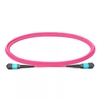
• MTP Breakout Fiber (100 m+): The standard for structured cabling environments. This relies on QSFP28 SR4 and SFP28 SR optical transceivers paired with discrete MTP-to-LC fiber harnesses.
Rule of thumb: If your 100G QSFP28 port and your 25G SFP28 devices are in the same rack or adjacent racks, a passive DAC is usually the cleanest, lowest-cost choice. If you need more than 5 m, moving directly to a Breakout AOC is generally recommended. For structured cabling or runs beyond 100 m, MTP breakout fiber with optical transceivers is the right path.
Where This Cable Delivers Value
Data Center Top-of-Rack
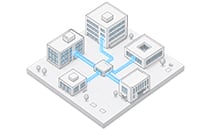
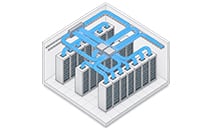
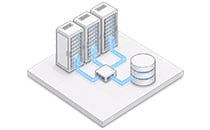
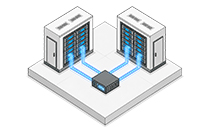
Connect 100G spine or leaf switches to 25G server NICs without consuming additional switch ports or transceiver slots. Passive DACs reduce power, latency, and cabling complexity at the rack.
High-Performance Computing (HPC)
Low-latency interconnects are critical for compute clusters. Passive twinax DACs add negligible latency compared to optical alternatives, keeping MPI and RDMA traffic responsive.
Enterprise Storage Networks
Link 100G storage controllers or Ethernet SAN switches to 25G host bus adapters (HBAs) for converged storage and compute fabrics.
Telecom Edge and 5G Infrastructure
Compact, reliable 100G-to-25G fan-out for edge routers, baseband units, and aggregation switches where space and power budgets are tight.
Frequently Asked Questions
What is a QSFP28 to SFP28 breakout DAC cable?
A QSFP28 to SFP28 breakout DAC cable is a passive twinax copper cable that splits one 100G QSFP28 port into four independent 25G SFP28 ports. It is used for short-reach interconnects in data centers where a 100G switch port needs to fan out to multiple 25G devices.
What is the maximum length for a passive QSFP28 to SFP28 DAC?
Passive DACs are generally reliable up to 5 meters. For runs beyond 3 meters, 26 AWG cable is recommended over 30 AWG to maintain signal integrity. For distances greater than 5 meters, consider a breakout AOC.
Will this cable work with Cisco, Arista, Dell, or Juniper switches?
Yes, when ordered with the correct EEPROM coding. FiberMall offers pre-coded options for all major switch vendors. If your switch enforces vendor-specific cable validation, selecting the right code is essential.
Do I need to configure FEC (Forward Error Correction) for this cable to work?
Yes. In 25G/100G networks, mismatched FEC settings are a common cause of link failures. Ensure that both the 100G switch port and the 25G server NICs are configured for the same FEC mode (e.g., RS-FEC, FC-FEC, or Off) according to your hardware vendor’s best practices.
What is the difference between a passive DAC, an active DAC, and an AOC?
Passive DAC uses no signal conditioning and is best for short distances. Active DAC includes signal conditioning inside the connector and can reach 5–10 meters. AOC uses fiber optics and active electronics, supporting much longer distances with lower weight and EMI immunity. Read our QSFP28 DAC vs. AOC guide for details.
What AWG should I choose — 30 AWG or 26 AWG?
Choose 30 AWG for shorter runs up to 3 meters where flexibility and smaller cable diameter matter. Choose 26 AWG for 3–5 meter runs where the lower insertion loss is required to improve signal integrity.
Does my switch port need to support breakout mode?
Yes. The QSFP28 to 4x SFP28 breakout cable provides the physical connectivity, but the switch ASIC and firmware must support 4×25G breakout/channelization on that port. Check your switch datasheet before ordering.
Can I order custom lengths or EEPROM coding?
Yes. FiberMall supports custom lengths, gauge selection, jacket material, and vendor-specific EEPROM coding for OEM/ODM and large-scale deployments.
What warranty does FiberMall offer on DAC cables?
FiberMall DAC cables are covered by our standard warranty with DOA replacement support. For volume and strategic customers, extended warranty terms are available. See our full warranty coverage for details.