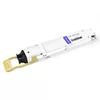
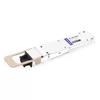
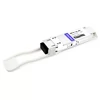
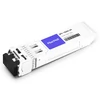
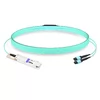
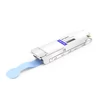
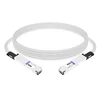
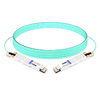
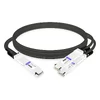
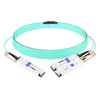
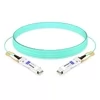
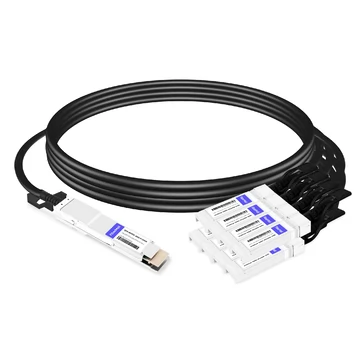
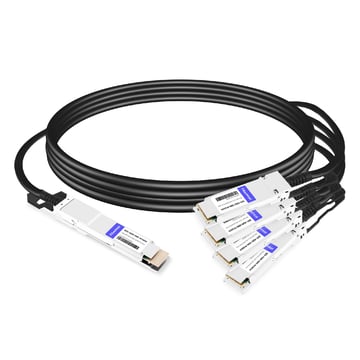
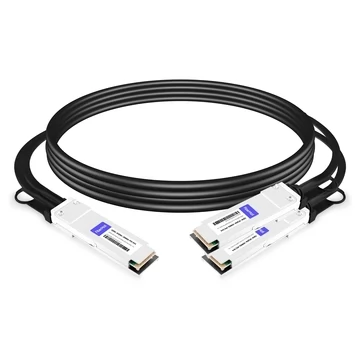
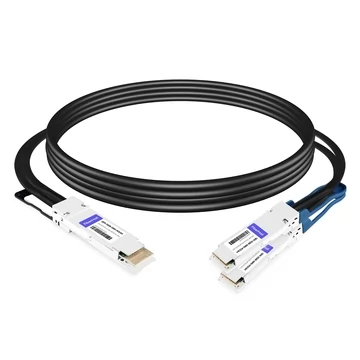
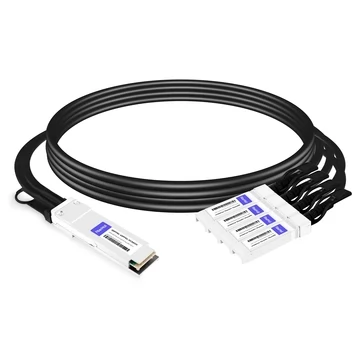
The QSFP56 QSFP-DD DAC breakout cable is a high-performance passive direct-attach copper cable designed to split a single 400G QSFP-DD port into two 200G or four 100G QSFP56 ports. Utilizing PAM4 modulation technology, it supports short-range transmission of up to 3 meters. Requiring no external power supply and offering advantages such as ultra-low power consumption, cost-effectiveness, and ease of deployment, it is an ideal choice for high-density interconnects in data centers, AI clusters, and high-performance computing environments.
The Real Risk with 400G/200G Breakout Cables Is Not the Cable — It’s the Configuration
Network engineers do not worry about whether copper can carry a signal. They worry about whether the switch will recognize the module, whether the port breakout mode is correct, and whether the part number they ordered maps to the platform they are deploying.
The most expensive mistakes in high-speed cabling are almost always compatibility errors:
• A QSFP56 module inserted into a QSFP28-only port will not negotiate to 200G because the host ASIC lacks 50G PAM4 SerDes.
• A 400G QSFP-DD breakout cable must be explicitly configured as 2x200G or 4x100G on the switch — it does not auto-negotiate by itself.
• Pinouts and lane assignments differ across QSFP+, QSFP28, and QSFP56 breakout cables, so a cable that physically fits may still fail electrically.
These errors do not show up in a spec sheet. They show up at 2 a.m. in a data center when links refuse to come up.
FiberMall Breakout DACs: Built for the Switch, Not Just the Standard
MSA compliance is the starting point. Real-world compatibility is what matters when you are under a deployment deadline. FiberMall QSFP56 / QSFP-DD DAC breakout cables are designed, programmed, and tested to drop into the switch platforms you already own.
Key Benefits
• Pre-tested on 200+ switch models: Validated on Cisco, Arista, Juniper, NVIDIA/Mellanox, Dell, H3C, Ruijie, and generic compatible hardware.
• Breakout-mode clarity: We document 2x200G, 4x100G, and 200G to 2x100G options so you order the right fan-out the first time.
• OEM-equivalent performance: IEEE 802.3cd, IEEE 802.3bj, QSFP-DD MSA, and SFF-8636 / SFF-8661 / SFF-8679 compliant.
• Factory-direct pricing: Avoid the 3–5x markup on branded cables without sacrificing reliability.
• Fast global stock and customization: Standard 0.5m–3m lengths ship the same day; custom lengths, labels, and EEPROM coding are available for volume orders.
Product Variants at a Glance
• 400G QSFP-DD to 2x200G QSFP56: Converts 8×50G PAM4 to 2×(4×50G PAM4). Ideal for AI/HPC clusters, DGX, and high-bandwidth aggregation. Typical lengths range from 0.5m up to 3m.
• 400G QSFP-DD to 4x100G QSFP56: Converts 8×50G PAM4 to 4×(2×50G PAM4). Best suited for spine-to-leaf architectures, server access, and phased 100G upgrades. Typical lengths range from 0.5m up to 3m.
• 200G QSFP56 to 2x100G QSFP56: Converts 4×50G PAM4 to 2×(2×50G PAM4). Designed for ToR switches, 200G-to-100G fan-out, and InfiniBand HDR environments. Available in 0.5m, 1m, 2m, and 3m lengths.
• 200G QSFP56 to 4x50G SFP56: Converts 4×50G PAM4 to 4×50G PAM4. Perfect for high-density server NIC connectivity. Available in 0.5m, 1m, 2m, and 3m lengths.
Features That Deliver
MSA-Compliant Construction with Third-Party Switch Validation
Every cable is built to QSFP-DD MSA, QSFP56 MSA, and IEEE 802.3cd electrical specifications. More importantly, each batch is validated on live third-party switches to confirm module detection, CMIS EEPROM reads, and stable link-up across all breakout lanes.
Programmable EEPROM for Major Platforms
We code cables for the platform you specify — Cisco, Arista, Juniper, NVIDIA/Mellanox, Dell, H3C, Ruijie, or generic. If your switch requires a specific vendor ID, we configure it before shipment so the link comes up cleanly.
Passive Twinax Copper for Zero-Power, Low-Latency Links
Passive DACs draw less than 0.1W per end and add virtually no latency. For same-rack and adjacent-rack connections up to 3 meters, they are the simplest, coolest, and most cost-effective interconnect available.
Flexible AWG and Jacket Options
Choose 30AWG for ultra-flexible 0.5m–1m runs, 28AWG for 2m–3m reaches, and PVC or LSZH jackets depending on your data center fire-safety requirements.
Active DAC and AOC Upgrades When You Need More Reach
When your cable run exceeds 3 meters, FiberMall also supplies active DAC (ACC) and AOC breakout cables.
Passive vs. Active vs. AOC: Which Breakout Cable Do You Need?
• Passive DAC: With a maximum reach of 3 meters and power consumption under 0.1W per end, this is the best option for same-rack setups requiring the lowest cost and lowest latency.
• Active DAC (ACC): Designed for distances between 3 and 5 meters, utilizing 0.5 to 4.5W per end. Ideal for longer copper runs that need active signal conditioning.
• AOC (Active Optical Cable): Capable of distances from 1 up to 30+ meters while drawing less than 10W per end. This is the optimal choice for cross-rack deployments, EMI-sensitive environments, or extended reaches.
If your cable run is under 3 meters and inside the same rack or adjacent racks, a passive QSFP56 / QSFP-DD breakout DAC is almost always the right choice. For AI clusters, HPC fabrics, and DGX deployments where every watt and every nanosecond counts, passive copper is the default interconnect.
FAQ
What is a QSFP-DD to QSFP56 breakout DAC cable?
It is a direct-attach copper cable that splits one 400G QSFP-DD port into multiple lower-speed QSFP56 ports — typically 2×200G or 4×100G — using passive twinax copper.
What is the difference between QSFP-DD and QSFP56?
QSFP-DD is an 8-lane, double-density form factor that supports 400G. QSFP56 is a 4-lane form factor that supports 200G or 100G. A breakout DAC bridges the two by fanning out the 8 lanes from QSFP-DD into multiple QSFP56 connectors. See our QSFP form-factor differences guide for a full comparison.
Is QSFP56 backward compatible with QSFP28?
Physically, they share the same form factor, but QSFP56 uses 50G PAM4 signaling while QSFP28 uses 25G NRZ. A QSFP56 module will not work at 200G in a QSFP28-only port. Read our QSFP56 compatibility guide for the full compatibility matrix.
When should I use 400G QSFP-DD to 2x200G QSFP56 vs 4x100G QSFP56?
Use 2×200G when you need high-bandwidth aggregation, GPU-to-GPU links, or DGX/AI cluster connectivity. Use 4×100G when you are fanning out to servers, storage, or leaf switches that operate at 100G.
What is the maximum length of a passive QSFP-DD breakout DAC?
Most passive DACs reach up to 3 meters. For 0.5m–1m runs, 30AWG is common. For 2m–3m runs, 28AWG or 26AWG is used to maintain signal integrity.
Do these cables work with Cisco, Arista, Juniper, and NVIDIA switches?
Yes. FiberMall codes the EEPROM for the specific switch vendor and model you specify, and we validate link-up on live hardware before shipment.
What is the power consumption of a passive 400G breakout DAC?
Passive DACs consume less than 0.1W per end. Only the EEPROM draws minimal host power.
Can I use a QSFP-DD breakout cable in a QSFP28 port?
No. QSFP-DD and QSFP28 are physically and electrically incompatible for breakout operation. QSFP-DD ports can accept QSFP28 modules in many cases, but the reverse is not true.
Do you offer custom lengths or private-label cables?
Yes. FiberMall provides OEM/ODM services, custom lengths, custom labels, and bulk packaging. Contact our team for volume pricing.