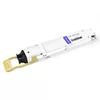
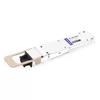
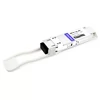
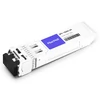
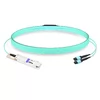
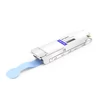
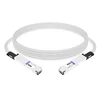
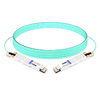
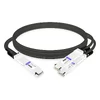
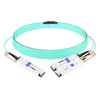
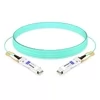
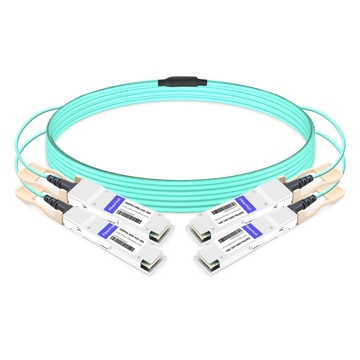
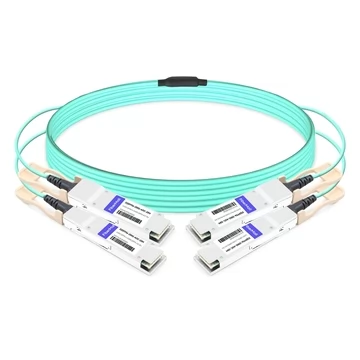
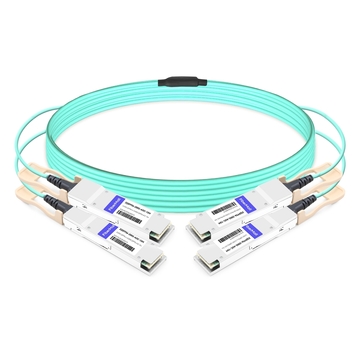
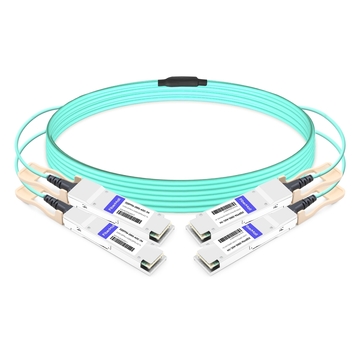
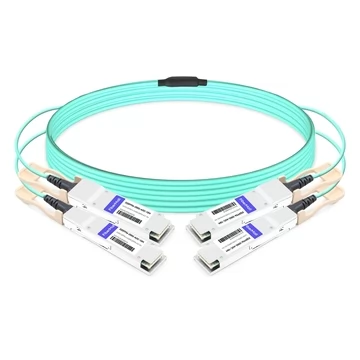
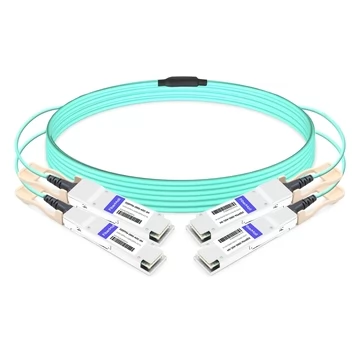
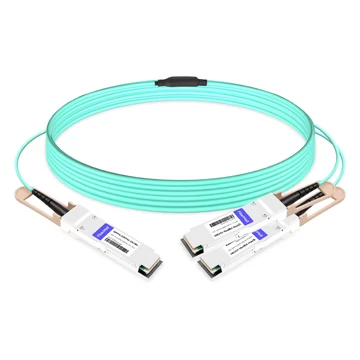
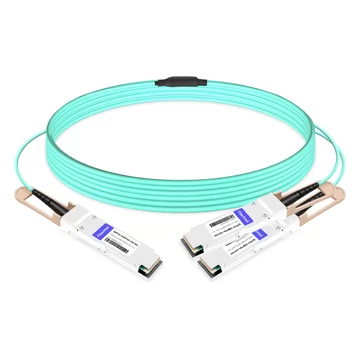
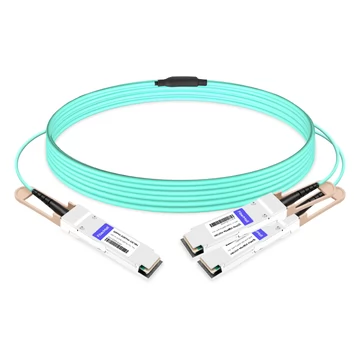
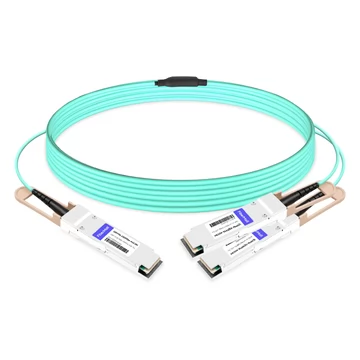
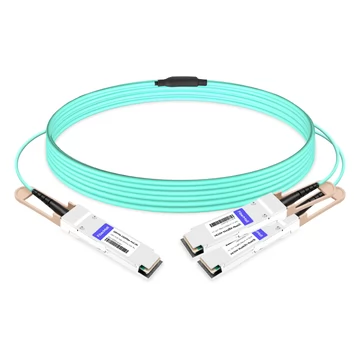
A 200G QSFP56 breakout AOC is a high-performance active optical cable assembly designed for 200GbE and InfiniBand HDR applications. Depending on the selected configuration, it can split one 200G QSFP56 port into two 100G links or four 50G links.
Using a QSFP56 connector on the 200G side, integrated multimode fiber, and 850 nm VCSEL-based optical engines, selected models can support transmission distances of up to 100 meters. The exact maximum reach depends on the cable configuration, internal fiber construction, host platform, and product SKU.
Its flexible fan-out design simplifies network architecture and cable management in high-density data centers and high-performance computing environments.
The Hidden Cost of OEM Breakout Cables
Data center upgrades move quickly. One day, you may be provisioning 100G leaf switches; the next, AI clusters may require 200G HDR links that break out to existing 100G or 50G endpoints.
OEM breakout AOCs can keep a project moving, but their high per-cable cost can quickly consume a significant portion of the cabling budget.
Network architects commonly face three recurring challenges:
• Sticker shock: Depending on the brand, cable length, platform, and distribution channel, vendor-branded 200G QSFP56 breakout AOCs can cost USD 1,200 to USD 1,800 per cable.
• Compatibility uncertainty: Unverified generic cables may fail identification, EEPROM, firmware, or port-validation checks on platforms with strict compatibility requirements.
• Supply delays: Long lead times from brand-name distributors can slow down data center upgrades and large-scale deployments.
A QSFP56 AOC Breakout Cable That Just Works
FiberMall 200G QSFP56 breakout AOCs are designed in accordance with applicable QSFP56 MSA requirements and are tested for interoperability with selected mainstream networking platforms.
Whether your network requires a 200G port to be split into two 100G links or four 50G links, the appropriate cable assembly can be programmed and validated for the specified host platform before shipment.
Compatibility depends on the exact device model, port type, operating system, firmware version, breakout mode, lane mapping, and FEC configuration. These parameters should therefore be confirmed before ordering.
Selected models also support digital diagnostic monitoring, allowing compatible host systems to read operating parameters such as temperature, supply voltage, optical transmit power, and optical receive power.
Key Benefits
• OEM-level interoperability: Tested on selected models from NVIDIA/Mellanox, Cisco, Arista, Dell, Juniper, H3C, MikroTik, and other MSA-compliant platforms. Compatibility should be verified against the exact device model and software version.
• Significant cost savings: Factory-direct pricing helps reduce cabling costs by avoiding a substantial portion of the OEM brand markup.
• Longer reach than passive DAC: Depending on the product configuration, AOCs can support distances from 1 meter to several dozen meters, with selected models reaching up to 100 meters.
• Lighter and more flexible construction: Optical cable assemblies are generally thinner and lighter than comparable copper breakout cables, helping improve airflow and cable management in dense racks.
• Digital diagnostic monitoring: Selected models support DDM functions for monitoring temperature, voltage, and per-channel optical power in real time.
Available Breakout Configurations
Choose the appropriate fan-out configuration for your network topology.
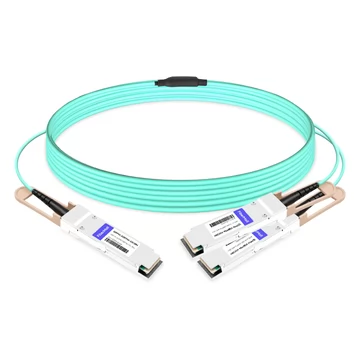
200G QSFP56 to 2×100G QSFP56 Breakout AOC
This configuration splits one 200G QSFP56 port into two independent 100G QSFP56 links.
It is suitable for connecting a 200G spine or leaf switch to 100G downstream devices during network migrations or in mixed-speed Ethernet and InfiniBand fabrics.
The 200G side uses four 50 Gb/s PAM4 electrical lanes. Each 100G branch uses the lane allocation required by the specific host platform and cable design. The switch or network adapter must support the corresponding breakout mode.
Some specialized 200G-to-2×100G designs may use QSFP28 connectors on the breakout side and incorporate active signal or modulation conversion. Such products should be treated as separate SKUs and verified against the target equipment before deployment.
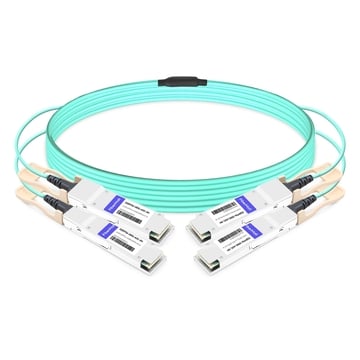
200G QSFP56 to 4×50G SFP56 Breakout AOC
This configuration splits one 200G QSFP56 port into four independent 50G SFP56 links.
It is designed for connecting 200G switch ports to 50GbE server network adapters, storage controllers, accelerator systems, or top-of-rack switches.
The host switch must support 4×50G breakout operation, and each downstream device must support the required 50G PAM4 signaling and host-side FEC mode.
Related 400G Breakout Configurations
For next-generation 400G fabrics, FiberMall also supplies related 400G breakout AOCs. These are separate product families rather than variants of the 200G QSFP56 breakout AOC.
A 400G QSFP-DD or OSFP to 2×200G QSFP56 breakout AOC splits one 400G port into two independent 200G QSFP56 links. This configuration is commonly used in AI training clusters, GPU fabrics, high-performance computing systems, and hyperscale leaf-spine networks.
FiberMall also supplies 400G QSFP-DD to 4×100G breakout AOCs for networks that require four independent 100G connections.
Connector type, management interface, power consumption, cable reach, and platform compatibility vary by 400G product SKU.
Technical Specifications
The following specifications describe a typical 200G QSFP56 breakout AOC. Exact values may vary according to the selected breakout configuration, cable length, connector type, and host-platform requirements.
The 200G end uses a QSFP56 form factor. The breakout side normally uses either two 100G QSFP56 connectors or four 50G SFP56 connectors. Certain specialized models may use QSFP28 breakout connectors with additional active conversion electronics.
The aggregate data rate is 200 Gb/s.
The 200G electrical interface uses four 50 Gb/s PAM4 lanes and is commonly based on a 200GAUI-4 host interface.
The optical engines typically use an 850 nm VCSEL array and integrated multimode fiber.
Available cable lengths generally range from 1 meter to several dozen meters. Selected designs may support up to approximately 70 meters or 100 meters, depending on the product construction and qualification requirements. Maximum reach must be confirmed in the datasheet for the exact SKU rather than assumed for every breakout configuration.
Power consumption varies by connector and breakout design. A typical 200G QSFP56 end may consume less than 5 watts, while the power consumption of each breakout end depends on whether it uses QSFP56, QSFP28, or SFP56 electronics. The maximum power value for each end should be confirmed in the relevant product datasheet.
For 200G QSFP56 products, management communication is normally provided over an I²C interface using an SFF-8636-compatible memory map. CMIS 4.x may apply to the 400G QSFP-DD or OSFP end of related 400G breakout products, but it should not be presented as the default management specification for every 200G QSFP56 endpoint.
Selected models support digital diagnostic monitoring. Available parameters may include module temperature, supply voltage, laser bias current, transmit optical power, and receive optical power. Diagnostic visibility also depends on host-platform support.
The standard commercial operating temperature range is typically 0 °C to 70 °C.
Applicable compliance requirements may include the QSFP56 MSA, IEEE 802.3cd, InfiniBand HDR or HDR100 requirements, and RoHS. Compliance should be stated on a per-SKU basis because not every configuration necessarily supports every listed protocol.
An LSZH cable jacket is available for selected products.
The cable assemblies are hot-pluggable. However, forward error correction is normally implemented and configured by the host switch, network adapter, or ASIC rather than by the AOC itself. The connected host ports must support and enable the FEC mode required by the selected 200GbE, 100GbE, 50GbE, HDR, or HDR100 operating mode.
When to Choose Breakout AOC Over Breakout DAC
Not every short-reach link requires an optical cable.
For intra-rack connections of approximately 1 to 3 meters, a passive DAC breakout cable is usually less expensive, consumes no active optical power, and may offer marginally lower latency. Depending on the platform and cable gauge, some passive DAC products can support distances of up to approximately 5 meters.
A breakout AOC is generally the better choice in the following situations.
For distances between approximately 3 meters and the maximum supported reach of the selected SKU, an AOC provides substantially greater reach than a typical passive DAC.
In dense racks, the thinner and lighter optical cable improves routing, reduces cable bulk, and can help maintain airflow around switches, servers, storage systems, and GPU chassis.
In environments with significant electromagnetic interference, an AOC is preferable because the optical transmission path is immune to electrical interference.
In AI and HPC clusters, the flexibility and lower weight of an AOC make it easier to route cables around large GPU servers, liquid-cooling infrastructure, storage appliances, and high-density switch systems.
When operational monitoring is required, selected AOC models provide digital diagnostic data that can support troubleshooting and predictive maintenance.
For future network designs, AOCs are available in multiple fixed breakout configurations. Each cable has a predetermined connector type, fan-out ratio, and length, so the appropriate version must be selected for the intended topology. A single cable cannot normally be reconfigured in the field from 2×100G to 4×50G.
Frequently Asked Questions
What is a QSFP56 AOC breakout cable?
A QSFP56 AOC breakout cable is an active optical cable assembly that connects one higher-speed QSFP56 port to multiple lower-speed ports.
Common configurations include 200G QSFP56 to 2×100G QSFP56 and 200G QSFP56 to 4×50G SFP56.
The assembly contains integrated multimode fiber and active optoelectronic components that convert electrical signals into optical signals and back again. The maximum supported distance depends on the exact cable model and configuration.
What is the maximum reach of a 200G QSFP56 breakout AOC?
The maximum reach varies by product SKU.
Selected multimode AOC designs may support approximately 70 meters or up to 100 meters, while other breakout products may be limited to shorter distances such as 30 meters.
The exact maximum length depends on the cable construction, optical design, breakout configuration, host platform, operating mode, and qualification requirements. The datasheet for the exact SKU should always be checked before deployment.
Which switch vendors are compatible?
FiberMall QSFP56 breakout AOCs can be coded and tested for selected platforms from NVIDIA/Mellanox, Cisco, Arista, Dell, Juniper, H3C, MikroTik, and other MSA-compliant vendors.
Compatibility cannot be guaranteed solely by vendor name. It must be verified against the exact switch, router, network adapter, or accelerator model, as well as the operating system, firmware version, port type, breakout mode, lane mapping, and FEC configuration.
FiberMall verifies the target platform and required coding before shipment.
What is the difference between QSFP56 AOC and DAC breakout cables?
An AOC uses integrated optical fiber and active optoelectronic components. It generally provides longer reach, lower cable weight, better flexibility, and immunity to electromagnetic interference.
A passive DAC uses copper twinax cable. It is generally less expensive and consumes no active optical power, making it a practical option for very short intra-rack connections.
Passive DAC reach is commonly limited to approximately 1 to 3 meters, although some platform and cable combinations may support up to approximately 5 meters. Active copper cables can reach farther but are a separate product category.
Does this cable support DDM?
Selected active optical breakout cable models support digital diagnostic monitoring through the applicable module management interface.
Depending on the cable design and host platform, available data may include optical transmit power, optical receive power, temperature, supply voltage, and laser bias current.
DDM availability and the specific monitored parameters must be confirmed for the exact product SKU. The host system must also support reading and displaying the diagnostic data.
Can I use a QSFP56 breakout AOC for InfiniBand HDR?
Yes, provided that the cable is specifically designed and qualified for the required InfiniBand operating mode.
A 200G QSFP56 to 2×100G breakout AOC may be used for InfiniBand HDR-to-HDR100 applications when the host ports support the correct breakout mode, lane mapping, firmware, and FEC settings.
Ethernet compatibility does not automatically guarantee InfiniBand compatibility, so the required protocol and target platform should be specified before ordering.
What breakout ratios are available?
The most common 200G breakout configurations are 200G to 2×100G and 200G to 4×50G.
Related 400G products include 400G QSFP-DD or OSFP to 2×200G QSFP56 breakout AOCs and 400G QSFP-DD to 4×100G breakout AOCs.
These configurations are separate fixed cable assemblies. Connector types, management interfaces, maximum reach, protocol support, and power consumption vary by product model and should be confirmed against the relevant datasheet.