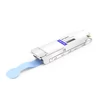
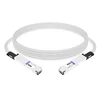
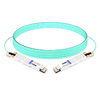
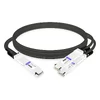
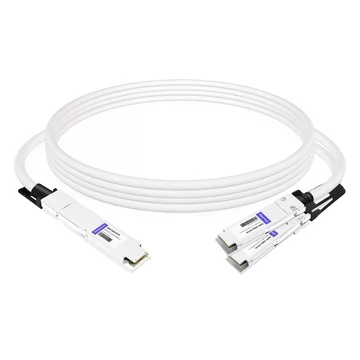
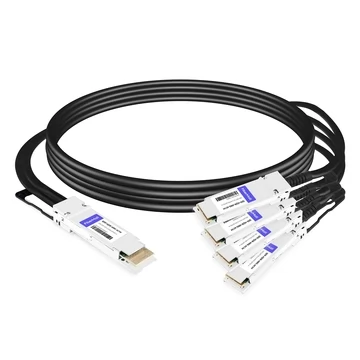
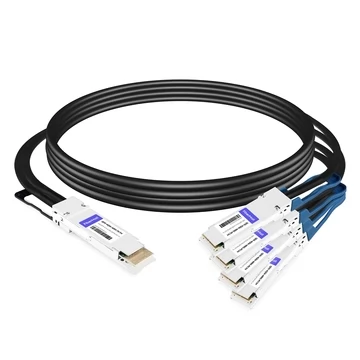
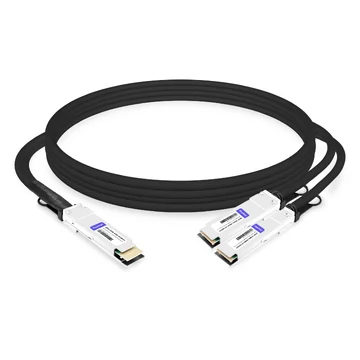
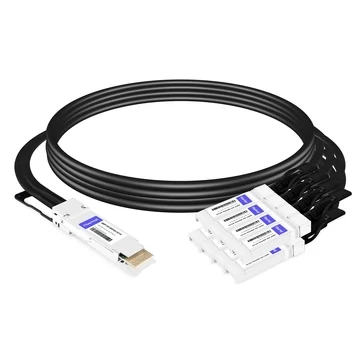
Deploying 400G connectivity means more than buying a cable. Network engineers need breakout configurations that map a single QSFP-DD port to 100G, 200G, or 50G endpoints without compatibility surprises, signal integrity issues, or inflated OEM pricing. The wrong cable type—or the wrong EEPROM coding—can stall a deployment for days.
The Challenge of Scaling to 400G
Upgrading from 100G or 200G to 400G introduces decisions that most product pages ignore. Do you need a passive DAC for in-rack connections, an active ACC for longer reach, or an AOC when distance exceeds copper limits? Should the breakout split to 4×100G, 2×200G, or 8×50G? Will your switch even recognize a third-party cable?
Complete 400G Breakout Cable Portfolio
FiberMall offers passive and active breakout options in the most common QSFP-DD configurations. This lets you standardize procurement on one supplier instead of juggling multiple vendors for different reach requirements.
Key Benefits:
• One supplier for every 400G breakout need: DAC, ACC, AEC, and AOC options in QSFP-DD and OSFP form factors.
• Multi-vendor compatibility: Pre-coded EEPROM for Cisco, Arista, Juniper, Dell, H3C, Huawei, and NVIDIA/Mellanox, plus generic MSA code.
• Factory-direct value: Competitive pricing without the OEM markup, backed by quality testing and global logistics.
• AI/HPC-ready: InfiniBand NDR and HDR support for GPU clusters and high-performance computing networks.
Passive DAC Breakout Cables
Passive direct attach copper cables are the lowest-cost option for short-reach, in-rack connections. They require no power and generate minimal heat, making them ideal for dense TOR deployments.
• Reach: 0.5 m to 3 m
• Power consumption: < 0.5 W total
• Configurations: QSFP-DD to 4×100G QSFP56, 2×200G QSFP56, 8×50G SFP56
• Best for: Top-of-rack switch-to-server connections inside the same cabinet
Active ACC Breakout Cables
Active copper cables add redriver chips to extend reach and clean up signal integrity. ACC cables consume slightly more power than passive DACs but cost far less than optical alternatives.
• Reach: up to 5 m
• Power consumption: 1–2 W per end
• Signal conditioning: Redriver-based equalization
• Best for: Adjacent rack connections where passive copper is too short
Active AEC Breakout Cables
Active electrical cables provide more advanced DSP-based signal processing than ACC, supporting longer distances and more challenging cable routes while staying on copper.
• Reach: up to 7 m
• Power consumption: higher than ACC but lower than AOC
• Signal conditioning: DSP / retimer with advanced equalization
• Best for: Multi-meter intra-row connections requiring copper economics
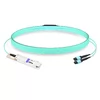
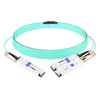
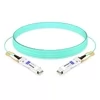
AOC Breakout Cables
Active optical cables use fiber for the longest reaches within a data hall. They are the right choice when distance, cable routing, or galvanic isolation rules out copper.
• Reach: 20 m and beyond
• Power consumption: typically 4–5 W per end
• Weight and bend radius: lighter and more flexible than twinax
• Best for: Rack-to-rack or end-of-row connections
Common 400G Breakout Configurations
QSFP-DD doubles the density of QSFP28 by adding a second row of contacts, enabling eight electrical lanes. A single 400G port can be fanned out to multiple lower-speed ports depending on your switch capability and endpoint mix.
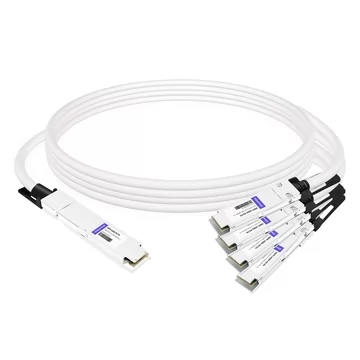
• QSFP-DD to 4×100G QSFP56: This configuration splits an 8×50G PAM4 lane into four 2×50G PAM4 links. It is typically used to connect 400G spine switches to 100G leaf switches or server NICs.
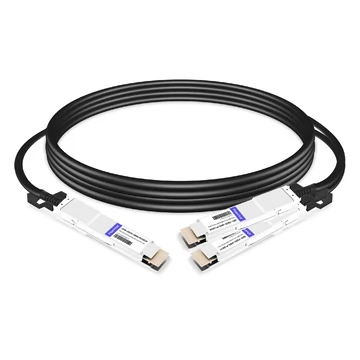
• QSFP-DD to 2×200G QSFP56: This maps the 8×50G PAM4 interface into two 4×50G PAM4 links, providing an intermediate density solution for 200G endpoint aggregation.
• QSFP-DD to 8×50G SFP56: This provides a direct 1-to-1 mapping of the eight 50G PAM4 lanes to eight individual 50G PAM4 connections, offering the maximum fan-out to high-density 50G server ports.
Technical Specifications Overview
All 400G breakout cable types share a 400 Gbps aggregate data rate, utilize 8 × 50G PAM4 modulation, feature a 400GAUI-8 electrical interface, support an operating temperature range of 0°C to +70°C, and comply with QSFP-DD MSA and IEEE 802.3cd standards. However, they differ in reach, power, and physical construction:
• Passive DAC: Uses 26–30 AWG copper wire and features no active signal conditioning. This limits its reach to 0.5–3 meters but keeps power consumption extremely low at < 0.5–1.5 W. It additionally complies with SFF-8636/8661/8679.
• Active ACC: Employs 26–28 AWG copper wire and relies on redriver-based signal conditioning to achieve reaches up to 5 meters. Power consumption is slightly higher at 1–2 W per end.
• Active AEC: Also utilizes 26–28 AWG copper wire but uses advanced DSP retimers for signal conditioning, extending the reach up to 7 meters. This processing draws 2–4 W per end.
• AOC: Replaces copper with optical fiber, relying on optical transceivers for signal conditioning. This allows for reach exceeding 20 meters, though it requires higher power consumption (typically 4–5 W per end).
Compatibility: Cisco, Arista, Mellanox, and More
Third-party cables work seamlessly when the EEPROM coding matches what the switch operating system expects.
• Cisco: Supported on Nexus 9300-GX2 and compatible 400G switches using Cisco-coded EEPROM.
• Arista: Supported on 7060X6 and 400G data center switches using Arista-coded EEPROM.
• Juniper: Supported on PTX / QFX 400G platforms using Juniper-coded EEPROM.
• Dell: Supported on Z-Series and PowerSwitch 400G ports using Dell-coded EEPROM.
• H3C: Supported on S-Series 400G switches using H3C-coded EEPROM.
• Huawei: Supported on CloudEngine 400G platforms using Huawei-coded EEPROM.
• NVIDIA / Mellanox: Supported on Spectrum-4, SN5000, MSN4700, and ConnectX-7 using NVIDIA-coded EEPROM.
• Generic / MSA: Any MSA-compliant 400G QSFP-DD port can utilize the standard MSA code option.
Built for AI, HPC, and Hyperscale Networks
400G is no longer reserved for the largest cloud providers. AI training clusters, financial services networks, and research HPC environments are all moving to 400G leaf-spine fabrics. Breakout cables let those organizations connect 400G switches to 100G or 200G endpoints without replacing every NIC.
Crucial Engineering Note on 100G Migrations: 400G QSFP-DD relies entirely on 50G PAM4 signaling. When breaking out a 400G port to 4×100G, the endpoints must support 50G PAM4 signaling (e.g., via QSFP56 interfaces). Standard breakout cables cannot convert signals; therefore, legacy 100G ports utilizing 4×25G NRZ signaling (QSFP28) are physically and electrically incompatible with standard PAM4 breakouts and would require specialized Gearbox cables or transceivers.
Typical deployment scenarios:
• AI clusters: Connect NVIDIA Spectrum-4 switches to ConnectX-7 NICs using QSFP-DD to 4×100G or 8×50G breakouts.
• Hyperscale data centers: Fan out 400G spine ports to compatible 100G leaf switches with passive DACs inside cabinets.
• Enterprise upgrades: Bridge PAM4-capable 100G server ports to new 400G TOR switches during phased migration.
• HPC networks: Deploy InfiniBand NDR breakout cabling with low latency and predictable signal integrity.
Frequently Asked Questions
What is the maximum length of a 400G passive DAC breakout cable?
Most passive DAC breakout cables support 0.5 m to 3 m. Longer distances require active ACC, AEC, or AOC cables to maintain signal integrity.
What is the difference between 400G DAC, ACC, AEC, and AOC breakout cables?
DAC is passive copper with no signal conditioning. ACC adds redriver chips for reach up to 5 m. AEC uses DSP-based retimers for longer copper runs. AOC converts the signal to optical for distances beyond 20 m.
Are 400G QSFP-DD breakout cables backward compatible with QSFP28?
While QSFP-DD ports are mechanically and electrically backward compatible with QSFP28 and QSFP56 modules, you cannot plug a QSFP-DD breakout leg (which terminates in a QSFP56 connector) directly into a legacy QSFP28 switch port that only supports NRZ signaling.
Which switches support 400G QSFP-DD breakout mode?
Cisco Nexus 9300-GX2, Arista 7060X6, Juniper PTX/QFX, Dell Z-Series and PowerSwitch, H3C S-Series, Huawei CloudEngine, and NVIDIA/Mellanox Spectrum-4 / SN5000 series switches support breakout mode. Specific split options depend on the switch ASIC capabilities and the OS version.
How much does a 400G breakout cable cost?
Passive DAC breakout cables typically range from roughly $50 to $200 depending on configuration and length. Active ACC/AEC and AOC cables cost more due to signal conditioning or optical components. Contact FiberMall for a quote based on your exact specifications.
Can I use a 400G breakout cable with NVIDIA InfiniBand?
Yes, when configured for the correct InfiniBand lane rate and breakout mapping. FiberMall offers NVIDIA/Mellanox-coded cables for NDR and HDR deployments.
What is PAM4 modulation and why does it matter for 400G cables?
PAM4 carries two bits per symbol by using four voltage levels, doubling throughput compared to NRZ at the same baud rate. 400G QSFP-DD uses 8 × 50G PAM4 lanes, so every conductor, connector, and equalizer in the cable must cleanly preserve PAM4 signal integrity.
How do I configure breakout mode on my switch?
Configuration varies by vendor. Generally, you set the port speed to 400G, enable the desired breakout split in the interface configuration, and commit the change. FiberMall can provide platform-specific guidance with your order.
Do FiberMall 400G breakout cables work with Cisco and Arista switches?
Yes. We offer Cisco-coded and Arista-coded EEPROM options that are recognized by the switch OS. MSA generic coding is also available for lab or multi-vendor environments.
What is the power consumption of a 400G ACC breakout cable?
Active copper breakout cables typically consume 1–2 W per end, or 2–4 W total. This is still significantly lower than AOC alternatives, which draw closer to 4–5 W per end.