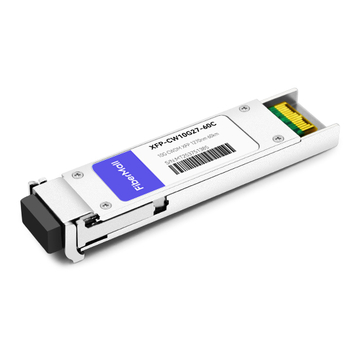
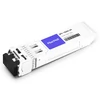
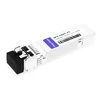
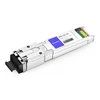
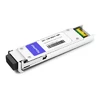
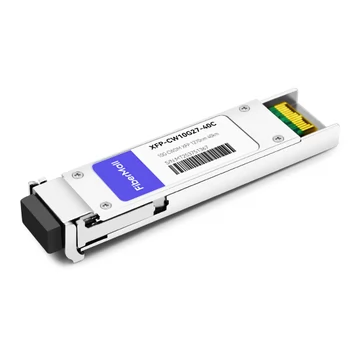
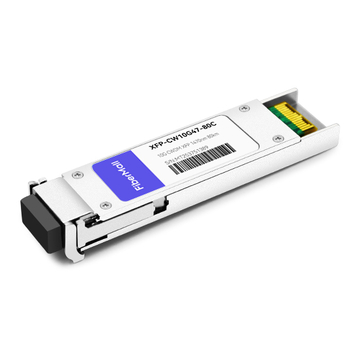
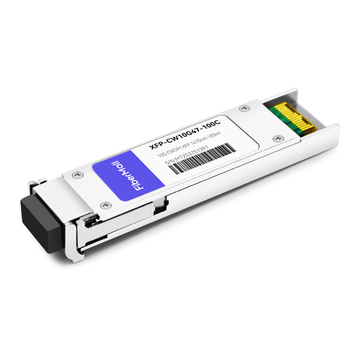
10G CWDM XFP Transceivers
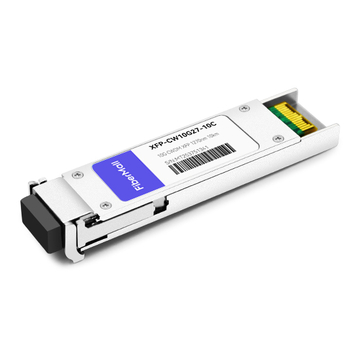
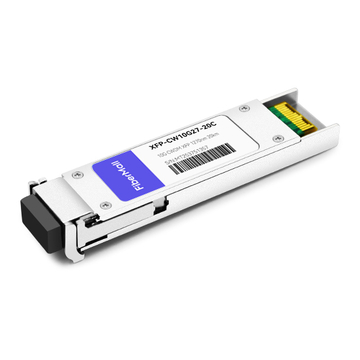
In modern network infrastructure, 10G CWDM XFP transceivers are a cost-effective solution that offers high-speed, long-distance data transmission without compromising scalability. They are compact, hot-pluggable optical transceiver modules that provide easy connections for data centers and large metro or regional networks.
Introduction to 10G CWDM XFP Transceivers
The 10G CWDM XFP transceivers are small, pluggable modules for telecommunications equipment that support Coarse Wavelength Division Multiplexing (CWDM). They operate at 10 Gbps and support transmission distances from tens to hundreds of kilometers, depending on the fiber type and link configuration. CWDM allows multiple channels to share a single fiber, optimizing bandwidth utilization and reducing infrastructure costs. These transceivers are primarily designed to increase network capacity in metro, enterprise, and data center environments.
Definition and purpose of 10G CWDM XFP transceivers
The 10G CWDM XFP transceiver is a removable, compact module used to transmit data over optical fiber channels. It supports 10-gigabit Ethernet interfaces and operates on CWDM wavelengths spaced 20 nm apart, spanning 1270 nm to 1610 nm. Its purpose is to multiplex multiple data streams onto a single fiber, reducing the need for new fiber deployment. 10G CWDM XFP transceivers are widely used in telecommunications, regional networks, and large-scale data centers to expand optical network capacity and reach without disrupting existing systems. They comply with industry standards.
How 10G CWDM XFP Technology Enhances Network Efficiency
10G CWDM XFP technology improves data flow efficiency by reducing the resources needed to transport large volumes of data. CWDM enables multiple data streams to travel simultaneously over a single fiber using different wavelengths. This minimizes the number of fibers required, lowering deployment costs. It provides reliable signal delivery over extended distances with minimal attenuation and is fully compatible with standard equipment, enabling easy integration and scalable network deployment. These features result in higher performance and lower-cost optical networks.
Advantages of CWDM technology in high-speed data transmission
Coarse Wavelength Division Multiplexing (CWDM) technology is a key advancement for high-capacity data transfer, especially under budget constraints and scalability requirements. Its main advantage is multiplexing multiple data streams onto one optical fiber, increasing capacity while reducing the need for additional fiber infrastructure. Compared to Dense Wavelength Division Multiplexing (DWDM), CWDM uses wider 20 nm channel spacing, making optical components simpler and less expensive. This leads to lower power consumption and reduced overall costs.
10G CWDM XFP transceivers are ideal for medium- to long-range networks and high-speed applications. The technology does not require complex temperature-controlled lasers, further lowering costs and simplifying maintenance. Its plug-and-play design makes it easy to deploy in metropolitan area networks (MAN), mobile backhaul, and enterprise connectivity, making CWDM a preferred choice where cost-effective high-speed connectivity is required.
Technical Specifications of CWDM XFP Modules
CWDM XFP modules are compact, hot-pluggable optical transceivers. They support data rates up to 10 Gbps and operate across the standard CWDM wavelength range of 1270 nm to 1610 nm with 20 nm spacing. Maximum link distances reach up to 80 km, depending on fiber type and system design. Compliant with the Multi-Source Agreement (MSA), these modules ensure interoperability across network devices and simplify optical network scaling.
Detailed explanation of standard operating wavelengths (1270nm–1610nm)
CWDM systems use 20 nm spaced wavelength channels from 1270 nm to 1610 nm. These channels are aligned with the low-attenuation windows of optical fiber across the O-band, E-band, and S+C+L bands. The wide spacing prevents interference between channels and eliminates the need for active cooling, making lasers more affordable than in DWDM systems. The wavelength grid follows ITU-T Recommendation G.694.2, enabling seamless integration and upgrades to existing network equipment without additional infrastructure.
Applications of 10G CWDM XFP Transceivers in Networking
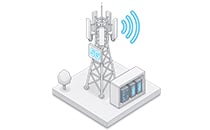
10G CWDM XFP pluggable modules are essential in modern telecommunications, enabling high-speed, long-distance transmission over single-mode optical fiber. They are particularly suited for metro networks, maximizing fiber bandwidth through wavelength multiplexing. These modules are also widely used in data centers, VoIP systems, and enterprise networks due to their cost-effectiveness and ability to extend reach without new fiber construction. They perform well with low-dispersion fiber, minimizing losses in high-demand information networks.
Use in data centers and enterprise network expansions
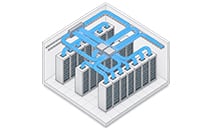
Optical transceivers like 10G CWDM XFP modules have become standard for increasing computing density and user bandwidth in data centers and enterprise environments. They support high-speed data applications without replacing core network infrastructure. By using coarse or dense wavelength division multiplexing, multiple signals share the same fiber, improving efficiency and reducing costs. Their low latency, minimal attenuation, and low power consumption make them ideal for enterprise and large-scale data center expansions.
Key Considerations When Choosing 10G CWDM XFP Transceivers
It is essential to verify that 10G CWDM XFP transceivers meet relevant standards and ensure compatibility with existing network equipment to avoid integration issues. Confirm that the selected CWDM wavelengths match the network's channel plan. Also, verify that the supported transmission distance meets the application requirements (e.g., metro or long-haul). Choose reputable manufacturers for reliable performance and MSA compliance.
Factors such as compatibility, power consumption, and durability
Compatibility is critical: ensure the 10G CWDM XFP module is supported by the host equipment’s operating system, port type, and brand certifications. Power consumption should be considered, especially in high-traffic or energy-sensitive environments; select low-power models to reduce cooling costs and operating expenses. For durability, choose industrial-grade transceivers designed for harsh conditions, including wide temperature ranges and vibration resistance, to maintain performance in demanding deployments.
Frequently Asked Questions (FAQs)
To what purpose are 10G CWDM XFP Transceivers put?
They are used in high-capacity, long-distance transmission systems with CWDM technology. They are essential components in telecommunications, data center interconnects, and metro networks for bandwidth optimization and cost reduction.
How far can a signal travel through a 10G CWDM XFP module?
Transmission distances depend on the specific model, wavelength, fiber type, and network conditions, typically reaching up to 80 km.
Can 10G CWDM XFP transceivers be used for all networking equipment?
No. They must meet the equipment manufacturer's specifications. Most comply with the Multi-Source Agreement (MSA) for broad compatibility, but verification with the vendor is recommended.
Which wavelengths are offered for 10G CWDM XFP Transceivers?
They use CWDM wavelengths spaced 20 nm apart from 1270 nm to 1610 nm, with each channel corresponding to a specific CWDM grid.
What are the environmental variables that affect their performance?
10G CWDM XFP transceivers operate over a wide temperature range. However, extreme heat, vibration, or harsh conditions can affect performance unless industrial-grade versions are used. Always match the transceiver to the environmental requirements of the deployment.