Carrier-Grade PLC Splitters with Verified Optical Performance
A single underperforming PLC splitter can push an entire PON loss budget out of specification, leading to truck rolls, subscriber complaints, and project delays. FiberMall supplies precision planar lightwave circuit splitters with verified optical performance, broad 1260–1650 nm wavelength coverage, and the compliance and qualification documentation commonly requested by network operators.
The Hidden Cost of Low-Grade PLC Splitters
Procurement teams often compare splitters based on unit price alone. In the field, however, small optical inconsistencies can become expensive problems:
• Uneven output loss forces network designers to reserve additional optical margin, potentially limiting system reach or supported split ratios.
• Excessive insertion loss can reduce subscriber-side receive power below the acceptable threshold.
• Poor temperature stability can cause performance drift in outdoor cabinets and other uncontrolled environments.
• Missing test data makes carrier acceptance testing and project validation more difficult and time-consuming.
• Incomplete compliance or reliability documentation may fail regional tender requirements or operator qualification procedures involving RoHS declarations, applicable CE documentation, or Telcordia GR-1209-CORE and GR-1221-CORE testing.
When a splitter fails after installation, the replacement cost is not limited to the component itself. It also includes the truck roll, splice labor, service interruption, project delays, and potential damage to the customer relationship. For this reason, experienced network engineers specify splitters that are individually tested and supported by documented optical and reliability data.
Precision PLC Splitters Built for Carrier-Grade Networks
FiberMall PLC fiber splitters use planar lightwave circuit technology to divide one optical input among multiple nominally equal outputs. They are designed to provide low insertion loss, high port-to-port uniformity, and stable performance across the wavelength bands used by passive optical networks.
Key Benefits
• Verified optical performance — Each splitter is individually tested. Insertion loss, return loss or reflectance, uniformity, and other applicable optical parameters are recorded, with test reports available upon request.
• Broad PON wavelength coverage — Operation across 1260–1650 nm covers the principal wavelength bands used by GPON, XGS-PON, NG-PON2, RF overlay, and other passive optical access systems. PLC splitters may also be used in broadcast-and-select WDM-PON architectures, although they do not provide wavelength routing and cannot replace an AWG or WDM multiplexer.
• Designed for demanding environments — Selected configurations are available with an operating-temperature rating of −40°C to +85°C for installation inside appropriately protected outdoor cabinets, fiber distribution hubs, splice closures, and similar enclosures.
• Flexible procurement — Low minimum order quantities, sample availability, and OEM/ODM customization are available for fiber type, connector type, pigtail length, labeling, and packaging.
• Qualification-ready documentation — Products are manufactured under an ISO 9001-certified quality management system. RoHS material declarations, applicable regulatory documentation, and GR-1209-CORE or GR-1221-CORE test support are available for specified products and projects.
Specifications That Matter for Your Loss Budget
The following values represent typical and maximum optical specifications for selected FiberMall single-mode PLC splitter configurations. Final specifications depend on the package style, connector type, fiber length, test wavelength, and whether connector loss is included. Always refer to the product-specific datasheet and test report when preparing a GPON or XGS-PON loss budget or tender submission.
For a 1×2 PLC splitter, typical insertion loss is approximately 3.6 dB, with a maximum value of 4.0 dB. Port-to-port loss uniformity is no more than 0.4 dB, polarization-dependent loss is no more than 0.2 dB, wavelength-dependent loss is no more than 0.3 dB, and directivity is at least 55 dB.
For a 1×4 PLC splitter, typical insertion loss is approximately 7.0 dB, with a maximum value of 7.4 dB. Loss uniformity is no more than 0.6 dB, polarization-dependent loss is no more than 0.2 dB, wavelength-dependent loss is no more than 0.3 dB, and directivity is at least 55 dB.
For a 1×8 PLC splitter, typical insertion loss is approximately 10.2 dB, with a maximum value of 10.7 dB. Loss uniformity is no more than 0.8 dB, polarization-dependent loss is no more than 0.2 dB, wavelength-dependent loss is no more than 0.3 dB, and directivity is at least 55 dB.
For a 1×16 PLC splitter, typical insertion loss is approximately 13.5 dB, with a maximum value of 14.0 dB. Loss uniformity is no more than 1.2 dB, polarization-dependent loss is no more than 0.25 dB, wavelength-dependent loss is no more than 0.5 dB, and directivity is at least 55 dB.
For a 1×32 PLC splitter, typical insertion loss is approximately 16.5 dB, with a maximum value of 17.2 dB. Loss uniformity is no more than 1.5 dB, polarization-dependent loss is no more than 0.3 dB, wavelength-dependent loss is no more than 0.5 dB, and directivity is at least 55 dB.
For a 1×64 PLC splitter, typical insertion loss is approximately 20.5 dB, with a maximum value of 21.5 dB. Loss uniformity is no more than 2.0 dB, polarization-dependent loss is no more than 0.35 dB, wavelength-dependent loss is no more than 0.5 dB, and directivity is at least 55 dB.
For connectorized assemblies, return loss is typically at least 50 dB for UPC-polished connectors and at least 55 dB for APC-polished connectors. These UPC/APC values do not apply to unterminated bare-fiber configurations.
Selected splitter modules are available with an operating-temperature range of −40°C to +85°C. The qualified environmental range of LGX cassettes, rack-mount assemblies, adapters, and complete enclosures should be verified separately because it may differ from the internal splitter-module rating.
Common Standard Configurations
• Wavelength range: 1260–1650 nm
• Fiber type: G.657.A1 bend-insensitive fiber, G.652.D fiber, or customer-specified fiber
• Connector types: SC/APC, SC/UPC, LC/APC, LC/UPC, FC/APC, and FC/UPC
• Maximum continuous input power: Up to 500 mW for specified configurations, subject to wavelength, connector, temperature, and packaging conditions
• Storage temperature: Typically −40°C to +85°C for qualified module configurations
Product Configurations for Every Deployment
FiberMall supplies PLC splitters in the package styles commonly specified by network engineers.
Bare Fiber / Steel Tube
This is the most compact configuration for installation in splice trays, closures, multi-service terminals, and compact fiber distribution boxes. It is suitable when installation space is limited and the splitter is protected inside a properly rated enclosure.
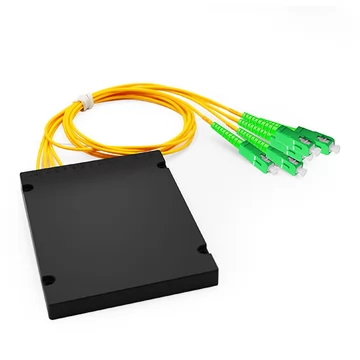
ABS Box Module
The ABS box module provides mechanical protection for the internal splitter and fiber pigtails. It is commonly installed inside wall-mount boxes, pole-mount terminals, fiber distribution hubs, and protected outdoor cabinets. The ABS module itself should not be treated as a weatherproof enclosure unless a specific ingress-protection rating is provided.
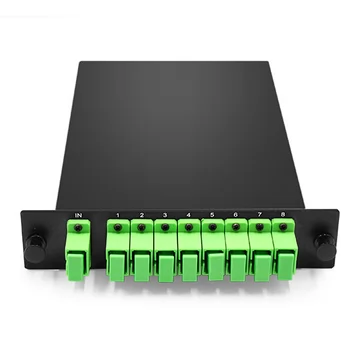
LGX Cassette
The LGX cassette provides a modular form factor for optical distribution frames, patch panels, and fiber-management systems. It allows convenient installation, removal, replacement, and service reconfiguration.
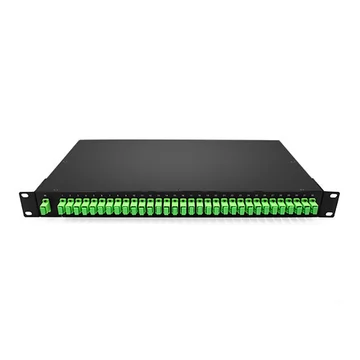
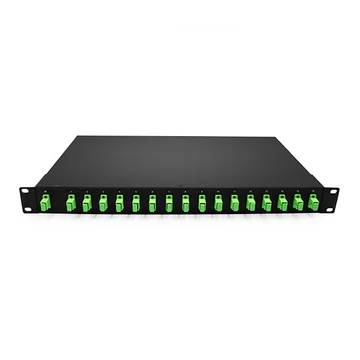
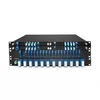
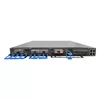
19-Inch Rack Mount, 1U
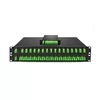
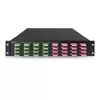
The rack-mount configuration is designed for central offices, equipment rooms, laboratories, and data centers. Multiple splitter circuits can be terminated in a single 1U shelf for organized patching and cable management.
Mini / Blockless
The mini or blockless package is designed for high-density terminals, compact closures, and micro-distribution boxes where internal space is extremely limited.
Applications Across Optical Networks
FTTH / FTTx
PLC splitters distribute the optical signal from one OLT port to multiple optical network terminals in GPON, XGS-PON, NG-PON2, and other point-to-multipoint fiber access networks.
Data Centers
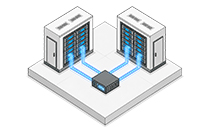
Rack-mount and LGX splitters can be used for passive optical monitoring, laboratory testing, optical test-access applications, and selected high-density fiber-distribution systems. The splitter loss must be included in the optical power budget, and PLC splitters should not be treated as substitutes for wavelength-selective multiplexers.
CATV / RF Overlay
Broad 1260–1650 nm operation supports passive distribution systems that combine PON services with RF video overlay or other wavelength-based services on the same optical distribution network.
Mobile Backhaul and 5G Fronthaul
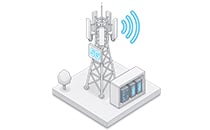
PLC splitters may be used in PON-based mobile transport, small-cell backhaul, selected radio-over-fiber systems, and other architectures that require passive point-to-multipoint optical distribution. Conventional point-to-point Ethernet or WDM fronthaul systems may require different optical components.
OEM / White-Label Manufacturing
Customers can source PLC splitters with customized branding, labels, packaging, pigtail lengths, connector types, and documentation for integration into their own enclosures, assemblies, or product lines.
Why Engineers Choose FiberMall
Per-Port Test Data, Not Just Datasheets
Every PLC splitter is individually tested for applicable optical parameters. Per-port insertion-loss measurements are recorded, while uniformity is calculated from the difference among output ports. Return loss or reflectance, directivity, and other parameters are measured according to the product configuration and test procedure.
Test reports are available upon request, helping customers demonstrate compliance during carrier acceptance testing, project verification, and tender submission.
Qualification-Ready Quality
FiberMall PLC splitters are manufactured under an ISO 9001-certified quality management system. RoHS material declarations and applicable regulatory documentation are available for specified products.
Selected configurations may be tested against applicable requirements of Telcordia GR-1209-CORE and GR-1221-CORE. When a project requires formal qualification, customers should confirm whether an existing test report is available or whether project-specific testing must be arranged.
Full-Band PON Compatibility
With an operating wavelength range of 1260–1650 nm, FiberMall PLC splitters cover the primary wavelength bands used by GPON, XGS-PON, and NG-PON2 systems.
An existing splitter can often remain in service during a GPON-to-XGS-PON upgrade, provided that its spectral performance, split ratio, connector condition, coexistence arrangement, and total optical distribution network loss remain within the XGS-PON system budget.
Flexible Ordering
Customers can request samples before placing a volume order. Low minimum order quantities support smaller system integrators, while scalable manufacturing capacity is available for larger carrier and infrastructure deployments.
Sample availability and lead time depend on the splitter ratio, connector type, fiber length, package style, and customization requirements.
Fast Technical Support
The FiberMall fiber engineering team supports technical inquiries and quotation requests. For complex projects, the team can help select appropriate split ratios, connector types, fiber types, and package styles based on the customer’s network architecture and optical loss budget.
Protected by Warranty
FiberMall PLC splitters are covered by a one-year limited product warranty. Coverage is subject to the applicable warranty terms, installation conditions, handling requirements, and exclusions.
PLC Splitter vs. FBT Splitter: Which One Do You Need?
PLC and FBT splitters are both passive optical branching devices, but they use different manufacturing technologies and are suited to different network requirements.
A PLC splitter uses a silica-based planar waveguide chip. It is commonly available in balanced configurations ranging from 1×2 to 1×64 and higher, as well as 2×N configurations. PLC technology offers broad 1260–1650 nm wavelength coverage, good port-to-port uniformity, compact size, and scalability for high split counts. Qualified PLC splitter modules are commonly available with operating-temperature ranges as wide as −40°C to +85°C, although the final rating depends on the complete package.
An FBT splitter is produced by fusing and tapering optical fibers. It is most commonly used for lower split counts, such as 1×2 or 1×4, and can be manufactured with balanced or customized asymmetric split ratios. FBT devices are generally optimized for one or more specified wavelength windows, such as 850 nm, 1310 nm, or 1550 nm, rather than for continuous full-band operation. Their optical uniformity, package size, and temperature rating depend on the specific design and may become less favorable as the number of output ports increases.
PLC splitters are generally the preferred option for FTTH, PON, carrier access networks, high-density distribution, and applications requiring consistent performance across many output ports. FBT splitters remain useful for simple low-port-count taps, customized split ratios, and cost-sensitive applications with limited wavelength requirements.
Frequently Asked Questions
What Is a PLC Splitter and How Does It Work?
A PLC, or planar lightwave circuit, splitter is a passive optical branching device that distributes one input optical signal among multiple nominally equal output ports using a silica waveguide chip.
PLC technology is widely used in FTTH and PON networks because it provides low insertion loss, good output uniformity, compact packaging, and stable performance across a broad range of wavelengths and environmental conditions.
What Is the Difference Between a PLC Splitter and an FBT Splitter?
PLC splitters use a planar waveguide chip and commonly support balanced split configurations up to 1×64 and beyond, with consistent performance across the 1260–1650 nm wavelength range.
FBT splitters are produced by fusing and tapering fibers. They are generally used for lower split counts, specific wavelength windows, and customized asymmetric power ratios. PLC splitters are usually preferred for modern PON and high-density distribution networks, while FBT splitters remain suitable for simple taps and custom-ratio applications.
What Split Ratios Does FiberMall Offer for PLC Splitters?
FiberMall supplies 1×2, 1×4, 1×8, 1×16, 1×32, and 1×64 PLC splitters, as well as balanced 2×N configurations. Customized split ratios, fiber lengths, connector combinations, and package styles are available through FiberMall’s OEM fiber solutions.
Are FiberMall PLC Splitters Compatible with GPON and XGS-PON?
Yes. The 1260–1650 nm operating wavelength range covers the principal bands used by standard GPON systems and standard XGS-PON deployments using approximately 1490 nm downstream and 1310 nm upstream for GPON, and approximately 1577 nm downstream and 1270 nm upstream for XGS-PON.
The same PLC splitter can often be retained during an upgrade from GPON to XGS-PON. However, the existing splitter, connectors, splices, coexistence components, and complete optical distribution network must still satisfy the XGS-PON optical power budget.
What Compliance and Qualification Documentation Is Available?
FiberMall PLC splitters are manufactured under an ISO 9001-certified quality management system. RoHS material declarations and applicable compliance documentation are available for specified products and configurations.
Selected products may also be supported by test or qualification reports addressing applicable requirements of Telcordia GR-1209-CORE and GR-1221-CORE. Customers with carrier or tender requirements should confirm the exact documentation available for the selected model before ordering.
What Connector Types and Package Styles Are Available?
Connector options include SC/APC, SC/UPC, LC/APC, LC/UPC, FC/APC, and FC/UPC.
Available package styles include bare fiber or steel tube, mini or blockless modules, ABS box modules, LGX cassettes, and 19-inch 1U rack-mount assemblies.