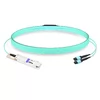
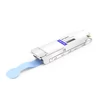
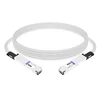
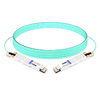
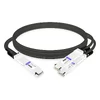
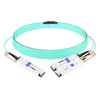
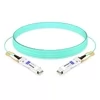
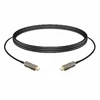
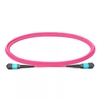
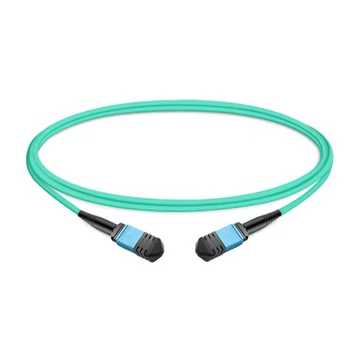
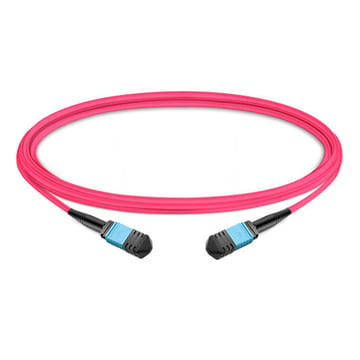
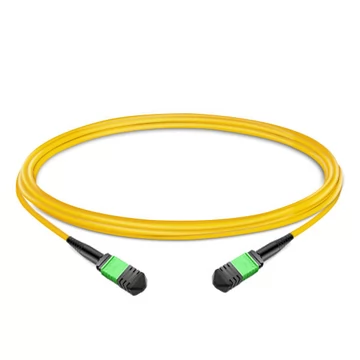
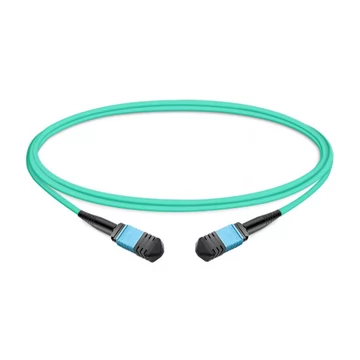
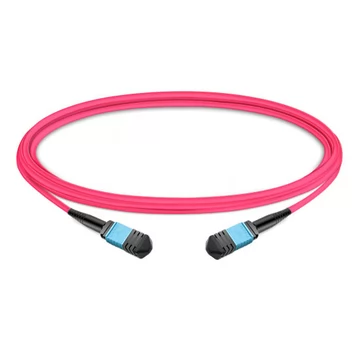
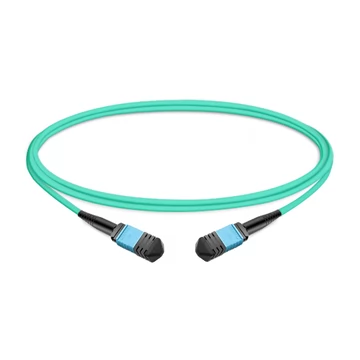
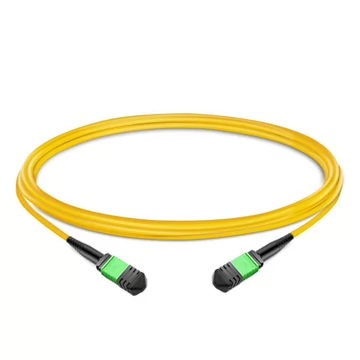
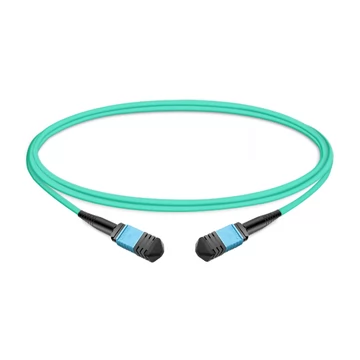
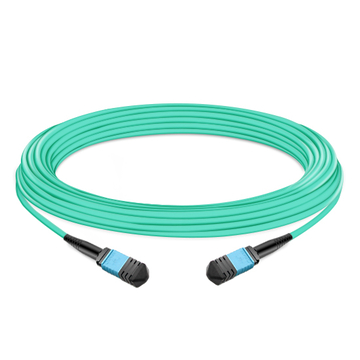
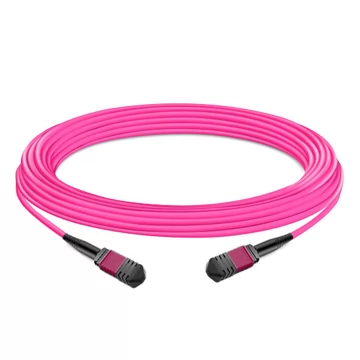
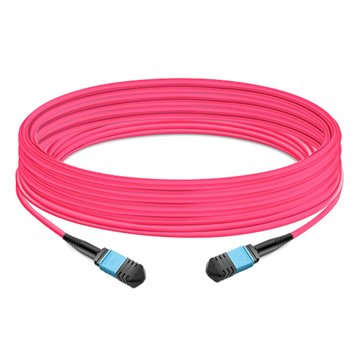
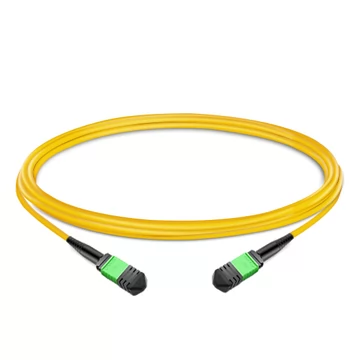
A single MPO trunk cable carries 12 or 16 fibers in one connector, meaning one cable can replace up to 16 individual patch cords in a data center cross-connect. However, if you get the polarity, fiber count, or loss grade wrong, the entire link will fail at commissioning.
Why MPO Trunk Selection Goes Wrong
Most MPO failures do not stem from fiber-quality issues. Instead, they are ordering mistakes that surface only after the cable is pulled and the link fails to come up.
The two most common causes are:
· Polarity mismatch: A Type A trunk dropped into a Type B channel breaks the transmit-to-receive path. The cable may test fine on its own, but the channel will fail end-to-end.
· Wrong fiber count for the transceiver: A 12-fiber MPO supports 40G SR4 and 100G SR4, but a 400G QSFP-DD SR8 or OSFP link requires 16 fibers. Ordering a 12F cable where a 16F is required wastes the entire run.
Buyers also get burned by unstated insertion loss. A "standard" trunk with no published loss specification can push a marginal link over its loss budget once adapters and patch cords are added to the channel.
FiberMall addresses all three issues: polarity is specified on every SKU, fiber counts are explicitly matched to the optical module, and insertion loss is published as a graded, testable value.
Features That Deliver
SENKO MPO Connectors
The connector is where MPO links live or die. FiberMall terminates trunks with SENKO MPO connectors rather than generic alternatives, providing a consistent ferrule, dependable alignment, and repeatable loss across every assembly.
Graded Insertion Loss — Standard vs. Low IL
Loss is published, not assumed. Choose Standard IL for budget-sensitive short links, or select Low IL when you need headroom for longer channels, more mating points, or tighter loss budgets. Every grade carries a measurable specification you can verify on the test report.
12-Fiber and 16-Fiber Counts
Match the count to the optics, not the guesswork. For a 12-fiber MPO count, the connector used is an MPO-12, which is typically applied in 40G QSFP+ SR4 and 100G QSFP28 SR4 setups. For a 16-fiber MPO count, the connector is an MPO-16, typically used for 400G QSFP-DD SR8 and OSFP applications.
OM3, OM4, and OS2 Fiber
· OM3 multimode: Supports up to 100 m on 40G/100G SR4 links.
· OM4 multimode: Supports up to 150 m on 40G/100G SR4 links, providing additional headroom for higher-speed multimode applications.
· OS2 single-mode: Designed for long-reach and parallel single-mode (PSM) trunk runs.
LSZH Jacket
Low-smoke zero-halogen (LSZH) jackets meet indoor data center safety requirements without sacrificing flexibility in high-density routing.
How to Choose the Right MPO Trunk Cable
Three decisions determine whether your link works. Confirm each before ordering.
1. Pick the Correct Polarity
Polarity refers to the transmit-to-receive mapping across the channel. MPO trunks use three specific types:
· Type A (Straight): Features a key-up orientation on one end and key-down on the other, mapping fibers directly (e.g., P1 to P1, P2 to P2).
· Type B (Reversed): Features a key-up orientation on both ends, reversing the fiber mapping (e.g., P1 to P12, P2 to P11).
· Type C (Pairs-flipped): Features a key-up orientation on one end and key-down on the other, flipping adjacent fiber pairs (e.g., P1 to P2, P2 to P1).
Method B (using a Type B trunk) is the most widely used in data centers because it utilizes the same patch cord on both ends. FiberMall's standard MPO trunk stock defaults to Polarity B. Because polarity methods are system-level designs, you must never mix a Type A trunk into a Method B channel.
2. Match Fiber Count to the Transceiver
· 40G and 100G SR4 links require a 12-fiber MPO.
· 400G SR8 links (QSFP-DD, OSFP) require a 16-fiber MPO.
3. Choose Fiber Mode and Loss Grade
· Short, budget-driven multimode links: Choose OM3 Standard IL.
· Longer multimode runs or 400G links: Choose OM4 Low IL.
· Long-reach or PSM runs: Choose OS2 single-mode.
FAQ
What is the difference between MPO and MTP connectors?
MTP is US Conec's branded, enhanced version of the MPO connector. Both are physically compatible multi-fiber connectors, but MTP is a registered trademark. FiberMall uses SENKO MPO connectors, which deliver equivalent multi-fiber density with dependable, tested performance.
What polarity type do I need for my MPO trunk cable?
For most data center deployments, Method B with a Type B (reversed) trunk is the standard choice because it allows you to use the same patch cord on both ends. Confirm the polarity method your channel is designed around before ordering, as mixing methods breaks the transmit/receive path.
Should I use a 12-fiber or 16-fiber MPO trunk cable?
Use 12F for 40G SR4 and 100G SR4 links. Use 16F for 400G SR8 links operating on QSFP-DD or OSFP transceivers. If 400G is in your future upgrade path, specify 16F now.
What insertion loss should I look for?
It depends entirely on your channel budget. Standard IL is sufficient for short, low-mating-count links. Low IL provides essential headroom for longer channels, connections with more mating points, or higher-speed transmissions. FiberMall publishes loss grades so you can confirm the exact specification before ordering.
Do I need female (unpinned) or male (pinned) MPO connectors?
Female (unpinned) MPO connectors are the most common choice for trunk-to-cassette and trunk-to-patch-panel connections. Male (pinned) connectors are used exclusively where the trunk mates directly to a female (unpinned) assembly. Always confirm the mating surface in your channel before specifying connector pins.
Can FiberMall support large-scale or custom MPO trunk orders?
Yes. FiberMall supplies factory-direct products at volume, offering OEM/ODM customization, dedicated account support, and priority production scheduling for bulk deployments.